Showing posts with label Michael Jecks. Show all posts
Sunday, May 14, 2017
The Abbot's Gibbet by Michael Jecks
The Abbot's Gibbet
Written by Michael Jecks
A Medieval West Country Mystery
A Knight's Templar Mystery
Michael Jecks continues the tale of former knight templar Sir Baldwin Furnshill and his ally and friend Simon Puttock in the fifth novel in the series.
The mystery around this time starts off with a headless corpse. In an era where modern forensics are unknown, to have a corpse with no head leads to difficulties beyond the standard whodunit mysteries.
Setting the murder during the fair of the 'dock' city of Tavistock, makes things more difficult. Michael Jecks initially hits us with so many characters, that the names and descriptions come fast and furious. It takes a while before we even get to Sir Baldwin and Simon!
As with other books in the series, Michael's enjoyment of the era comes through. This isn't blind devotion or thinking it a superior in terms of moral authority, but a knowledge of how things work. Take the title of the book itself, The Abbot's Gibbet. Sir Baldwin's order, the Templars, did not fare well under the agents of Gods mercies. When Sir Baldwin looks at that, the ultimate sign of authority over life and death, he is not a man pleased with his place in the world.
It does serve to steel his spine and ensure that he always works towards providing the justice he feels his brothers in the templars were denied.
Michael continues to expand the setting. This novel introduces us to Lady Jeanne, a widower who benefits from the generosity of the Abbot. Sir Baldwin, who is a single man of no small years, is smitten with her and her presence is hinted at being continued strongly through their courtship in the novel.
There are enough characters and possible motivations and possible rationales and red herrings, that if you catch the villain before the end piece, I salute you. Mind you, this is somewhat deliberately obstruction in some instances as bread crumbs leading in very specific directions are laid before pulled back. Too much of that can ruin a story but as more information comes to light, nothing from before is invalidated.
For me, it's enjoyable to read these books because it's fun to see where the characters are going. Who the characters are interacting with. How the setting itself as it involves the characters, is getting larger and more involved.
If you're interested in history or more information on Michael Jecks, check out his youtube channel.
Monday, November 17, 2014
The Crediton Killings by Michael Jecks
While going through Half-Price books a while ago, I came across several volumes in the Knights Templar Mystery series. The one I did not however, was the Crediton Killings. Bad news as I'd just finished volume three and was eager to start the next one.
Amazon to the rescue. For whatever reason, it's 99 cents right now in Kindle format. So for less then the price of a cup of coffee, I was entertained for a few hours.
Michael Jecks characters, Simon and Sir Baldwin, are becoming old friends. Much like watching an enjoyable series coming back for another season, reading another novel in the Knights Templar series is an nice diversion.
One of the interesting things that Michael Jecks brings to the forefront of the reader, is how important food is. I've mentioned the themes of famine before, but Michael felt it so important he did a little video over it on Youtube.
I notice that much like the Dresden Files series, that time tends to pass between the novels. As these novels are now numbering past ten, I think maybe twenty in total, I'll be curious to see if that trend continues. It's a good trend though, both in Dresden and here, because otherwise the main characters would be running from place to place and murder to murder.
In this novel, a street beggar has no one looking after him. A potential care taker doesn't want the child around because of the extra costs of feeding the child. While there are still problems with hunger today, even in America, where numbers range from one in five children suffering 'food securities', it's a real problem.
In addition, there are mercenaries involved in the novel. The mercenaries have numerous leadership issues and motivations run the gambit of who could be committing murders in the town of Crediton.
The author does a solid job of laying down the groundwork for how Simon and Sir Baldwin go about their business of trying to find the murderer and it flows smoothly.
In terms of gaming, it's brought to mind several different things.
Motivations: What was it Ultron said in the trailer for the Avengers? You're all covered in strings or something? People are bound to one another in many ways. Here, the mercenary captain is suspected of murdering three women for different reasons ranging from rage, shame, and even pettiness. All three were 'known' to the captain and his motivations different for each as his own personality is revealed to the reader layer by layer.
Having said that though, there are other characters, like Wat, a fellow mercenary who wouldn't mind being captain, have their own motivations that cause their own appearance of innocence or guilt shine to the forefront.
Having characters that the player's interact with on a regular basis, have their own cache of secrets and motivations is a good way to give the player's an inside look as to how their minds work. Filling in the details of how the character's get along ahead of time and seeing how a husband may be perhaps too doting on a wife, or a child may be looking sickly and frail in one scene and not seen again.... these things lend continuity to the game.
Mind you, in standard dungeon crawls, it might not be necessarily to know the inn keeper's name and what he does when food or ale or running low, but if the player's are involved in small towns and are frequent guests, they may make conversation to find out rumours about locals, either people or local legends. Use those elements to your advantage and lay the groundwork for future sessions there.
The Crediton Killings brings mercenaries and murder to the forefront of the historical novel and does so in an entertaining and quick read.
Monday, November 10, 2014
A Moorland Hanging by Michael Jecks
Book Three in the Knights Templar Mystery series, A Moorland Hanging, written by Michael Jecks, brings the reader back to medieval times with Simon Puttock and Sir Baldwin Furnshill as they investigate a murder on the moors.
Michael Jecks is able to bring the reader into a situation that has two solid factions, the landowning nobles and the tin miners. Each with their own goals and motivations and each a thorn in the other's side, but forced to deal with one another as both serve the king.
Jecks does a solid job of providing information on the importance of the tin mining. The need the king had of vast wealth allows the tin miners many rights that superseded even those of the noble landowners This puts the landowners in a weak position when the tin miners come around and threaten to claim various parts of the land in order to find tin.
And yet at the same time, much like in Japan and their own falling caste of Samurai, the nobles here are arrogant and militant. They have a great deal of power thanks to their own ability to fight and while wars may not necessarily wage without end in the moors, there are always wars where some type of glory may be won.
The mystery itself has some parts that are stronger than others. This could be a deliberate choice. One of the big 'reveals' should be obvious to anyone who's paying attention, but I'll admit to having the completely wrong idea on the killer until nearly the end as vital pieces of information are brought into visibility.
A Moorland Hanging follows the strength of The Merchant's Partner and is a solid mystery novel for those looking for some background on how things might have been in this far away time.
Below I'll be hitting spoilers specific to the novel and discussing how I'll try to keep it in mind when running my ongoing Dungeons and Dragons campaign using the King Maker adventure path by Paizo.
1. Outsiders: While the tin miners have been present for years, there are those who've dwelt on the moor for much longer, generations. To those old inhabitants, the tin miners are a blight on the land. To those who've been here not as long as the old inhabitants, any new inhabitants, like those seeking to make a new life for himself, are another brand of outsider.
2. Isolation: There are old beliefs on the Moors. When you're cut for from civilization and don't travel, the old beliefs have no reason to die out. They've encountered no resistance. This is still true today. In areas that aren't major hubs or on water ways, the people do as they've always done, believe as they've always believed. This can be jarring for people who visit as first off, they're automatically labeled outsiders, and now their outsiders that don't share the same beliefs.
This isolation can take other forms too though. THere are several instances in the novel where the characters feel isolated and cut off from civilization. That they've entered another time and place and that they are gone from the standard realms of men.
3. Bandits: In all the novels thus far, the fall of knight hood as a way of earning a living is reflected on again and again. Those seeking to earn their way may have to travel afar to places such as Italy. Again there are parallels with the Samurai who become ronin, masterless men. The other bit though, that dovetails nicely into the River Kingdoms, is that people may come from other parts of the world to 'get away' from their past. Without an easy way to quickly check the background and history of someone new to the area, wolves may assume the guise of sheep.
4. Protected Interest: While the moors are isolated, the value of the tin miners is obvious to the king. Because of that, they have numerous rights. While this isn't necessarily anything like that in the River Kingdoms, the River Kingdoms does have it's own laws, it's own Six River Freedoms as they are known. Bring in reasons that the players can't just run roughshod over everything and everyone.
5. Visibility: This is one I've always had a problem with. There are numerous mentions that thanks to the even level of the ground and the lack of forests or hills, that people can spot each other for miles around. This can add a bit of suspense if the players know they are being hunted and can see the opposing party rushing and wearing them down. However, given the extreme range of some spells and missile weapons, this could easily backfire!
6. Depth: One of the things that's enjoyable about the series, is that many of the characters have aspects to their past that they would rather not come up. If anyone's seen the movie Snowpiercer, will know what I'm talking about. Having each major NPC have such a secret, have such a past, is something that can put the characters in a completely different frame of mind when they see that person again.
A Moorland Hanging brings the isolation to life and is a solid piece that should be able to inspire many a role playing session.
Saturday, November 1, 2014
The Merchants Partner by Michael Jecks
Michael Jecks, website here, does a series of medieval murder mysteries that feature one of the knights Templar. I'd finally gotten around to reading the first in the series, The Last Templar, and to be honest, wasn't that impressed.
It wasn't bad mind you, it just didn't jump up and say, Appendix N me bitch!" as some books are wont to do.
The second book in the series, The Merchant's Partner, read much better. Mind you, I can't tell you if that's because I was in a different frame of mind when I read it or if it's just better written or if it has a better cast of characters and plot. Regardless of the reasons, it resonated with me more.
The characters are continuing to know each other. The cast is growing. The background is coming more into focus. The murder mysteries themselves are involving more people in more direct fashions that provide the reader with more things to become involved with.
The intricacies of the historical period are more in play. Events that happened long ago still echo in the current time line. Things that people think are secret and hidden are in fact, known.
If you're looking for a taste of murder in a dark era, The Merchant's Partner is a solid book and convinced me to move onto the third book.
Below I'll be hitting some specifics and spoilers of the books so if you care not about such things, read on, otherwise read no further.
Now there are some similarities in the books. For one, life is tough in these dark times. When the crops fail, people die of starvation. I'm no fan of starvation rules that micro-manage the amount of effort it takes to keep track of characters in games like Dungeons and Dragons, but having such information be a known thing, having the characters know that people are dying of starvation, can be a campaign bit in and of itself.
Some settings, like Warhammer, have gods like Nurgle, a god of disease and rot. Other enemies, like Skaven, can sabotage the fields. Protecting your food source can be a vital part of any campaign or a brief adventurer's mission. In some famous movies, like, oh, Seven Samurai, the bandits are coming for the food! They need someone to stop them.
Another point of interest, was banditry. While I'm running the Kingmarker series from Paizo for Dungeons and Dragons 5th edition now, the setting their in, the Stolen Kingdoms, is rifle with bandits. History, or at least this part of it, is also heavy with such issues.
When knights have no wars to fight in, they face the threat of starvation. Turning to banditry is one way to avoid such a fate. In many ways, this echoes what happened in Japan when the era of the Samurai was coming to an end and samurai found themselves as ronin. When you have a sword and you're good with it, continuing to use it, even against those they once fought for.
Another theme hitting the book again, and most murder mysteries, is red herrings and coincidence. Strangers appear and then things happen. Surely the arrival of these new characters is directly tied into these horrible happenings?
In some cases, it's directly true. In others, it's that the characters have some reason to be there and may have information tied to the happenings going on, but aren't directly responsible. In most forms of media, there is limited time to introduce slice of life bits to readers and viewers. In role playing games though, that's not necessarily true.
You can introduce individuals and characters that may not be seen or met again for many sessions. One of the nice things about having all six volumes of King Marker ahead of time, as opposed to the monthly fix, is that you can read the whole thing and set up different elements of the campaign ahead of time so that when players finally do get to see the whole thing at it's apex, they can go, "Man, I never would have thought three months ago this guy would be here!"
A third element that hits again this time around, is the search for motivation. One of my friends likes to quote the old movie All The President's Men, "Follow the money." While that's not always true, especially in a campaign setting where religious fever may provide real magical augmentation and the ability to summon demons and devils to enact your will, for the majority of people, money, power, and of course sex, are all common motivations and having a motivation that the players can find and work into the campaign, is a useful tool to have as a Game Master.
One part that the 'Templar Mysteries' really diverge from role playing games standard though, is that the investigative parts don't necessarily mean that there will be combat of a appropriate nature. There may be no grand melee in the capital of the city while the gods watch. Rather in these books, much like courtroom drama in bygone eras, the 'gotcha' is the reveal, the breakdown of the how and why, the final questioning of the murderers.
Be aware of those elements when you're working them into your campaign. Even in games like Call of Cthulhu where the focus is on investigation, there are often times where if the players get it, they may still have to blow up a mine shaft or perform some action that pits them against the mythos directly. In Dungeons and Dragons, while I can easily imagine a scenario where a paladin pulls a mask off of a noble and we discover that it's a drow, I can also see that scenario where the wizard casts dispel magic, the drow is revealed, and then the big fight happens. Not all elements work with all games.
When looking to get some inspiration for your campaigns, don't be afraid to look at 'historical' books as well as the standard fantasy fare. The writing might be different enough to force you to evaluate what you're doing in your campaign and more importantly, why you're doing it that way. If nothing else, you'll come away with a few genre appropriate names in most cases.
Sunday, March 18, 2012
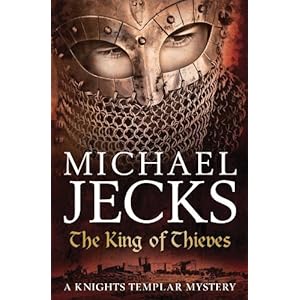
The King of Thieves by Michael Jecks
When Borders Bookstore was closing, I purchased many a book that looked interesting. I didn't do it when the hordes were crowding and pushing one another for 20% off. I waited until the books were well and low priced at 60% or greater. Mind you, the selection wasn't at its peak but there was more then enough that I'm still reading those books when I find the time.
I'd never heard of Michael Jecks before. I'm also NOT an armchair historian. However, I do like a good historical and I find them easier to mine for role playing purposes since most of the games I play tend to be low tech, dark ages styling. Well, magic is usually a big element too but that's another thing I'd have to add as needed.
I'll be discussing some spoilers pulled out of the book so if you want no spoilers, read no further on Michael Jecks The King of Thieves.
Let's start with terminology. I love it when the author provides us some details. Like a Crophead being slang for a priest, or a harvester a cutpurse or a picker, a thief who takes everything from his victims or a planter, a thief that makes fake jewels. Great stuff. Adds to the atmosphere of the book right away.
Another thing I enjoy is learning about real characters that were... interesting so that I can steal, I mean, borrow them or their routines for my games. I hate to say it, but I was ignorant of Hug Despenser and that's a shame because after reading some on him in this novel and on good ole Wiki, I have to say, he's a hell of a bastard and looks like he would make a great rival noble enemy for characters, one whose protection from a higher source means that the outmaneuvering must take place in the courts and not on the field of battle where character often have an advantage.
Another character mentioned in this historical, is Charles Martel, a well known warrior with his own nick name. Adding such background elements to your own campaign, famous warriors, generals, saints, and other well known figures of history, can provide more depth to the setting as it gives, say, the martial characters in the game, something to strive for, to go beyond.
"and now the King was married to his third wife..." Not a particularly grand statement in all things but one that puts out there that people, everyone suffers. One of the problems I've heard players complain about with their loved ones or NPCs close to them, is that the Game Master is always messing with them so its easier not to have any close contacts. Well, remind them that life is indeed a contact sport and kings and queens suffer the disasters of disease and death in child birth and other ravages, that its okay for them too.
"But the instability which he had assisted was now growing alarming. Robert Sapy's deputy in Wales had been attacked... There had been a time... when no man would have dared to treat such an important man in such dreadful a manner, but that time was past. Now no one was safe."
Political unrest can be a powerful tool. But it might be only part of a problem. For example, if there is famine, is there is plaque, is there is banditry, then adding to that a King whose most favorite subject is widely hated? Yeah, that might cause some problems. On the other hand, it also sets the stages for players to shine. I've mentioned it before, but if you're playing a 'standard' styling of Dungeons and Dragons where players will be in combat, then you want there to be unrest in the land, you want political factions lining up to march to war, you want bandits for the players to fight, you want church and state taking shots at each others. The more conflict, the easier it is to get the players actively involved in it.
"A large sideboard stood at one wall and upon it were many silver plates and some goblets... Large tapestries covered the bare walls on two sides...the large goblet with gilding all around it."
A quick quote about the wealth of one man of the cloth. This type of wealth, these material things that are not coins, is mentioned several times. I myself am guilty to resorted to X amount of platinum, Y amount of gold, and Z amount of silver, but it can give the setting some contrast and character when you start throwing in physical art objects. In this case, one of the objects actually turns out to be a clue later on. The physical descriptions of combs, plates, goblets, utensils, tapestries, and other non-coin wealth can say a lot about the campaign.
Of course it doesn't hurt that at lower levels it can make it difficult for the players to simply pick it all up and leave.
"Let me put it like this: the King is now moving his prisoners from one castle to another."
In terms of those uprisings, well, there really weren't any prisons in those days. You did a crime, chances are you'd get the immediate punishment, like having your ear clipped or your lip split and then be sent on your merry way. Otherwise you went into the dungeon of a castle. Not good times. In the above case, the King's forces may not be up to the task of taking care of fomenting rebellion so he keeps the prisoners on the move to prevent them from being freed.
"It was hard when speaking to someone like this to remember that he was just a man like any other. Jean was intimidated by rank. He was too aware of his own lowly background."
IN today's 'modern' D&D, for some reason we still have kings and farmers but no slaves and a social system that tries its best to mime modern times so that rank and other non-tangible values are well, meaningless. When setting up your own campaign, talk with the players about their own expectations of what they assume the setting is going to be like. If everyone is on the same page, that's great, but if you're running a dark and gritty fantasy campaign with low magic and rank is everything, well, wandering adventurers may get a welcome they'd rather not have.
"Just the atmosphere made Jean feel chilled as he entered the place. There were marks scrawled into the walls here, the despairing words of prisoners who knew that their time was almost over..."
Here's an idea for a map. Instead of finding one in a treasure lair on a piece of paper, what if it's actually a huge map on the wall. A dragon, beholder, or other fantastical creature would have no problem defacing a granite wall and it would give the players a little something different to remember as they try to copy down the map.
"Cardinal, if is your duty to uphold God's laws, surely."
"I have many duties. I have served four Popes now. They each were different men, but the main thing was, they were practical men."
Here's an interesting one. When looking at fantasy religions that actually have deities and miracles and divine powers in the game, how does one NOT serve correctly? In Eberron, well, the gods don't necessarily take an active interest. It's far more nebulous than say the Forgotten Realms where the gods have walked the earth and even had children. ON the other hand, the Forgotten Realms has had its share of heresy and its share of deities impersonating one another. Some churches, like that of Tempus, encourage active war fare as that is the god's portfolio. Others... you kind of have a hard time seeing them not be one large brother hood under that active god. Think about the role of religion, how heavy the god's hands are, are they any clerics who've actually lost spellcasting ability, or is spellcasting ability something only players can do? It changes setting assumptions quite quickly if it is.
"It was mere good fortune that he himself was not present in the Preceptory on that day, and thus evaded the arrest and subsequent punishment."
It's a comment about the fall of the Templars. In Dungeon Siege 3, it starts off with your organization being crushed. Some might think that heavy handed but organizations come and go all the time in history. The stalwart warrior against God's foes today, is the gold laden victim to be robbed tomorrow. If the players are part of a guild, it's always good to have a few real life organizations that were taken down in order to show case that, no, you as the Game Master are not being mean to them and that these things do happen and will they please man up about it.
"He killed my boy' the cook said...
Anyone ever see New Jack City? The heroes of the tale go about finding out how to take down a very bad man. They lose friends and allies and suffer great hardships and loses and at the end, the bad guy is going to walk away free as a bird when an old man pops out of the crowd and guns him down!
The same thing happens here where the heroes find out the clues and find the murderer and that murderer is killed by another minor character.
That doesn't work too bad in a movie or in a novel but I personally would NOT be happy as a player if the Game Master were to do that. "Great game guys. You spent weeks hunting down the murderer but it's the kings brother. He laughs as you'll never be able to prove it all but then old man Fellows whose daughter was killed steps up and stabs the King's brother right in the neck!" Ugh. If you want to write a story, there's no need to drag the players into it. Write the story. Give the players their moment of glory.
On the other hand if the players are getting restless with the current crop and don't want to do the whole law and order thing and you asked them if they'r ready to move on, yeah, it might be time to New Jack that NPC.
Michael Jecks does a great job of bringing history, and Paris, to live. He makes Paris a filthy city, but one that is teeming with life of all sorts. A strong read, I hope to find more Jecks on sale or for those ebooks to come down in price.
Subscribe to:
Posts (Atom)