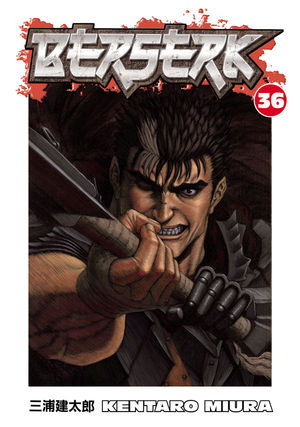
I'm out of touch. I didn't even know the new Berserk came out until I saw that a new animate 'movie' came out. Immediately bought both. Don't know if I'll be talking about the movie outside of "m'eh" and yet it's a "m'eh" with potential if they cover the core story elements cut out like Puck and Skullknight and actually, you know continue it.
Anyway, Berserk 36 was like visiting an angry old friend. Kentaro's art reminds me of Goerge Perez or Jim Lee in that his detailed line work is awesome. I still refer to my art book despite the fact that the text is all in Japanese. I figure it's an art book right?
The book continues to make use of some elements that I find would be right at home in most campaigns.
1. Curse Magic Items. Elric had Stormbringer. Guts has the Berserk Armor. With it pain and injuries that don't outright kill him are... well, not healed by the armor, but modified enough that he keeps fighting. Bad news is that in this state he makes a frenzied berserker look sane. Still, unlike Elric, Guts has at least one comrade wo can pull him out of the frenzy.
2. Ritual Magic is very powerful. Despite the limited knowledge of magic that Lady Farnese has, she is able to do a ritual magic that prevents magical entities from entry. A mystical barrier if you will to prevent fully monstrous magical creatures from entering it. While it's use is somewhat limited and it doesn't stop those things that are hybrids of magic, it's powerful enough to stop those that are fully of 'the other world'. Many games use some type of this effort but often have such long casting times or high material component costs that they're not very practical. Here the same is true but they do have the time and knowledge to use it.
3. The Foe Too Big To Face! Many times a character will encounter something that they just shouldn't be able to defeat. In Star Wars, A New Hope, the rebels have no chance against the death star but it does have a certain famous weakness. In How To Train Your Dragon, Toothless, as powerful and unique as he is, is not where near powerful enough to battle 'the Red Death'. Here, Guts comes face to face with 'The Sea God'. It's so enormous that the ship sized creatures that he has been fighting with the ship he's taken passage on, are essentially it's whisker's and decides the only way to kill it is by going to it's heart!
This is old hat as they say. I've seen Thor do it with Celestials and other heroes with Ego the living planet and I'm sure other people could point out numerous instances of the foe too powerful to simply beat down. In 4e, it might be possible to use a Skill Challenge to model how best to overcome this entity. In another game, it might be possible to just model many of the 'antibodies' or other efforts of the host body to repel the invaders. Make the players realize what a do or die situation they're in and don't hold back!
4. New Character Bring It. Isma has just joined the crew but already in this new world, she's shown that she fits right in as she is capable of turning into a mermaid. In traditional games, the power level of the core group may grow and grow to such a point that a fresh character starting at the recommended baseline power level wouldn't have a chance to survive much less contribute to the game. There are numerous ways around this including splitting the party or the focus of the campaign and giving the lower level characters appropriate enemies and side liens and goals and then they're the way Kentaro takes and that's to make the new character have a 'hook' or a unique ability that lets them jump right into the fray.
The only problem with Berserk 36 is that despite it's hefty length, we're left with essentially a very long high level fight which means that we've got to wait until the next issue to get resolution. Damn you Kentaro!
Showing posts with label Skill Challenge. Show all posts
Sunday, February 3, 2013
Thursday, October 7, 2010
The Way Of the Samurai
Different cultures place different values on different actions. One way to showcase these changes to a default setting is to allow players to see the action prior to becoming involved with it.
For example, if the players are the 'strangers in a strange land', they may find it odd that an older samurai suffering from a disease is determined to die in combat. On the other hand, as default Dungeons and Dragons tend to have knights, who have their own brand of honor, the idea might not seem that strange to them.
Stan also is able to use the visual medium to showcase daily things that the samurai do. For example, when Usagi is speaking with General Oyaneko, the general is polishing his sword with great care and dedication to the blade which he refers to as his 'soul'.
These visual and verbal clues can be great aids to players new to role playing as it allows them to see and experience how others in the setting go about their daily business.
For more experienced players though, they may need a little more out of a meeting with a general. For Usagi, part of it is that the general has reknown. For players in the campaign, this can be copied a bit by either having the players meet famous NPCs of the setting, if they enjoy that vein of the game, or by having them meet their old characters or versions of their old characters, who have gone on to different things.
When the general engages Usagi in a duel, the two don't actually battle. In 4e, or with the right frame of mind and the right skills in play, 3e, this might be considered a skill challenge. Usagi uses old samurai wisdom to counter the codes of bushido that the general uses to justify his action. In a 4e situation, if Usagi failed to make his appointed number of rolls, then it would go from a skill challenge to actual combat. For players and
Game Masters more comfortable with role playing, if the players can provide an out for combat, especially against one they admire, they should role it out to the nines so to speak. Having game mechanics in place for something is not necessarily always the way to run the game if your group is comfrotable with other methods and it doesn't impact the group.
If that in and of itself isn't enough, there is always the set up for the next adventure. Here Usagi learns of a samurai who was framed and now seeks revenge. A samurai who travels with his son. A samurai commonly known as Lone Goat and Kid assassins.
Subscribe to:
Posts (Atom)

