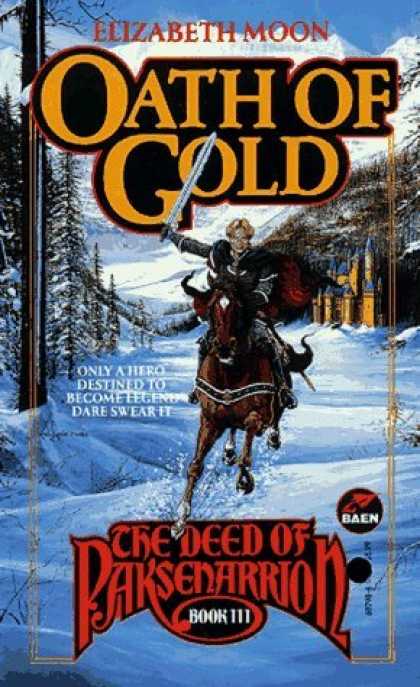
Oath of Gold is the third and final book in The Deed of Paksenarrion by Elizabeth Moon.
So what did I think of when reading it?
Don’t be surprised if the readers, aka the players, figure out your plot points and hidden agendas before you’re ready for them. I knew what the big twist here was probably fifty to sixty pages before it was ‘officially’ revealed in the book and those parts I read in between the figuring it out and the big reveal were almost ‘wasted’ to me.
If the players figure out that the local Duke they’ve been working for is actually a lost half elf heir, then run with it then. Don’t make them travel all around the campaign setting collecting little clues and bits of lore to verify it unless you are absolutely certain those pieces of the puzzle are going to blow the players out of the water. You don’t want to bore the group with how smart you are.
In terms of the lost heir, this is a common theme and dates back to the big baddie of them all, the Lord of the Rings. This is not a problem. Some Game Masters are unhappy if their campaign has any links to the original material. They feel that elves, dwarves and Halflings are all overdone and that only by having a ‘pure’ campaign setting, can they ‘evolve’ their campaign.
If you’re playing with new people who’ve just seen those movies on Blue Ray though, they make excellent ‘touch’ points. The reason authors like Terry Brooks and Dennis L. McKiernan are essentially able to add fan fiction additions to the setting and sell, is because people like these common fantasy themes. Some of the more esoteric settings like Talislantia and Journe might be so off the path that none of the players can relate to them and thus languish.
Use that enthusiasm the players bring to the table and when possible, provide them your own recommended reading or movie list if you find that those ‘old styles’ don’t necessarily mesh with your own campaign running. Nothing worse then bringing new players to the game who are eage to play reclusive elves who are master of the bow only to learn that in your setting based on Dragon Age that all elves are slaves.
Another thing I though, was that songs are a part of many a campaign setting. While I’m not saying you as a GM need to write out some golden oldies hits, songs are like legends and lore in the campaign setting and can reveal the character of the setting itself. By writing out a few songs and insuring that the players know them, the GM can provide further bits of culture to the players so that they have a better, firmer grip of the setting they live, fight, and die in.
In terms of power source, Paks, being an unordaned paladin in any official church sense, is accepted by the official members as her powers are given to her straight for the deities. She gains a sense of purpose and a sense of right and wrong that make her know where she should be and where she should go.
In Dungeons and Dragons 4th edition, and to a lesser extent previous editions, characters are defined by their power source. Paks would be ‘divine’. In such an instance, the Game Master can use that divine power source as a source for pushing the party in a certain direction. It allows the players to have a patron larger than any one particular individual while still giving them plenty of space to work.
4th edition for example, has tied psionics into the Far Realms and the GM could easily substitute a call to action against local aberrations as opposed to a paladin being nudged to go a certain direction.
In terms of Paks abilities, one of them is to sense evil, or at least powerful evil. When she meets the Duke’s intended, the woman sets off the alarms in Pak’s head. If Paks had just been a regular warrior, then that plot line could’ve have gone on for several books being built up in the background. Paks takes care of it in a few pages.
This is just a reminder that you need to refresh yourself with the abilities of your players. If you design an adventure around certain plot points that the players are able to easily overcome or avoid thanks to their abilities, you’ve missed something in the preperation. While some GMs are happy with a result like this because it can showcase the players own unique talents and abilities, be sure that’s why you’re designing the encounter that way in the first place.
As a game master, the weight of the game often falls upon the game master’s shoulders and to create what is not needed is essentially a waste of time.
In the end, the three volume series, The Deed of Paksenarrion costs me $3.00 from Half Priced books and was well worth those funds. If you’re looking for something that has echoes of The Lord of the Rings with a more military ring to it and a quicker progress, you might enjoy the Deed of Paksenarrion.
Showing posts with label The Deed of Paksenarrion. Show all posts
Thursday, September 2, 2010
Wednesday, September 1, 2010
Divided Allegiance by Elizabeth Moon
Divided Allegiance is book two of The Deed of Paksenarrion written by Elizabeth Moon.
As in the first book, Elizabeth Moon showcases a strong grasp of everyday subjects that the characters in such a setting must go through. This includes Paks cleaning of her black stallion’s hooves, checking them for wounds, cuts, and training. This section alone could be used as a hand out to a player who enjoys mounted combat but is unsure what the standard duties of taking care of such a mount might be.
A large part of the book, is what Paks wants to do with herself. She’s not really clear of the idea of what she wants to do or be but she knows that she wants to be a competent fighter. She seeks high end t raining from the warriors of Grid, a patron saint of warriors in the setting.
During her training, she is accepted to become a paladin. For some games, this may seem strange as the paladin may be a core class. In others, the paladin may be a rarity. In earlier editions of Dungeons and Dragons for example, the paladin had to have fantastic stats and this alone made the class fairly rare. In a late 3.5 option book, Unearthed Arcana, there was a Prestige Class devoted to allowing one to become a paladin. Prior to that, there were several prestige classes that allowed one to become a holy warrior.
4e has both Paragon Paths and Epic destinies. Depending on how the Dungeon Master runs his campaign, he may want to know what the players are interested in branching out at a very early point in their career to provide that training in game. Other GMs may just allow the players to take such a class with the assumption that the player has always been training for it.
When the complaints of rapid level advancement hit the game table, the GM can slow that down with in game events. Previous editions of the game often called for a xp limit, that you could gain no more xp than necessary to raise one level. Others included training time between levels that cost gold. Part of that though, was in older editions you gained experience points for gold and would often wind up with an amazing amount of loot.
In her search for further training, she is initially prodded on by not enjoying the dirty work that she is forced to do in the Duke’s mercenary employment. This isn’t dirty work in a sexual fashion, but rather, the taming and conquering of cities by sword and hangman. It’s work that a person whose preference is for clean combat does not like.
This is another important element that I’ll get back to. If you are taking the campaign in a certain direction and start getting clear signs from the players that they do not want to go in that direction, don’t go in that direction. You don’t have to change what’s happened in the past, but provide an out for the characters so that they can move the campaign in a direction they want to play in. Paks does this by leaving her company and seeking higher training. She does so on good terms and when she meets the Duke later, they are still friends.
There are other aspects to the book that almost fall perfectly into RPG terms. For example, this setting has its own version of dark elves. Unlike the traditional RPG dark elves who have black skin and are obviously evil most of the time, these are more like the Warhammer dark elves who caused a war between dwarves and high elves through deception because no one could tell the physical difference.
While I wouldn’t recommend another whole race of evil elves, it certain can’t hurt to have the players encounter elves who are not pleased with the rise of man or the forces that may be as old as them. This can be showcased in a number of ways ranging from the subtle to the outright attack. Having some background elements in mind for these renegade elves would be a good thing to give them a little more depth than might be standard for dark or demon elves.
Other traditional gaming elements include the arena. My copy has a cover of Paks standing victorious over several dead orcs with a massive spider behind them. IN the book, Paks is captured by these dark elves and made to fight time and time again and her wounds are healed with dark magic that allow evil and anger to take seed in her soul. That leads to other problems.
However, the quick succession of battles she fights would easily be possible in a standard 4e campaign. The only real trick would be players burning too many healing surges or using their daily powers too quickly. The GM could of course allow players longer resting times to regain those healing surges and daily powers, but if doing so, should make the initial encounters more difficult so that each encounter has the threat of death to it.
During the course of her adventures, Paks loses her inner fighting ability; her courage, her resolve, her steel will. This leads to her being unable to pick up a weapon and leads to her going into dangerous situations and almost being raped.
Note I said almost. If this was another author, one going for a more ‘realistic’ style, I have no doubt of what would have happened to Paks. However, and its important to remember this for a role playing game as well, the GM should not necessarily be out to strickly impose just his idea of the campaign to the players. Might it stretch the credibility of the campaign? It could. Does it stretch the campaign any further than having demons, devils, demi-gods and other high power entities all floating around in the background until the players reach the appropriate point? Not at all. Prior to engaging in activity of this sort with a player’s character, the GM should speak to them ahead of time and ask them what they expect and what they’ll accept. If it’s worth losing a player to keep your setting real, that’s your decision.
Lastly, have the characters be part of something big. Here, Paks frees an old elf home and destroys a great evil. That in turn leads her to discover an ancient fortress used by the comrade of Grid. These are grand events in the setting and can be reference time and time again. If the players start off by saving a village, have the villagers spread their fame in the local area. If they defeat a tribe of orcs, have the orcs allow them free passage through their lands as a tribute to their strength. If they destroy a temple of Orcus, have them given welcome at all good deities temples. It doesn’t take a lot of effort to showcase the players direct actions on the setting and doing so makes the setting more alive and organic over time.
I’ve mentioned that as a GM, you may not be able to please everyone all the time. For me personally, this book ends in a horrible spot and is meant to act as a direct lead into the next book. It’s a cliff hanger.
In a game however, a cliff hanger may be the exact place to stop. It insures that the party will have to start the next session right in the middle of something and that they need to come to the came with their wits sharp and on the ball. It provides a quick “into the game” mindset that is difficult to achieve with other means.
Divided Allegiance may not be to everyone’s taste. The book read, to me, a little dry at times. However, Elizabeth Moon knows her subject and it comes through in the clear descriptions she provides. For $1.00 from Half Priced Books, I’m well satisfied with it.
Subscribe to:
Posts (Atom)

