Showing posts with label Player Archetype. Show all posts

Monday, April 7, 2014

Red Country by Joe Abercrombie

I was fortunate enough to pick up Red Country in hardcover at Half Price Books not that long ago for a cover price of $12.99, but it was during one of their many sales so I think my final price on it was well under $10. Not bad considering the hardcover at Amazon is just under $20 and the kindle version is just under $10.

I've enjoyed Joe Abercrombie's previous works. I like how he takes certain assumptions of the genre, like the 'good wise ancient wizard' and turns it on its head. I like how certain characters wind up threading through the different books in different capacities. Having read the others in the series, of which this book is the next chronologically, I was looking forward to seeing what he did here.

I've heard the book described as a fantasy western. To a point, that's a good description. We have frontier towns. In many fantasy settings, those in and of themselves are not that unusual. Anyone who has played the beloved Keep on the Borderlands knows that it's a staple of the genre.

There are a native people whose technology doesn't quite match that of the 'civilized' nations. Again, this is old hat if you will with fantasy games. One of the most famous characters in fantasy literature, Conan, for example, comes from such a people and others like Kull, make their way into kings.

Outlaws and grudges abound. Anyone who knows about westerns knows that grudges especially are a popular bit from that lore, some of them going back generation upon generation. Looking at other parts of the world though where tribalism is the main standard, it's not necessarily a western only element.

Then we have the setting itself; the great plains. Now this is an element I don't see get a lot of airplay in many other genres. The flooding, the difficulty of survival out in the open? The vast night skies? Those are Western for sure and haven't been co-oped by many other genres.

More important than that though, is the gold rush. The West, with a capital W, came about in many ways due to the unslakable thirst of people for 'easy' money. This leads to those dangerous frontier towns and to many a dangerous situation. The drama Deadwood is perhaps one of my favorite shows in terms of playing out characters and factions against one another.

While those elements are present though, they are minor as opposed to the main quest of Shy and her step father, Lamb. They are not seeking treasure. They are not bounty hunters. They are not lawmen. They are not settlers.

They are seeking Shy's younger brother and sister who have been kidnapped and so must follow those who've taken them into 'The Red Country'.

Joe does a solid job of making this an easy to read book. There are numerous characters that are dragged together by circumstance who might otherwise never have met and it's good to see some of the old friends, like Lamb, even if they are never called by their... 'proper' name. Which to me is a bit of a waste. Whenever someone recognizes 'Lamb', well, it doesn't tend to end well for them.

If you're looking for a rousing action packed fantasy, Red Country by Joe Abercrombie hits that nail on the head fairly easily. I'll be talking about some specific plot points and spoilers below, so for those who wish no spoilers, read no further.

We have the old hero coming out of retirement for one last big showdown. In many instances, I think people would like to compare 'Lamb' here to say, Clint Eastwood's character from Unforgiven. That to me is a very false comparison which I'll discuss when I get to spoilers. The old hero though? It's also a classic of the genre. We have, what I'd consider the 'modern' version of this archetype thanks to David Gemmell and his classic Legend, as well as others like Kell from the Clockwork Vampire Chronicles.

One of the nice things though, is that Joe Abercrombie doesn't blather about how old, weak, and ineffectual Lamb is while then going on to describe how dangerous he is. No, when the initial switch happens at the start of the novel, Lamb goes from one entity altogether to another with few complaints about the aches and weariness he faces. For this, I'm grateful. As I've mentioned before, there is no use bemoaning how crippled up the characters are if in every single action sequence they act like none of that matters.

For other archetypes, we have Sweet, who is in many ways, a ranger, a frontiersman who leads people back and forth between the old civilized world to the new world. Sweet's role is that of scout, of reader of weather, of outdoor survivalist. His skills in dealing with the natives and knowing what their moods are, are all things that rangers would traditionally handle.

I mentioned up thread that I wouldn't compare Lamb, aka the Bloody Nine, to William Munny because it takes WIlliam a long time to get into gear. William can't shoot at first. He's a 'real' family man. He is unsure about the mission. He's doing it for money for his family, but for money. He's not going out to save them from slavery. He also suffers a sever beating initially and it isn't till later on in the movie where his 'real' persona clicks.

Lamb? Not quite so much. As soon as Lamb see what's happened to the farm, his dead friend, and the missing children? It's on.

And that's great. But it's what makes Lamb the Bloody Nine and a killer right off the bat, not like William Munny who has to gradually assume that form.

In terms of role playing games? I like the Dragon People. Not because they are the 'Noble Savage', but because they bring children in from outside their bloodline because they are all sterile. In a role playing game, this would be a fantastic background element to showcase different races raised together. For example, need a reason why dwarves, elves, and half orcs are all part of one group? They are all part of the 'Village' so to speak.

The idea of the book itself could easily make a role playing session of three in and of itself. Players could either have their relatives or family members captured and taken for slavery purposes, or players, most of whom are damned lone wolves to begin with or would relish at the though of those damned NPCs being slain, could be hired by other NPCs to find and bring back their family members with the reward dependent on how many NPC's are returned alive and unharmed.

Sidetracks could happen such as that of the duel, where the players are pitted against another group of adventurers of similar powers and abilities. They could be hired to perform this task, could be 'tricked' into it by being called out say, by the other group that wants to make a quick name for itself out in the frontier town.

The environment can play against the characters as well. The threat of storms showing up from no where and creating flash flood situations, lack of shelter, the heat, and of course, the native hazards such as snakes and other inhabitants of the plains should be on the character's minds.

For those thinking about staying in the long term, outside of the whole prospect of building a town or joining an already existing one, there is always the prospect of mining but then the characters have to deal with the natives who are already there. Natives who may have their own gods and goals.

A way to make it more uncomfortable for the players? Give the natives some means or measure that the players need that the players initially don't know how to use. Some type of ritual or item that requires specialized training. Will the players throw away such a tool in exchange for some quick easy treasure? Red Country has one answer, players in a long term campaign may have another.

Red Country has a lot of potential adventure seeds and tons of quirky characters that a Dungeon Master could easily yank out and place into any frontier town like The Keep on the Borderlands.




Friday, October 19, 2012

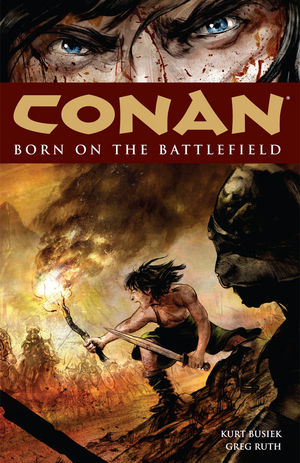
Conan: Born on the Battlefield

Dark Horse comics has been publishing Conan comics for a while now. Not only have they done brand new stories, as well as stories based on Howard's original material, but also reprints of Marvel Comics own Conan stories as well as the stories of Conan from the magazine via the Savage Sword reprints.

In this volume, Born on the Battlefield, labeled 0, Kurt Busiek writes of Conan's youth with illustrations by Greg Ruth. Greg does a great job of illustrating Conan in his various stages of life. I've always been one who thinks more of Conan in his 'pantherish' style rather than the hulking style that is often incorporated into some of the icongraphy associated with Conan.

This volume itself is a nice collection as, like many of the Dark Horse collections, it not only has a great introduction, this time by Ed Brubaker, but has a nice set of additional materials including various sketches by Greg at the end of it. It's a bit of an odd task as Conan is a fairly well known character but it is not the first time Conan's early years and birthing even, have come under scrutiny. I'll be talking about some of the spoilers specific to the book below so if you don't want any information ruined for you, read no further.

First off, as a Dungeon Master, I am not that interested in starting backgrounds for some games. This may sound cold or callous but in a AD&D 1st or 2nd edition game, I'm not too worried about building in too much until the survivability factor comes into its own. If you're a first level wizard with four hit points, I don't need to see six pages of how and why you came to learn sleep and magic missile.

In more... I hate to say story driven games, because I've played plenty of D&D games where it wasn't about dungeon crawling at all, but in games like Hero or GURPS, even starting characters in those games, and others like them, tend to have a little better survivability factor and more reason to have a certain set of skills and a background story can flesh that out some.

As a player, the more complex the game system is without survivability, like Rolemaster, the less likely I'm going to invest any time into making a detailed background myself. For a convention character, I might whip a few paragraphs together if he's not starting past first level.

On good old RPG.net, when the question of background comes up, there are some who prefer only what is revealed during actual game play. It makes the characters more organic and real to them. I can see that point.

I suspect that many Dungeon Masters fear that players try to build too much into their background. That player's are looking for that 'gimmie'. In some aspects, its not a goal without effort. While writing may come naturally to some people and like pulling teeth for others, it still involves some effort to write it down, to provide it in context of the setting, and to present it to the Dungeon Master. Is that worth a reward? Depends on how the DM is going to run the game and what the long term intentions are.

Anyway, most of Conan's background doesn't really lend itself too well to a RPG outside of the events of his birth where his mother is fighting on a battlefield, hence the title of the volume. Events like these can fall under an 'omens' table if you will.  The old Central Casting: Heroes of Legend provided a few different types of tables to roll on for these bits. Mind you though, there are differences between where your born and what happens when your born. The battlfield for example, is merely a location. Making the birthplace an unusual local isn't a bad thing mind you, but what if it'd been in a castle during a siege? What if it happened in jail or a brothel?

Adding other details like a twin tailed comet being visible to all on that night, or all the milk turning sour or the birth of farm animals with hideous mutations? That's an omen.

For much of the material, Conan's personality traits tend to emerge, but that would be somewhat difficult to mine for much outside of modeling a character directly on them.

However, the importance of Conan's grandfather is reinforced here. I say reinforced because while this is volume 0, it is certainly not the first in the actual printed publication and Conan's grandfather has been referenced as the one who helped instill the wanderlust in Conan.

This bit of background building, of relatives who help mold the character, are useful in a few ways. It allows the player to claim to have some knowledge of X, but that knowledge of X is coming from a third party, is coming from a perspective that's some odd twenty to thirty years off, and may be embellished to provide entertainment. This can easily smooth over any differences between what the player thinks he knows and what the setting actually is.

Perhaps more importantly, Conan's grandfather dies at the end of this volume. While that may sound harsh, it does allow Conan to go wandering without too many ties left to his home country.

For gaming purposes, Brita's Vale from its initial description alone makes a worth addition to a setting, "Dark forces seep from the blood-soaked ground. The vale attracts wizards, madmen who feast on human flesh, and worse they say." Now many game settings already have such a location as the Battle of the Bones in the Forgotten Realms, but its good to have a spot where the fields of the dead are stacked high and strange things wander.

The closer one gets to such a location, the more things can be of the 'other'. In this comic for instance, Conan dreams of a panther he has slain providing him with dire omens. When he gets to the vale itself, breathing in the dust of the dead provides him with visions of how the fighting went. In the midst of that he is forced to fight for his life against a cannibal and sees a bone-witch who appeared in other comics that series wise, take place later, although again, the printing chronology make that reversed in when the reader initially saw them.

Having such a location allows the setting to have graveyards that aren't man made but yet, are visited by men. In settings that are soaked in superstition, many sword and sorcery ones for example, the Game Master can run counter to those traditions and have it be where individuals meet to discuss various business matters as normal people stay away from these 'haunted ruins'. It could also be a place where survivors of the wars come yearly to pay their respects to the dead. It could also be a place where certain items have been rumored to be lost ever since the original conflict.

One 'moral' lesson of this series though, is an old one; No Good Deed Goes Unpunished. Conan, as a youth, sees strangers coming to his homeland, a wizard and her daughter. The daughter grows up even as Conan does and the two becomes lovers. While playing, the daughter falls into a field and startles a bull. Conan leaping in to save her winds up putting the strange girl in front of his fellow villagers and that in turn brings her wizard father. The two sides do not see things eye to eye and soon the civilized lands know of the value of ore and other valuables in Conan's home.

That in and of itself leads to a war where Conan takes a place among the men and the end result? The girl and her father are dead. Not at Conan's hand mind you, but the end result is still the same. The very thing Conan sought to prevent, the death of the girl, comes about in a long drawn out way that costs many their lives on both sides, because Conan tried to do the right thing. Are there events and elements in your own setting that can trigger a negative? Something that should be done for the greater good but isn't because the current cost of doing that would be too high?

The destruction of the invaders and their fort though, follows another example of one of Howard's themes that barbarism is the natural state of the world and that it will sweep away civilization.

Born on the Battlefield is an interesting take on Conan's early years. It makes him a little "too" much in my opinion as he's always killed various animals, experienced the supernatural and taken part in a war, well before leaving the homeland, but at least its not so far out there that future adventures he has are reduced to repetition or lesser actions. If you're interested in seeing how Kurt Busiek, known his his initial tenure on the story, The Frost Giant's Daughter, back in 2005, this is a good volume to pick up.


Wednesday, June 27, 2012

Tarzan of the Apes by Edgar Rice Burroughs

Tarzan of the Apes is a book I haven't read in decades. I'd actually thought that the Disney version was much closer to the written material than it is. Tarzan is a prototype of the savage hero, more outcast than even Conan in terms of civility and equipment. His reliance on training and instinct couped with awesome intellictual gifts and a few trusty weapons, make him a fierce lord of the Jungle.

I'll be pinging some thoughts from reading the book that will contain spoilers but it's not like this is a new story. Indeed, I got my latest version free from Amazon and their Kindle books. Remember how I keep harping on price points for e-books? It's because of some great free literature like this, that well, I'm able to. If several Tarzan and other Edgar Rice Burroughs books are free and available, what's to stop someone from having weeks ir not months of reading enjoyment for free?

Anyway, onto thoughts of the book.

Orphan Outcast. One of the standards of most characters, Tarzan is essentailly an orphan for most of the book. Sure, he initially has his parents and even his ape mother, but she's taken from him relatively early in the tale.  This gives Tarzan a bit of freedom that characters 'burdened' with family don't necessarily have, but in time, the action revolves around him saving outsiders who essentially become his new family. Ties are what makes characters interesting. Without them, games like Final Fantasy VII just become pretty pictures on a screen and Tarzan just becomes another savage.

Technology. I'm not saying Tarzan is running through the Jungle with Phase Plasma Rifle with a 40 Watt Range or anything, but even something like his knife makes a huge difference when he finds himself pitted against the strongest adversaries the jungle can throw against him. And this is something that doesn't automatically grant success mind you, but a well equipped and armed party, especially with missle weapons, shouldn't necessarily have much to fear from normal animals as the opportunity to finish them off before a single blow can be struck in retaliation should be fairly high.

Physically Gifted: Tarzan, like many heroes of his era, is simply not human. He is capable of straight leaps into the air of something like twenty feet at a stretch. He is able to carry more than four people put together. Not only that, but he is the owner of an awesome intellict as well. With no mentoring, he teaches himself to read and picks up information like an insatiable sponge. And he isn't the only one of this era. Doc Savage is the 'perfect' human who has a group of gifted allies and he's better than all of them. These guys really make Bat Man look like some little bored rich kid who decided it'd be a gas to dress up and fight crime. The problem with them is they can set some highly unrealistic standards when players try to use them for inspiration. When doing something like a Champions or GURPS game, and the GM wants to emulate their physical abilities and weird talents, be generous with the points.

Rogues Are Everywhere: Tarzan's parents are stranded in Africa because the people who they took passage with were lead by an unkind captain who in turn, is murdered by his crew. Jane and her father and cohorts are stranded on the same island because... well, untrustworthy pirates! Tarzan's first meeting with another group of men is stained because those men has in turn been mistreated and have taken it out on all they then meet. It doesn't matter the time or distance, the civility or the savegry, rogues are everywhere.

Scars: Initially there are a few fights that take Tarzan months to recover from but leave no blemish upon his 'brown skin'. Later on though he almost has his scalp ripped off and whenever he's pissed that scar shows red in contrast to the rest of his face. Think about some defining characteristics for your characters, both as a player and as a Game Master. I know that in some of his Conan writings, Robert Jordan wouldn't even name the thug villains that Conan battled, merely referring to them by their scars and other physical afflictions.

Evolution: Tarzan in some instances and incrantion is popular for his "Me Tarzan you Jane" bit, but by the end of the first novel, he's speaking multiple languages, knows how to drive a car, and fully understands the value of money and its ability to influence the world about him. Characters that don't change or evolve can indeed be fun to play, but stretching those initial character concepts and letting the game play take you to new places can test out different role playing muscles.

Tarzan has inspired many artist like Joe Jusko, as well as many writers, and many movies and cartons and other media. It's worth giving the original a read not only to see where it all started, but what people have done with it since.