Below is a quote taken from The Blade Itself from the Science Fiction Club edition.
"I don't need men with good blood. I need men who can plan, and organise, give orders and follow them. There will be no room in my army for those who cannot do as they are told, I don't care how noble they are."
"This war was a bad thing, a terrible thing, no doubt. He felt himself grinning. A terrible thing. But it just might be the making of him." (p. 255-256)
Many of the most famous fantasy settings for gaming, like Greyhawk and Forgotten Realms, are psuedo Middle Ages with various factions that have somewhere on them, a structure where the laws and money are held by the nobles and those of noble blood and where the merchant class is either just starting to appear or is kind of just ignored on the side.
In the Berserk series, Griffith's ambition is to have his own kingdom despite coming from nothing. It causes trouble with those of the kingdom and leads to some interesting scenarios.
I mention the plight of West from the Blade Itself and Griffith from Berserk because this is a reptition of theme. That change against an established government is not an easy thing and that despite the outside threats and enemies, that those who are seen as being responsible or part of the change, become enemies of the established heirarchy no matter how much that current government may need them.
Game Masters can use corruption, incompetence, intolerance and other themes to showcase how different the members of an up and coming group of adventurers are different even among their own people. Sure, there may be those who want their alliance and those who have missions for them, but what do those people actually think of the characters. Have the characters almost enter a chamber room where their patron is having a meeting with another noble house and is talking about how useful it is to have such wonderful lap dogs. Have the players have to battle a group of inquisitors who are after their cleric for supposed heresy. The potential for inner conflict with one's king, country, and religion, are not just limited to fighting the obvious evil ones.
Showing posts with label The Blade Itself. Show all posts
Showing posts with label The Blade Itself. Show all posts
Sunday, July 25, 2010


The Blade Itself by Joe Abercrombie
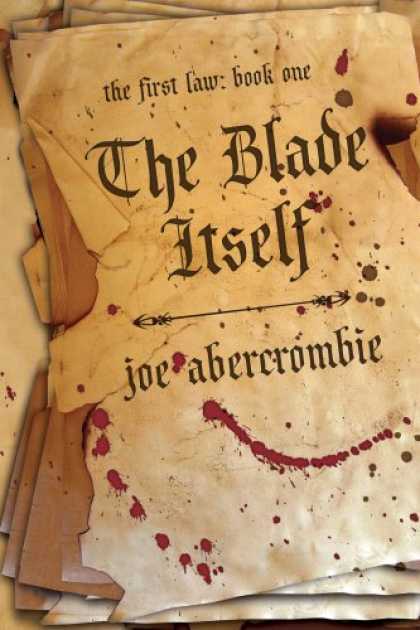
The Blade Itself has a series of characters who don't have feet made of clay. Rather, the clay stops at oh, say the neck. This can be solid reading for those who don't like their heroes to be perfect or for them to be prestine but in a role playing game, it has to work with the party.
For example, one of the characters, Glokta, is an inquisitor who used to be a great warrior until his capture and years of torture that broke his body down. The character suffers limitations on movement, eating, and other areas. In a game like Hero or GURPS where those limitations might come in as a reward somewhere else, it might be useful. In a level based game where such issues are not rewarded? Not so much. It's one of the primary reasons why D&D doesn't have a critical hit system that targets limbs.
Now if the GM and the player want to have the character role play out some issues, like talking about a limp or walking slow without it actually effecting the game mechanics, that works in many situations. Most often the other players will roll with it and perhaps even throw in their own jibs when the character has to put the run on. "No problem running from the dragon eh?" In other instances, it may not work and in those instances, you need to know why the player wants to run such a character in the first place. If it's just a role playing challenge, then there is no need to 'reward' them for it. If they want something in exchange, then it's not for the right reason.
But that wasn't why I wanted to post about the book. Rather,..
"This is better," said Logen. It was a simple, solid-looking sword, in a scabbard of weathered brown leathers. "Oh yes indeed. Much, much better. That blade is the work of Kanedias, the Master Maker himself."..."Consider it a gift. My thanks for your good manners. (pg. 151-152)
The idea of a character getting a powerful weapon as a gift is often frowned upon in many games. After all, if they didn't earn it, what good is it? But if you look at some famous examples, like King Arthur, pulling the sword from the stone didn't exactly require the squire to go and do battle.
Peter Morwood wrote a series, The Book of Years, that started off with the Horselord. The main character there is given a gift of a fine sword whose blade has to be continuously refitted to new hilts as the old ones wear away, the Widowmaker.
If you don't like the idea of powerful weapons and items just happening to be in a monsters lair, go the opposite route. Have these items become gifts to those that the ones already in power wish to befriend. Have them become gifts that are 'fated' to be used by the character. After all, owning a nifty magical weapon and mastering it are not quite one and the same as the Sword Bearer by Glen Cook finds out.
Subscribe to:
Posts (Atom)


