I've mentioned the importance of individuals both in starting wars and in fighting wars.
I've mentioned naming conventions and how things are named after people. The Orebites, after Zizka's death, labelled themselves 'The Orpahns', because of the loss they had suffered. People have historically had names that might sound odd even at a gaming table. For example, the successors to Jan Zikka, Prokop the Great and Prokop the lesser. The Great and the Lesser? I know which one I'm going after first.
Don't know if I'm mentioned the use of heraldry or how important it could be. The Hussites used a few symbols. These went on their shields, surcoats, and horse barding usually. Symbols include the chalice and a goose. Some illustrations combine the two. I can't imagine a player today using a goose as his herald symbol but there it is in history.
Women: Don't know if I mentioned it before, but women fought in the Hussite armies. Yeah, Women At Work In Medieval Europe points out women doctors on the field of battle and the Hussite armies bring the peasant women with them into the actual field of combat.
Historical importance: The events of the time may leave their mark on the landscape for centuries to come. Jan has several statues dedicated to him. Some of the ideas and issues of the initial Hussite Heresy come to the foreground in the Reformation. In a fantasy game, it would probably go a lot further.
For example, magic items. The Mace of Zizka could be a high powered Rod of Lordly Might. When he died he supposedly ordered his men make a drum out of his skin and beat it at the front of the Hussite Army. Drum of Zizka? Oh yeah. Anything a hero uses could be said to be of his power and by taking those names and events into the campaign, the GM can turn even a +1 item into something a bit more.
Now mind you this won't work in a magic item heavy campagin because the players will still turn in that Mace of Zizka if it's just a +1 mace and it's easier to get a +2 mace, but if the mace is used to improve moral, build troops, and other non-combat activities, even if it's not as powerful, it has greater appeal.
Artwork: The material by Angus is up to his usual standards. Several powerful illustrations of the movers and shakers of the time as well as an excellent illustration of a war wagon.
The Hussite Wars showcase how one event can lead to others and to decades of warfare and in doing so, sparks the imagination with wonder and awe at the strength of the principle characters brought to the foreground in its wake.
Showing posts with label Hussite Wars. Show all posts
Showing posts with label Hussite Wars. Show all posts
Monday, November 15, 2010


Sunday, November 14, 2010
The Hussite Wars: The War Wagons

They were first used when Jan Zizka used the landscape to control the flow of the enemy against him by using lakes as natural barriers and then arranging existing wagons as another barrier. After that, they become a central part of the Hussite army. One of the interesting things is that historically, it is assumed that these were defensive vehicles, using both crossbow men and gunmen using essentially murder holes to fire at the enemy and pike men to protect the outside. But that defensive nature seems overstated when in the book, two accounts talk about how the war wagons could encircle a part of the enemy army and cut it to ribbons.
Another interesting bit I like about the war wagons, is that despite having gun men, and a limited number at that due to the cost associated with the guns, is that they have stones for when the conflict gets too close. On one hand, using the gunpowder, on the other, man's earliest weapon.
The thing that comes across in the war wagon though, is that it's use was relatively limited to these areas because they required a lot of open area to use. Those in more mountainous or uneven terrain would find them useless. The other important part, according to that linked website, was the nature of the Hussite army. Peasants; infantry. When many armies consider the knight to be the pinnacle of military superiority, you make do with what you have.
When looking at the history of your own setting, remember the vital role that geography will play in the development of weapons; not just small weapons, but huge weapons of war.
Now if only Games Workshop would get around to releasing some War Wagons...
Saturday, November 13, 2010
The Hussite Wars 1419-36 Part One
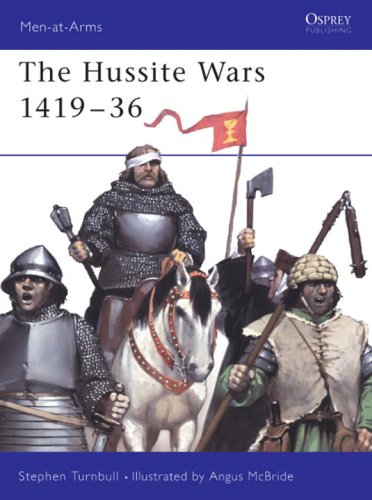
And it is another interesting read, well worthy of a look. I had no knowledge, or at least, direction knowledge, of The Hussite Wars before hand, but I am curious to learn more about them now.
One of the things that stands out to me as a reader and a Dungeon Master, is the enormous effect that individuals of character and charisma and skill have had on the world. The Hussite Wars themselves, take their name from Jan Huss. This is something that happens time and time again in the real world history and it's something I often forget about when looking at designing historical battles for any backgrounds I'm working on.
Not all wars can be the War of the Roses with such symbolism crashing through, but named individuals whose actions and fates, can inspire decades of warfare.
In addition to Jan Huss, the man in the centerpiece here, Jan Žižka, is a military genius of his time, revolutionizing the way battles were fought in his home and winning battle after battle despite only having one eye. Even more determination and grit is shown when he losses the other eye years latter and leads his army for another five years. This is something that in a fantasy book, people might laugh at and go, "Yeah right." But here it has apparently happened with no magic involved. Or course history revisionism is another topic...
But another point of interest about Jan Žižka is his death. He doesn't die on the battlefield. Rather, like several great warrior leaders before him, his death doesn't necessarily involve his profession; he dies of the plague in 1424.
The Hussite Wars bring some interesting bits together and showcase historical weight that will continue to roll down in history. When designing your own settings, if things happen at point X, do those actions have further repercussions down the road? Do people look at the leaders of a bygone era and say, "Yes, they were right and we will continue those works."
Lastly, once again, the strength and importance of religion is hammered home. These Hussite Wars are also Crusades with the Hussites being on the receiving end. Mind you they win these battles but the strength of faith is what starts off wars. Thousands of people killed for the methods of worship. This in turn reminds me of the great job Kate Elliot did with her series, Crown of Stars, and how strong the power of belief, without necessarily clerical magic or any magic for that point, can be.
In many fantasy campaigns, these wars of faith can be somewhat difficult. Some settings like the Forgotten Realms and even Greyhawk, are so brimming with deities that the idea of holy war or heresy on a large scale seems completely against the context of those settings. The best one might be able to do with them, is set up rival deities that can have various smaller rivalries and battles.
In these more intimate battles, the actions of single individuals, like the player characters, come more into focus. Do you want to be one man in an army of thousands, or one hero in a handful that knows of the plots of Shar against Sune?
On the other hand, as King of the North proved, althought briefly, the only thing more impressive than a war of faith is a war of gods. One of the fun things about Palladium Books and their Rift setting is that essentially everything is possible. There are gods, there are fake gods, there are ancient elder entities that had the same roles as some of the other gods and all manners of interesting bits and pieces that some how or another make a near whole. But, if you're looking for religious war fare on a grand and cosmic scale, then a war of Pantheons, where entire countries are moved by gods that are real and do take part of the battles, can be the route to go.
Subscribe to:
Posts (Atom)


