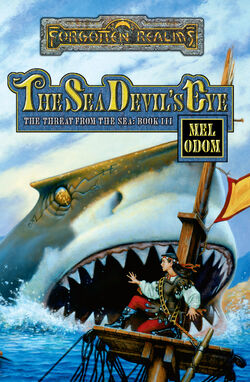
The third and final book in the Threat From the Sea series brings a close to the adventures of angst and ancient evil. I'll be discussing some of the things in the book that I didn't like and how I would try to avoid them.
The first thing is over use of the gods. The malanti that starts us off on this journey turns against her master and is protected thanks to the god.
The emo hero of the piece has been directed and guided by a god. He was knocked out a few times early in the series including once where he was shot by a crossbow and lived because he had to serve.
The bard hero of the piece is also directed by a god.
While the use of deities is not necessarily a bad thing, especially in a setting like the Forgotten Realms where the gods are very real, after a while you have to wonder, where the hell are the evil gods while the rest of these deities are planting their very firm hand on the setting? Mind you, the villain of the piece of old enough and powerful enough to perhaps qualify as some sort of demi-power, but you figure that some of the evil forces out there would be aligned on his side right?
So when running your game, try to be aware of the powers that be and that their overuse might have an adverse effect on the game.
For one, the players can become spoiled if they expect to have their fat pulled out of the fire by the gods when the going gets tough. If you bust them out of death's door once, why only that time? They can also get jaded in that they'll wonder why they are playing if the gods are going to solve all their problems to begin with. It's a fine line and once that can be crossed easier when you are familiar with the preferences of your group.
The next bit has to do with the villain of the piece. Iakhovas is an ancient entity native to the Forgotten Realms. He enjoyed the love of the Bitch Queen when the lands were young and he was one of the first creatures upon it. But he failed to keep that love and was punished.
Thousands, if not tens of thousands of years later, he comes back and seeks out all the old items that made him into such a power back in the day.
Okay, this is like the Emperor rebuilding the Death Star in the third Star Wars movie. Yeah, it was awesome when we first saw it, but do we need to see it again? Is that 'ultimate power' that got is ass whipped the first time around really the solution?
If in the day he could not achieve his goals with the items he had, why would he search out those exact items again? Did something change where now they are more powerful then ever? This falls into the trap of "the old stuff is better". It would have been more interesting if the author took that old standard and had the heroes going around securing all of Iakhovas old goods while he went and either made new ones himself or had new ones crafted for him.
The other problem I had with Iakhovas, is that he's shown as being a great leader. He's shown that he is a tactical genius. At the end, he stays to fight to the death against someone who has a superior weapon. This reminded me of the Transformers movie with the Fallen going on and on about how only a Prime can defeat him and hey, there's Optimus Prime renewed and invigorated and yeah, let's fight him!
What's worse, is at the point of his death, Iakhovas has a magic eye which when hit with a magical sword, blows his head off. How stupid of an entity do you have to be to put something that can take your head off into your head? "I think this grenade really sets off my features." Stupid.
Now the things that I thought worked, included bits that were set up for future follow up. This includes some glimpses into the future where the hero sees himself fighting his father. I thought this would've happened prior to the fight against Iakhovas as a sort of redemption piece but by leaving it for later, the author saves some space for future conflicts that perhaps may not be as epic, but are still personal to the hero.
The mentor of the young hero mentions his fallen sister, a necromancer, and her alliance with the Zhents. Another field where we get no resolution.
The destruction of the Sharksbane Wall. This was used to keep the old beasties away from the rest of the population in the Sea of Fallen Stars. It is a very real thing that leads the setting into more dangerous tides.
And on that last note, I have to wonder, again, how badly 4e screwed the Forgotten Realms pooch.
Prior to 4e, and not necessarily all at once, but all having long term effects, you have the following:
The elves retake Myth Drannor.
The Shades take over Sembia.
The Sharksbane Wall is destroyed and naval powers have suffered some crippling defeats.
The Dragons have gone mad and destroyed a lot of the standards and standbys.
And then instead of having to help fight back the hordes of undead dragons created during this time, or sail in peril across the Sword Coast or across the Sea of Fallen stars, or fight against the Shades in Sembia, or help rebuild the city of elves, we get a hundred year skip where all of the interesting stuff is someone done by still relevant?
M'eh.
One thing I thought interesting, when discussing the gods though, is that it provides a good example of how some of the deities, in this case, Sekolah, the god of the sahuagin, are multi-natural in order and would allow the villain of the piece to rise to prominence. The villain makes a note early on that the Shark God swims through many worlds, a nod to the huge connected nature of the planar settings that the Dungeons and Dragons rules utilized back in the day.
Threat From The Sea has a lot of action and keeps things moving, even when I'm not down with all of the pieces and bits that are used to tell the story.
Showing posts with label Threat From The Sea. Show all posts
Saturday, January 7, 2012
Thursday, January 5, 2012
Under Fallen Stars by Mel Odom
One of the interesting things about how the previous book, Rising Tide ended, was the heroe's quest to get to Baldur's Gate. This is a fairly famous city in the Forgotten Realms for several reasons ranging from its initial launch point in the gray boxed set back in the day with the mercenary group the Flaming Fist, to its importance in a video game called... yes, Baldur's Gate.
At the end of the previous novel, the hero discovers that he needs to be at Baldur's Gate and so, he goes on an overland journey. Due to the raids and attacks, the pirates in alliance with the various horrors of the depths, the goods going north must now do so through land. But here Mel pulls out another set of sharpened stakes and notes that even overland journeys are more dangerous because everyone is doing it so the orcs, goblins and other land based monsters, are essentially having a field day. This is a good example of showcasing how one change in one part of the setting can effect other parts of the setting. Sure, soldiers and sailors are in more demand than ever, but that doesn't guarantee victory!
At the start of this novel though, the journey is finished. There is no daily recap of the heroic quest to reach the city. They made it. When running your own game, how important is each and every potential conflict? In some games I've played in, the GM insisted on careful calculations of every gold piece spent and earned, of every item of clothing and possession written down. Depending on the GM and the players, this can be fun and serve some distinction between games. In other groups and GMs, it can be tedious to a level that makes the players simply not want to play.
This gets back to another old adage around this blog; know your players. If your players are highly detail oriented and enjoy noting their possessions and are always on the lookout for the strange bits, then indulge them in it. If they don't, have some common ground where the players understand X amount of wealth will be lost on housing and supplies and in exchange you want bring the ban hammer down on them when they make assumptions that might be... presumptious in another style of game.
Now the big bad of the series, his attack on Baldur's Gate is meant to shatter it. To cast the city to the four winds. Well, at least according to this book and the 4th edition version of Baldur's Gate, that didn't quite happen. Which makes sense. Previous novels and material have established Baldur's Gate as well, not invincible, but something that would require such a major upheaval that having it taken down by some fish men might prove problematic to those readers heavily involved with the series.
And here's another old adage; kill your babies. If you, as the GM, are running some epic material and want to do the old styling of showcasing just how powerful and vile the enemy is, destroy a few major cities, kill some major NPCs, and create havoc on the shipping lanes. This lets the players know that the stakes are very high and that they need to be at the top of their game if they are to thrive.
The only potential problem in such cases though, is that if you are running multiple campaigns in the same setting and want things to not be so smashed or if you're running a group with other GMs in the same setting. You can either let the other Game Masters know ahead of time or you can decide that the epic nature of the story requires you to bring the setting to a different level than the players have assumed and this in and of itself will let the players know that something big is happening here.
As a GM though, unlike an author, you have to be ready to follow what the players do after the attack. In the previous novel, Waterdeep took a beating. In this one, it's Baldur's Gate. What if you're players are like true old school players, not like the 3rd and 4th ed ones, but characters who have build their towers, created their castles and have their thief guilds? Chances are good that they may want to rebuild their schools, recreate their schools, and renew their alliances prior to moving on to attack the ones who attacked them.
You can either push them onto the 'adventure' that is waiting, or you can craft material out of their rebuilding efforts. If supplies are limited, then there will be struggles over those supplies. If the players have not made firm alliances with the local politicians, then they will have even greater struggles. At the end of the day, depending on the previous actions of the players and their current activities, they may have to actually pack up and leave the city. If they are ready though, and they do have supplies, then let them reap those rewards. Perhaps they have foodstuffs that the city needs or access to magic that allows them to quickly clean and rebuild the city. Perhaps the fighter is in alliance with the thief and they keep the rougher rogues of the city in check allowing people to come into the city and make new opportunities for themselves until they learn that the beneficial players perhaps have a few 'taxes' of their own that they are going to lay down.
Another factor that comes into play here is a massive gate that allows the villain of the piece to move from the Sword Coast to the Sea of Fallen Stars. There are also nods to Spelljammer with a Helm, used tospelljamming helm on a ship or want that much magic in the setting, if it's not overly abused and isn't a sign of the campaign tone and focus shifting, and just an nod to those other elements, even the most jaded player may get a gidding feeling about knowing what a helm is and how the ship is going to meet up with others in the Sea of Fallen Stars from a river that ends long before it gets there.
Use the setting and the rules are bones to build the structure of your game and if those tools don't let you do what you want, smash them and make some new ones.
Subscribe to:
Posts (Atom)
