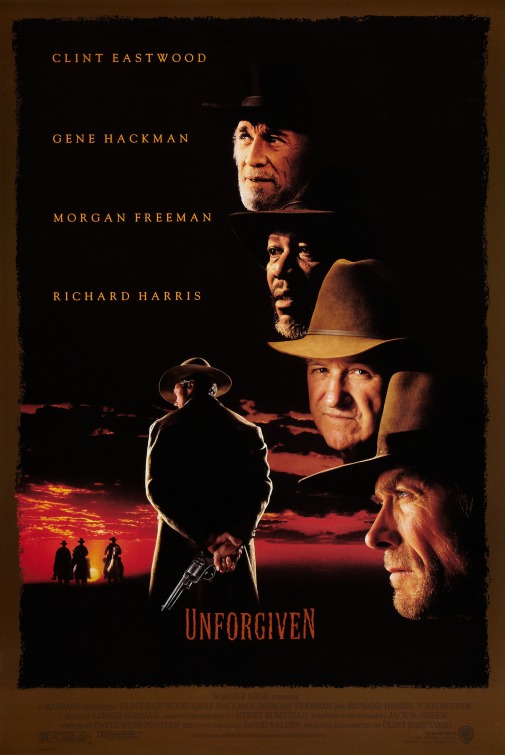
The thing that makes Unforgiven however, is the atmosphere and the characters.
The atmosphere drifts in through names like the town, Big Whiskey and through little statements made here and there, like when someone mentions the billiards table was broken down for fire wood years ago. Or how technology isn’t there to solve every problem such as vision difficulties or simply having the hogs suffer flu.
But it is the background of the characters that helps the whole movie to gel. For example, the viewers are often introduced to characters not only through those characters actions, but by how the other individuals in the movie react to them.
When English Bob and his biographer are travelling along on the train and being taunted by one of the cowboys, another cowboy warns him that this fellow might indeed be English Bob and is not one to be trifled with. The audience is further granted a view of skills involved here with a pheasant shooting contest from the back of the moving train with Bob hitting eight and the cowboy hitting one.
But as in many setups, this is just a tease. You see, it’s a tease for the build up of Little Bill who is spoken of in near holy tones by his fellow law men. Was he scared? No. He’s a bad carpenter, but he ain’t scared. Indeed, Little Bill is so unafraid of English Bob that he gets the drop on him with a full posse and beats the crap out of him. This sets Little Bill up as a truly big bad.
One of the 4e DMGs has some advice on trying to showcase the strength of the big bad including allowing the players to take the role of the person going up against the big bad. This allows the players to first hand experience the gaming effect without the GM only having to rely on narration to showcase the strengths of the villain.
It is also the characters that move the story along. There is no dungeon to explore here. While there is a beautiful scenery all about, the vast empty plains are not there for exploration but to travel through. Rather, it’s the characters that move the story forward.
One man makes a bad decision. A lawman makes another decision. The mother figure of the person wronged is not pleased with the lawman’s decision and puts a bounty out on the men who have wronged her people. The lawman now has to deal with bounty hunters, assassins, and other vagrants moving about his peaceful town.
In helping to make the characters stand out, think of the five senses. Hearing is a good one because when the players hear the names of the characters, if the names are descriptive and appropriate, the characters will probably get it more. The Black Company and The First Law use a lot of names that make sense only in their context, like the doctor being called Croaker or the hunter with the good smell the Dogman. Here, it’s names like Skinny or Fatty that come across on even the normal people of the setting.
In terms of player character types though, the three killers, tend to fall into three separate camps.
The Kid: He comes across as tough. He has access to high quality gear. He claims a lot of deeds under his belt. But… he doesn’t seem to know things that he should. The things he does know, he learned from an older relative, a member of the old posse. He doesn’t seem as capable as he should. Those who’ve been in the field for a long time may even notice that the kid suffers from some sort of physical defect that may not be easy to notice at first. Say… being short sighted? Not a good thing for a gun fighter.
The Eternal Companion: When first introduced to Ned, he’s a friend of the Seasoned Killer. He’s okay with his past. He’s not only made peace with it, he’s moved on. He doesn’t talk about it with a lot of regret but merely as something that happened. But more importantly, he’s a keystone for the Seasoned Killer. He’s a true comrade who would face death rather than betray his friends. He may have his own specialties but he often acts as a bit of comedy relief and a mirror for the Seasoned Killer.
For example, when questioned by the Kid about facing down two marshals and coming out with only a scratch, after the Kid goes away, the Companion tells the Killer that, “I recall it was three marshals.” He’s not necessarily there to act as the conscious of the seasoned killer. Indeed, he may spur the killer on if he thinks that will get the group where they’re going, but he has limits and will not cross them, leaving his friends if in good hands, to wash the blood off his own.
The Seasoned Killer: In the movie, Munney as played by Clint Eastwood is at first a man seemingly at peace with himself. He acknowledges his foul ways. He knows that he’s done wrong. He’s pushed by circumstance to go into “one last job” but isn’t going to fall into his old ways again.
But that’s nonsense. It takes a lot for the Seasoned Killer to simmer to the top. Here, Munney endures being made a fool of by his horse. He takes it in stride for his “wickedness to animals when I was weak.” He suffers the harsh life of an outdoor travelling man in the fall season suffering rain and snow and wind. He suffers disease, his mind ravaged by fever dreams, dreaming of those he’s killed, those he knows are dead, and even his loved ones. He even suffers at the hands of Little Bill. But the encounter is too early and so, the Killer, weakened by the fever, is unable to fight at his peak and suffers a beating, worsening his condition.
And when the killer wakes up? When he throws off the beating and the fever days latter? At first he may even seem like the repentant killer. He looks about the landscape and marvels in being alive and in the beauty of a scared woman. But when it comes to the killing? No uncertainties now. Indeed, he turns out to be a better shot than his Eternal Comrade whose specialty was with that weapon. His blood turns to ice and its only on getting the job done.
Consequences? Those are for lesser men. The Seasoned Killer may be a ruthless killing machine with a cool hand, but he’s not mindless. He values his friends. When people turn on those friends, woe be unto them.
For example, here, when Munney sees his friend Ned in a coffin outside Skinny’s Bar, it’s all over for skinny. When Little Bill protest that he just shot an unarmed man, Munney replies, “He should’ve armed himself” and goes on for a second about anyone going to decorate their bar with his friend is a dead man.
This is in the midst of a room full of lawmen. This is in the middle of town. This is walking into the cave of the bear with the bear awake and pissed.
And he walks out of it with a threat to burn the town down if they don’t take care of his friend.
There are variants of the Seasoned Killer, such as Samurai X, where the character is so earnest in trying not to kill anymore, that they essentially strip themselves of the ability. But the struggle of self perception, of telling people, “I’m not like that anymore” against what the character falls back unto?
For a different example, in The First Law, the Bloody Nine noted that its difficult to change if you stay in the same place with the same people doing the same things. The old habits return and good intentions are useless.
The Seasoned Killer also has another problem that the Eternal Companion and the Kid may not. While the Companion is competent and the Kid a young blood who hasn’t made a name for himself yet, The Seasoned Killer, when identified, is a known quantity. He’s a wanted man. Those on the side of justice want him dead or behind bars and those looking for a dangerous man are willing to pay.
If you’re looking for a movie with a ton of character that has a slow built up with a great cast, Unforgiven is a solid Western.