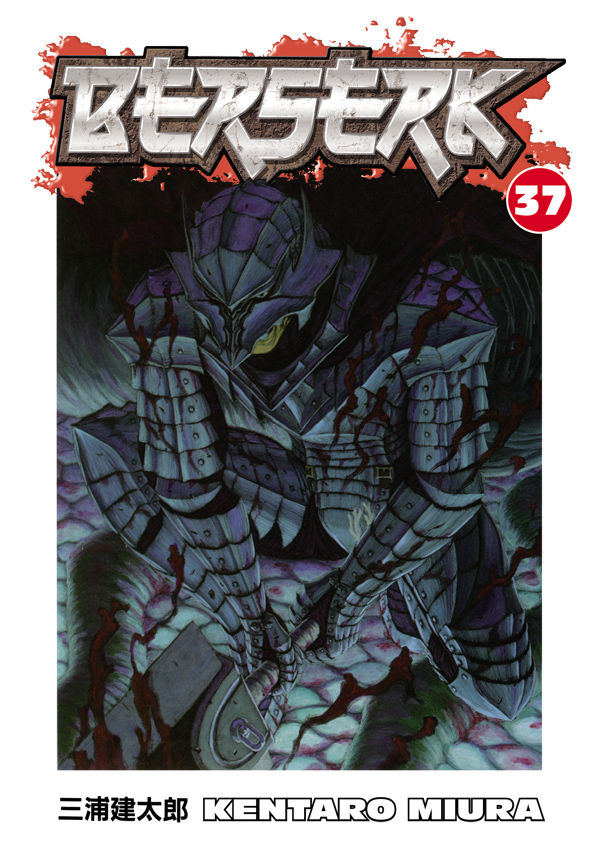
While Berserk by Kentaro Miura has not come to an end in the manga version, it has slowed considerably. This volume, afaik, is the last one we'll see in a while. Ironically enough, the movies have been moving forward. Hopefully we'll see more Berserk and of Guts in that field while the manga lays fallow.
This volume concludes the 'Sea God' story and brings in more magic and more visibility to the changes that have rocked the world since "the Wind" event where a strange wind blew through the land and heralded the age of magic and monsters returning to the world.
The art is up to Kentaro Miura's usual high standards. He, George Pereze and John Buscema all have a great timeless talent and I hope that if Berserk is on hold for a while that we'll be seeing his work in some other forms. Perhaps even an art book or something.
In terms of gaming?
1. Judge not by size. When Guts is 'fighting' the Sea God, he's fighting an island. Like several other similar situations where the character's size is of such insignificance, Guts is able to deal damage based on a weak point of the creature, in this case, it's heart. Designing such an opponent is like designing a dungeon. There are 'anti-bodies', various monsters that make their home there, there are parasites, there are creatures too small for the entity to notice. There are also natural hazards like stomach acid, drowning in blood and other unpleasant bits.
2. Red herrings: Guts is aided in this volume by Merrow and by a magical child. It's strongly been hinted, or at least argued online, that the child is Guts and Caska's child that is only able to reach the mortal world during the period of the full moon. This volume throws a wrench into that theory though as we're given two other options. The first is that the character seeking the elves to restore Caska, have been given a guide. The other is that the boy is a manifestation of King Hanafubuku. I'm sticking with it being Gut's and Caska's child.
3. Blow up the Outside World: Because Guts is at sea on a voyage, he doesn't know what's happened to the mainland. With all of the magic and monsters roaming freely through the land, man has retreated to shelter under Griffith's new country. Growing from outside the country are huge arcs of crystal called "Wing Stones" due to their appearance like wings. These keep out the 'wild' monsters and keep the humans and the Apostles, demonic creatures that serve Griffith, 'safe'. The real question is are the humans safe from the Apostles long term?
In addition to these Wing Stones, there is also the World Spiral Tree, an object so huge that it casts its branches over mountains and its visible against the moon when it first rises.
Lastly, we have the newly raised, in whole through magic and ritual, city of Falconia, a city where harvest season never ends, allowing people to continue to survive as well, people. Food and shelter are now not issues and they can continue to bring in outsiders.
These elements are a far cry from where the series has been prior to the Wind incident. In the past there were elements of ancient India and the Dark Ages of Europe. All that is potentially washed away but what it's replaced with is not certain. Only by effecting HUGE change can this be done.
Now I can hear some people saying, "I could swear that you didn't like it when WoTC blew up the Forgotten Realms." and yes, that is true but that's because of the manner in which it happened. There was no opportunity for the players to experience the events as they happened but rather, they get to play in the aftermath of that, and in many cases, the setting, at least in the novels I read, read much the same with a few nods to the vast changes. And when I say nods, that's what I mean. For example, Dragonborn? Not in the novels I read. Real effects to magic and the Spellplague? Again, nods to it, but effectively no. The whole point of putting the setting in that far reach having little impact on the characters.
Putting the characters IN the middle of that action however? Completely different beast.
Berserk 37 may be a temporary close to the story of Guts, but it's visual impact remains long after the last page is turned.
Showing posts with label Campaign Settings. Show all posts
Sunday, November 24, 2013
Thursday, June 20, 2013
Lost Cities in the Modern World
The modern world is very well connected. Technology is everywhere. Spies are all about us. Our movements tracked. It's easy to imagine that there is nothing new under the sun. That we know all we shall about our world.
Then we find out, often, that no, that's not quite true. How about the discovery of a lost Maya city? Sure, the rain forest has a lot to do with its concealment all these years, but most fantasy settings play host to far more dangerous and hostile terrain than a rain forest. When seeing the numerous "lost cities" it's easy to grow skeptical. To think cynically that its an unoriginal idea. That it's all been done before.
While not as recent, another "Lost City" discovery leads to one of the many 'cities of gold' that the early Spanish and English explorers sought out in their travels in the Western side of the world. These cities often have heroes associated with them as well as their own legends that are at least fairly well known by the locals.
An article linked to from that one, shows a perfect 'necromantic' trap in the form of 80 skeleton warriors.
Forests are not the only place where one can lose a city though. A far easier "buy" in is an city that has fallen not only to ruin, but into the sea. Ruins of this nature are being discovered on a fairly 'regular' basis if one were to label the frequency of findings.
In a fantasy campaign, the players may be part of an exploration party that's requested by one of the 'friendly' races of the sea such as merfolk, sea elves, or tritons. They may want the 'muscle' that the players can provide and in exchange, provide them with magic that can allow them to survive underwater. Perhaps even turning them into the race in question for the duration of their hunting of the haunted halls.
The world is still filled with wonder and if we can mine it for our games, all the better.
Tuesday, April 16, 2013
Spears of the Dawn
Spears of the Dawn is a game with a bit of history to it.
First, it's funded through the Kickstarter process. This in and of itself might be enough to make some people shield their eyes and turn their heads. The thing about Spears of the Dawn though, is that it actually game out a little ahead of time.
Second, it challenges the reader to do better by the gaming community. The author talks about using Scribus, OneBookShelf, OGL material and asks that if you don't like the game, make something better. I don't get the vibe of "You ain't got no game" or nothing hostile like that. I get the vibe that the author is endorsing people to be creative and put their efforts out for the masses in a good way. Probably why he's released the art for the game as public use for gaming too eh?
In between different bits, like looking at apartments and waiting to see what's going on with where I currently live, I've been pinging between Spears and other PDFs. On my computer, the file comes across fine. On my Toshiba Android Thrive tablet, using something like ezPDF, the heading files lose almost all of the detail, leaving only the capital of each word.
While I haven't read the whole book yet, and will hopefully come back to it soon, I wanted to point out the in game mechanic of having the characters be Spears of the Dawn. In games where the culture doesn't default to noble knight, shifty rogue, enigmatic wizard and pious cleric in a pseudo Middle Age Europe, it can be difficult to get a group together. It can be difficult to have a starting point for the game. It can be difficult to know what the players are supposed to do.
Another game, long ago mind you, Legend of the Five Rings, saw this potential problem in its first edition and recommended that the players be Magistrates who must uphold the law, work together, solve problems, and do right not only by their clan but by the Emperor!
Spears of the Dawn is a calling, a caste, a title, but from what I've seen this far, it's not a game mechanic. The people of the Three Lands have come out of war only recently against a dark and evil force that has many pockets of malice behind them and it is up to the Spears of the Dawn to battle against those monsters.
It's a great plot device that allows a diverse group of characters to get together and take to the dungeons with a bit of a background. It's one that can be used for multiple characters. It can be as deep or as shallow as the game master wants to make it. For those who might not be interested in that venue though, there's a sourcebook/adventure out by Sine Nomine Publishing already, House of Bone and Amber.
I haven't read through enough of the game rules to determine what is new and what is old school in game mechanics. In many ways it seems at first glance to be lot of old school including some of the old stand by for gaming stats: Strength, Intelligence, Wisdom, Dexterity, Constitution, and Charisma, rolled 3d6 straight in line. Bonuses are relatively small starting at +1 from 14-17 and +2 for 18. One of the nods to old school, or at least I consider it a nod, is the use of a silver standard. Many times one of the cries against the old Dungeons and Dragons is the sheer amount of wealth characters can accumulate.
In a non-campaign moment, one of the things I was looking at in terms of the stat generation, was either a nod to the old Rolemaster game system, or a case of parallel development. Many moons ago, in Rolemaster, if you didn't have at least a 90 in your prime stats, you could swap out your stat for a 90. Here, in your class, while you do roll 3d6 in order, you can put in a 14 for your prime score. While it's not going to be as awesome as an 18 in say, 3rd or 4th edition, or anything, especially in an OSR style game, it does provide some options for those players who have to have some better stats then the minimum eh?
Another non-standard bit, is rolling hit points. While it's a random roll, it's a random roll every level. It uses the lower end hit dice types, so fighters using d8 for example. The 'thing' though is that say at 3rd level, you can roll 3d8 for your hit points and take the better of the two, the new ones or your original ones. That's a bit of a strange system for me as it can have some flux in lower level characters who roll poorly but doesn't seem too useful as advancement happens and dice start to 'average' out on weight.
I hope to get back to Spears of the Dawn soon. It looks like a nice campaign setting that could easily be yanked out of the OSR system for exploration by characters from other systems or settings.
Monday, January 7, 2013
Random Observations on 4e
Over on RPG.net, there's some talk about Paizo Pathfinder and WoTC 4e.
http://forum.rpg.net/showthread.php?670531-Comparing-the-D-amp-D-and-Pathfinder-Product-Lines-to-Discern-Why-4E-Failed
Here's what I posted there and my take on it.
Why 4e 'failed'? Well, it failed WoTC that's for sure. For anyone else it would probably have been like Nirvana but here's my 'gamer' theories.
1. Reputation. Firings every X-Mas. Taking down the DDI and claiming about 6 different reasons why but boiling it down to "thieves in the temple!", calling your consumers thieves on the PDF front and taking your toys and going home with them. Minor things but...
2. PDF Consumption. While we can say that the DDI takes the place of PDF that's not quite true. After WoTC sold out of PHB2 they claimed to have suffered damages by PDF files that were released into the wild that were legally bought and cancelled that line of revenue NEVER to replace it directly.
3. Adventure Support. There was one print adventure path and it was not viewed well. There was Dungeon online and it's one adventure path... also not viewed well. In print adventurers, especially towards the tail end?
4. OGL. While Paizo is the big dog, they've done a lot of enhance the OGL and have been very friendly towards 3rd party publishers. This includes putting their products on the front page of their own web site and talking them up. WoTC took interest in the GLS out back and shot it in the face. When Necromancer Games goes, "I will support 4e or nothing at all" and it turns out to be nothing at all? You know WoTC done fucked up.
5. Setting Support: That solution they had of fire and forget wasn't going to make a lot of people happy.
6. Setting Support 2: Trashing the Forgotten Realms YET AGAIN did nothing to help convince older players that may be coming back that this is what was needed.
7. Rule Mastery Failure. The first printings of the first few books are compatible with later books but there are a ton of errata's and updates and the monster math changed greatly from the original MM to MM2 to MM3. People felt robbed. It's been a while but I also believe there was some flubbing with the new introductory boxed set with the Larry Elmore cover of classic days.
8. Essentials or "Which way am I walking?" Initially announced the changing of product lines to smaller books that lasted for about ten seconds.
9. Release Schedule Panic: People like some steady releases and like to know when they're coming out. Cancelling books left and right and reshuffling them looks like something a small third party company would do, not the leader of the pack.
10. Novel/Tie in Support. The comics weren't bad but not huge sellers. Their book selection has bounced a bit and while there were a few series set after the Spellplauge, it was nothing like it was when it was at its peak.
11. Dungeon and Dragon Utility = m'eh: When they took the DDI off the download, I still had like two months on it. I was NOT impressed with it as it lost a lot of utility it used to have. I understand that came back but in the meanwhile, for a while Dragon and Dungeon were simply put, not good values in and of themselves. The adventurers were okay, the format kept changing, the focus keept changing, the magazines had articles late, and hey by the way, for "your convenience" we've gotten rid of the compiled issue and you have to download articles individual one by one. I think they've back pedaled on that one too.
12. DDI Misses: I went to an interview with the guys doing the DDI before 4e launched. You can read about it on EN World from back in the day. But there were a ton of things that were supposed to be there at ground zero that I think are only NOW starting to pop up like the VTT.
13. Miniature Mishaps: Hey, we're going to introduce two brand new races to the game and make almost all the miniatures for at least one of them super hard to get. Sure, you can sub for them but really, is that what the consumer wants to do? What? They don't want to pay inflated prices for repaints? What? They're not happy with the massive drop in quality that accompanied several price increases? They want to know why the adventurers never have miniatures to go with them and that those miniatures come out months or years later? Foolish mortals! It's hard keeping communication lines open in a big company. We have no idea what games are being written or what core races are in the book.
14. Holding back material to boost further sales. In the 3.5 era, the PHB2 was a massive seller. MM2 and others... not quite so much. In order to boost sales of future core books, Gnomes, barbarians, frost giants, and a host of other material was deliberately split from the 'normal' core material and put into future volumes. Nothing like forcing people to pay for a few monsters more eh? Anyone remember the old 1st edition Monster Manual where you had Orcus and Asmoedus? Dispather and Demogorgon? Stop holding back the goodies dudes.
WoTC as a company has been handicapped in competitng in what is a niche industry. Their main benefits are useless when the main competition has access to all the same resources as you. Wayne Reynods? Monte Cook? Other fan favorites? Being the people who saved D&D only gets you so far when you showcase that hey, you're not a niche industry provider, you're a corporate entity that must met X, Y, and Z goals and your lengths gone to to protect your IP are hurting you among the people in the niche fandom. You know, the very same people you're trying to sell to? Yeah, them!
But again, those are gut shots from a fan, nothing more.
Labels:
4e,
Campaign Settings,
Dungeons and Dragons,
GSL,
OGL,
Pathfinder
Thursday, December 27, 2012
Honor Among Thieves: Book Three of the Ancient Blades Triology
David Chandler wraps up the Ancient Blade trilogy with Honor Among Thieves. I have to say, I'm no art critic but this is a terrible cover. The whole angle of the main character is way off for some reason. Colors aren't doing it any favors either. The dark nature of the previous covers were solid in contrast to the colors. This to me, is muted and awkward.
Writing wise, the book continues to follow the previous established pattern. If you enjoyed the first two books, this one follows through in that manner. The material continues to expand the setting, has large scale conflicts, and some 'fantasy revolutions' in technology and portents for future material set in this series.
Again, perhaps because I read it prior to this one, I find myself doing some contrast to Riyria Revelations by Michael J. Sullivan. In the third book of that series, the elves have their time and quickly wipe out most of the resistance. In Honor Amongst Thieves, the barbarians have free access to the lands and quickly decimate most of the opposition leaving only one city, the Free City of Ness, left to resist.
One of the problems with some campaigns is that they become like glass. You want to look at them and admire them. To insure that they're is a continuous flow of one thing to another. Authors know better. Smash the setting. Unleash the hounds of war. If you don't like the way it goes down, next campaign do another variation of the campaign. Mind you, that's easier to do with a new group as the old group, at least in my experience, is often interested in seeing how things 'went down'.
Another interesting aspect is the rise and fall of characters. Malden, who started off as a simple free lance rogue, gained membership, and in this volume, not only becomes the guild master, but then the 'mayor' of the free city. Mind you, at the end of the volume, he's back to being a freelance rogue but the shifting nature of power, especially social power, is made clear here.
Sir Croy, whose been fairly boring in some instances, by design I suspect, has his chance to shine through. He rises from being an exiled knight to becoming the regent of the kingdom. It's not what he wants mind you and his interest in it is slim compared to the longings of his heart, but he is a duty bound man who does not run from his responsibilities. At the end of the novel, while he has indeed lost his heart's goal, his political position and social status are higher than they were at the first novel save for one important thing that I'll mention later.
Cythera on the other hand, whose initial role was a ward against poisons and curses, comes into her own as much more than the rival love of the main male characters. Her mother, who laid the protections against curses on her, now trains her to be a witch. However, as her father was the most powerful of sorcerers, she's inherited that talent as well and winds us using a bit of that. Now in this setting, sorcerers are demon bound and their use of such magics mark them. In this instance, she gains some gray hair.
Open Ended. While the bulk of the story is resolved, there are many parts that are not. This is a good thing as it evolves organically from the story. The barbarian invasion force splits due to differences between brother and sister. This leaves the main invading force of barbarians defeated, but a goodly sized portion still in control of several fallen cities. This leaves the series open for future investigation as to what will happen with the mingling of different cultures there. This doesn't count the pass open from the destroyed mountain either. More barbarians could wander forth. More trade could be established.
More interestingly to me at least, is the fate of the ancient blades. The barbarian war chief, Morget, found some very potent dwarven weapons last volume. One of these, an axe, is apparently able to smash through the ancient blades themselves. This is fascinating. I'm always advocating that new methods and new techniques should be able to overcome things of the past. If the modern world ran like most fantasy stories, someone would unearth a copy of MS-DOS and destroy the modern Internet with it's ancient and archaic powers. On the other hand, those ancient blades were craft with magic for a specific purpose. With only one left at the end of the series, wielded by a rogue who doesn't know how to fight even, the author sets up a return of demons and sorcery for future volumes and the creation of new blades even.
Mind you, not all the loose ends are so interesting. Elves were introduced to the setting, or reintroduced to the setting, and not a peep out of them. Some of the elements, like the introduction of a canon by the dwarf Slag, may seem awesome at first and indeed, worthy of a player character doing, but with the nature of the setting showcasing so much that appears to take place in several different eras in terms of how it might be first introduced, still feels somewhat forced. Minor things for me but others might be more irate about it.
Honor Among Thieves is a good source of inspiration for role playing games like Dungeons and Dragons or Rolemaster where the character is the star of the story and not necessarily just the mechanics of the character.
Monday, December 24, 2012
Thief in the Night by David Chandler
Thief in the Night is the second book in the Ancient Blade Trilogy by David Chandler. I see over on David's website that when I found the first book for $2.99, that was a temporary sale. Man, dude needs to update that blog some more or have some links to his more modern work or more complete work. Last updated on 2011? And I thought I was bad.
Anyway, Thief in the Night continues the tale of Malden and Croy and the woman who they both love as well as dwarfs, dungeon ruin exploration, barbarian introductions and all manner of other interesting bits that would feel right at home in most role playing games. I'll be talking about specific spoilers below so if you would rather avoid that, read no further.
1. Racial Changes: I've mentioned before that in various settings, one way to make things stand out a bit is to change the 'core' fantasy races around. In the Riyria series by Michael J. Sullivan, the elves were vastly powerful and held at bay only through honorable agreements with their ancient pacts. Here, the elves were wiped out. Well, apparently not all wiped out as Malden and his friends discover in this novel as the elves have changed to more suit an underground civilization. This includes breeding large beetles for meat, fungus farms, and using the 'ancient's, which appears to be a thing that resembles an old Shoggoth by a Erol Otus from the old Deities and Demigods book.
Yeah, all eyes, and teeth, and hands, and strange bits to it.
When the elves die, they 'feed' themselves to it and their knowledge is then absorbed by it. This allows the elves to draw forth on knowledge that is ancient and rare and powerful. And in the case here, to survive their imprisonment in these ancient dwarven halls.
The dwarfs continue to be fleshed out a piece at a time. Slag showcases his vulgarity with vast amounts of swearing. It's entertaining to a point mind you. He also illustrates how dwarfs have changed. They have taken to some human vices such as gambling and this has lead some, like Slag himself, to do things that lead to exile. Their numbers are also on the decline. So some of the same old same old and some new.
2. Historical Nonsense. Again, the Riyria series covered similar ground. The humans have told themselves some pretty lies about how the war against the elves went but as Malden and his comrades explore the ancient ruins, which no dwarf in modern times could ever recreate, they learn that the elves weren't beaten by the humans, but betrayed by their allies, the dwarfs at a time when they didn't necessarily want to even fight anymore in the first place. This taking huge chunks of history and reworking them can also work in a RPG but care needs to be taken so that it actually works. Here, Croy and Malden are young enough that they wouldn't know the truth. In RPGs some long lived races, like elves, or even some immortal races, would know would actually happened. Not necessarily a problem for all games, but as Dungeons and Dragons tries to throw more and more material against the wall to see what sticks, its not entirely unusual to see such a player character pop up.
3. Expanding Setting. The first volume dealt mainly with the free city of Ness. This volume, by its nature of exploration of a ruined dwarf city outside Ness, expands upon that some. We see for example, Morget, a barbarian from the opposite side of the mountains, is seeking out Croy because his destiny is to kill a demon that looks like a strange slithering thing of arms, eyes and teeth. Morget is also a wielder of one of the ancient blades, one that explodes with light. This light is painful to undead and would make a good substitute for a Mace of Disruption with an area effect were the GM wanting to incorporate something like it into their own game.
In many ways, this is a natural in role playing games. You first dungeon leads to your second dungeon. Your first exploration in the sandbox leads to the second exploration in the sandbox. Your first departure from Sigil or the Rock of Bral leads to further exploration. Don't try to cram the whole campaign into one setting. Let it develop from the actions of the players.
4. Big Changes. One of the things I've been guilty of myself, is trying to keep things, to a certain point, at a status quo. To not have any huge effects happen to the setting. David doesn't have that problem. By the end of the novel, the characters have collapsed the mountain on the elves. This leaves a pass open from Morget's people, barbarians who have a lot in common with say, vikings and crossbreed with Mongolians. So that opens up a whole new vista for them to say attack the kingdom.
5. Character Optimization: One of the things that role playing games tend to suffer from, especially when they get pregnant with rules, is that there are 'builds' and abilities that almost become mandatory to take. Malden, while perhaps one of the best 'thieves' in the setting, one of the most agile, one of the most able, is still a terrible fighter. In 3rd edition and 4th edition of Dungeons and Dragons, its almost impossible to play such a character as so much of the setting focuses on their tremendous back stab damage and 4th ed kicking that up even more of a notch with special abilities that put them right into the fighter's arena.
The Game Master and player should have an understanding of what type of campaign is happening and the players should try to work with the Game Master to build characters that will thrive within it. In Malden, we have a character that is charismatic, works well with a party, and is a master thief. If the campaign requires only martial powered characters that can dish out damage, Malden would be useless. Check with the GM and hope you have one that's willing to work your abilities into the campaign.
Tuesday, January 31, 2012
Honor Among Thieves (Tales of Servin) by Elaine Cunningham
Honor Among Thieves is book one in a new series set in Servin by Elaine Cunningham. Elaine may be familiar to fans either of the Forgotten Realms setting where she's written numerous novels, or even fans of the more recent setting and novels, Pathfinder, where she's got one down and hopefully more to come.
At her website, http://www.elainecunningham.com/ she has numerous bits of lore on the setting. Some of that comes through the story, which is a novella. These isn't quite a steam punk setting, but there are clockwork elements including mechanical men along with magic and other bits.
I'll be delving into the book so there will be spoilers below.
So why am I mentioning it? There were a few bits I enjoyed.
For one, she takes the familiar, in this case the dwarfs, and provides her own touch, in this case, a sub-race, one of the "stone races", a Carmot. First, their blood is believed to amplified alchemical transmutations. Something useful in this setting because alchemy is on the rise and magic on the downfall. More interesting though is that the natural state of this type of dwarf, pale silvery gray hair, kin and teeth can be changed, like a chamelon. With a few reflavoring bits, you could take feats and PrCs designed for a Changelling and apply them to a Carmot.
New monsters are also good. How about a swarm of giant half moth, half mosquito creatures known as death moths that guard dwarf tombs? Good stuff. Some brute clock work guards done up in old style knight armor also show up.
Another thing I enjoyed was how the author makes it like an ongoing situation as opposed to some books where all the loose ends are done in one. There are things that are introduced here that don't come to a tidy end, even though they may in the future as the second book is now out.
Lastly, I enjoyed the twist. I admit that I did not see the big switch at the end coming. I suspected something was going to be different or special, but didn't know what it was. This would make for an interesting switch around in a role playing game where one of the players was using class and race X but perhaps even without them knowing it, they were perhaps monster Y. It's always good to be able to surprise the readers and yet leave enough slack that you can go back and reunite the heroes at a later date.
Wednesday, October 26, 2011
Warhammer Religions Versus Brunner by C. L. Werner
In the Warhammer setting, there are many deities that are followed. The general ones or the popular ones, would probably be Sigmar, the patron of the Empire, the White Wolf 'cult' in the north, and the Ruinous Powers of Chaos.
While Brunner himself is not given over to active worship, or at least, does not appear to acknowledge it, he does have several incidents or encounters with religion and those who are religious, or at least pay lip service to it that span a bit differently than the standard gods of the Warhammer setting.
Shallya: While Brunner does wind up crossing blades with a worshipper of Uncle Nurgle, the interesting thing was the prespective it puts on that worship. Tear down hospitals not because the help the injured, but because they cure the sick. This in and of itself could easily become a mini-campaign with one faction trying to wipe the other one's forces out. Brunner appreciates the healing but doesn't feel he owes anyone here anything because he earns his keep.
Solkan: I remember when I first bought my Warhammer FRPG book. It wasn't the hardcover first edition, but it was a great edition by Hogshead. Nonetheless, one of the interesting things I remember reading about in those early days, was deities of law. Not as known or as active in the world as those of Chaos, nonetheless, they were there. One of my friends ran a campaign where we were trying to free one of the trapped gods, the Lady of Law or something like that.
In one of the stories, Brunner is visiting a city state where Solkan is ascendant and his worshippers, while not the only faction, do have a lot of leeway in how they deal with sinners. The unfortunate thing is that they essentially come off like flagellants or other heavy handed worshippers of Sigmar so with a little name change, I wasn't seeing a lot of difference.
Ranald: The patron god of thieves and someone one of Brunner's bounties gives lip service to often.
When using a setting that has a lot of deities, try to focus on some that may not be receiving a lot of attention. It may force the players to pay a little more attention. If in a game where there are special toys different deities provide their worshippers, or different methods of worship are known, use them. Make the game a little different in aspects so that you can get away from the whole Ruinous Powers and Sigmar association that tie up so much of the Warhammer setting.
Keep it fresh and keep the players guessing.
Labels:
Brunner,
C. L. Werner,
Campaign Settings,
Deities,
Warhammer
Monday, March 14, 2011
The Wolf Age by James Enge
The third book featuring Morlock by James Enge, The Wolf Age is the best in the series so far. The cover is a powerful piece, featuring Morlock surrounded by werewolves with his magical sword and a flaming brand. I think the switch to darker colors for Morlock's clothing helps set the tone of the character better than the old red-blue on the previous covers.
I'll be discussing spoilers from the book below so if you wish to know no more, read no more.
"Sorry it's so heavy - can we change it for silver, somewhere?"
"Silver," said Hrutnefdhu faintly. "Are you still crazy?" pg. 144
"You should stay back. This hillside was a silver dump, I think. There may be some of the metal in these dust clouds." pg. 207
Morlock's capture by the werewolves has left him without funds and when he acquires some, in the form of copper, the fact that werewolves, indeed, a werewolf based society, would have absolutely no use for silver, comes to the forefront of things. When designing those alien societies and those monstrous societies, what standards would become the norm?
Would vampires outlaw the growing of garlic? Would they outlaw mirrors? Would they damn all streams and rivers to prevent running water?
On the other hand, such a scenario as the werewolves brings up a great opportunity for a heist style game. The werewolves don't want others to have the silver because its a weapon against them. Others, like the players, would want the silver because its worth money. The werewolves are allowing it to go to waste. In situations where silver may be slowly accumulating in a werewolf community, it probably all winds up in one spot. What happens if the players know of that spot? Ocean's fourteen?
Morlock's casual assumption that he would fight alongside Rokhlenu when the time came eased the werewolf's mind. pg. 172
Today your blood was shed for me and for these others. I will pay for that blood with the blood of your enemies. Blood for blood: that is the only law I know. Pg. 190
Rokhlenu, I will have blood for my friend's blood.
Is this what Hrutnefdhu would want?
I don't know. It doesn't matter, anyway. I am myself, not him. pg 330
This comes up several times. Morlock is the type of individual who when he befriends someone truly does so. His motives are that they are now his chosen family and blood is thicker than water. It makes him a great ally to have and a terrible enemy to betray.
In many ways, if the players can work out this type of alliance among themselves, it will help insure smoother game play while at the same time removing some of the potential fun game play of that nature involves itself with. The important thing though, is that everyone is on the same page. If you're bringing a new player into the game and he's unaware of the political alliances and ramifications the group has within its own dynamic and he assumes everyone is buddy buddy right from the get go, unless he is deliberately playing a naive character, the inevitable treachery such games encourage will not be seen as a good thing.
It's okay to have backstabbing and villains and morally gray ground in the campaign as long as everyone knows what the game is about. Rare are those who will week after week crawl into dark places to steal treasures of the ancients with people they can't trust at their back.
"Archers!' he thundered with what was nearly his last breath. "Sardhluun boat outside the fence! Kill all but the steersman. He's one of ours."
It was sheer bluff. pg. 180
In 3rd and 4th edition of D&D, skills came into their own a bit more than in previous editions where secondary skills and non-weapon proficiencies were the standard. Bluffing your enemies can be a skill check in the later editions and if the GM feels that the situation and role playing attempt deserves it, reward those actions in older editions. For those GMs of older systems, if you want to encourage this type of role playing effort, make sure that it works occasionally. Players will pick up their cues from what the NPCs do, how other NPCs react, what they do, and how the situation changes accordingly.
If they keep trying to use skills like bluff, intimidation and information gathering with little or no results, they'll stop doing it.
"I hate this place," she whispered, when they were fairly out of earshot. "I hate the stinking dirty water and the bugs in summer and the rickety lair towers and the mud and the wobbly boardwalks. But it is mine. It is mine. They gave it to me, after my last husband died; they made me First Wolf for life. I won't let anyone take it from me. You can go if you want." pg. 185
Possession and ownership of a thing provides responsibilities and loyalty to that thing, even if initially it wasn't something that was wanted. Give the players a run down keep that has to deal with raiders who used to use it in the winter, with orcs who used to stomp past it in the summer, and with politicians who seek to reclaim it once the players have put the hard work in or restoring it and see what the player reaction is.
"You don't want that swill," said Rokhlenu. "try this!" He cracked open the jar, poured a stream of purplish red wine into the bowl, and proudly handed it to Morlock. pg. 242
Character flaws are a great thing for a game master to use to further complicate the lives of players. Morlock, in addition to having a fiery blood, in addition to being a great swords master, in addition to having magic unlike most, in addition to have weapons of glass capable of cutting through armor, is a drunk. He didn't mention the drunk part to his friend, only that he had a preference for wine. So when its presented as a gift at a wedding, Morlock starts down the long downward spiral again.
Morlock opened his right hand and shrugged pg. 244
I know that seems like a weird thing to throw into the mix, but in terms of characters, both PC and NPC, having characters who not only have distinctive looks, like Morlock does, and distinctive catch phrases like Morlock does, goes even further when they have distinctive physical movements like Morlock does. This can be something done at that table.
In one game I ran, one of the players was a half-orc monk. Prior to every combat, the player would physically stand up and crack his knuckles loudly and smile. He didn't do that with his other characters and so it became something that character was known for.
He turned back and tried to find Iacomes' shop, but he lost his way in the twisting streets and finally had to give up.... "The streets shift. They say nothing is ever in the same place twice. All sorts of weird entities come and go." pg. 268
Towns and cities and forts should have their own distinctive ticks and tricks about them. The little things can make even the most boring village come to life.
"If he does, I'll buy him enough wine to stay drunk every day of his life, even if he lives to be a hundred." pg. 295
Morlock has not hidden his age, being hundreds of years old, but few believe him. In the old Kane novels by Karl Edgar Wagner, the same was often true. There may be rumors or hints of greater age and power behind the hero, in this cane Morlock and Kane, but the belief factor is low. This should make people underestimate them. Of course other ancient entities like outer planar creatures, ancient undead, and other near immortals won't make that mistake, but the standard folks in the setting? Why would they be expecting the middle aged man to actually be a powerful wizard?
There was a silence, and Wuinlendhono said with amusement, "Are you proposing that we eat fish?" pg. 216
When looking at different cultures, especially monstrous ones, what is the standard? For werewolves, apparently fist aren't even considered part of the menu despite the ease of access. This may be a cultural bias that has something to do with events in the far past. For example, several religions forbid the eating of Pork products. Ah, delicious pork products he said eating his ham steak and eggs..
Someone had crept into the den while Morlock was drunk, killed his friend, decapitated him, and escaped - not just unharmed but unchallenged. pg. 327
Morlock is far more dangerous than Hrutnefdhu so why would an assassin come in the middle of the night, kill Morlock's friend and make off with it?
What would happen to the book if indeed Morlock was killed? What would happen if the GM threw a skilled assassin that made all his rolls and killed all the party members through a combination of poison and stealth? The current game would end.
While that may be a fitting end, providing punishment to the heroes, in this case Morlock's friend's death, is more of a reminder of what can happen when vigilance isn't used. In a game, perhaps the players lose something of value? Perhaps one of their friends suffers retaliation for something the players did? Failure does not have to equal death unless the Game Master is set on having the players roll up new characters and to be frank, he could waste a lot less time by simply telling the players to roll up new characters.
Brum silently prayed to his gods in the dark, the Strange Gods. It was the Coranians who had first spread their worship through the north. Brum's people in the old time had persecuted and tortured and robbed and murdered the Coranian prophets. But the Coranians worked certain miracles that impressed the people deeply and led them to believe in the Strange Gods, even as they continued to rob and murder Coranians. pg. 344
So where do the religions in your world originate? In a setting like the Forgotten Realms, there are home grown deities, deities that arose from the ranks of modern man, deities from other setting, etc... Deities that are new to the setting should have a path that others can trace if they choose to. Such information might come in handy.
The manifestation of Death became disorganized and ceased to represent an individual identity.
Even in long ages, Death cannot die. Death continued to stand at the end of every road, the darkness framing the light of everything that lived until it lived no longer.
But Death who had been one of the strange Gods who had once been a woman, who had walked arm in arm with her sister Justice on the western edge of the world and talked of the way things were and the way things should be, that Death was gone.
In this limited sense, Death was dead. pg .447
In speaking of the gods a little more, what do the gods actually do in terms of the organization of the setting. In the 4e printed adventure path, Orcus seeks to take over for the Raven Queen. She is the god of death. Orcus the god of Undeath, well, demon prince of it at any rate. Does fighting the gods have unnatural effects on the setting?
Neil's the Sandman did a great job of illustrating some of the weird things that can happen when an aspect itself suffers as happened during the initial launch of the series where the Sandman, the master of dreams, is captured.
As the players continue to rise in level and the unthinkable becomes thinkable, in ever edition (yeah, Odin's tough but those 400 hit points in 1st ed ain't an infinite amount), think about what happens when the gods die.
The Wolf Age by James Enge is well worth a look to see how a standard adventurer may act in a supernatural setting where the werewolves aren't masters of horror, but just another civilization with its own ups and downs where the gods are interfering.
Labels:
Campaign Settings,
Character Design,
Gods,
James Enge,
NPC,
The Wolf Age
Monday, October 4, 2010
Blade of the Gods
Blade of the Gods introduces the 'boogey man' of the Usagi Yojimbo setting, Jei. It's a deliberate bit too because when people add the san address to his name, it then becomes Jei-San... like a certain Friday the 13th character who always comes back...
During the fight, Jei is apparently killed by a lightningbolt that also knocks Usagi out. So no body, no visible evidence of death. He'll be back.
In traditional Stan methodology though, everyone has a backstory. The latest graphic novel collection, Return of the Black Soul, even features the 'origin', if you will, of Jei. Think about that. From Book Three to Book Twenty Four, the author is able to add little bits and details to the character in order to continue to make him more than just another nameless monster that Usagi fights.
When people talk of reoccuring villains, they need methods on bringing those bad guys back. In this case, the unrecovered body of Jei is a good indication that the bad guy got away. Stan does this with a lot of characters and it happens in several instances ranging from falling into the water, off of a cliff, in a cave in or something similar where the body of the character cannot be found.
But here is where the medium is a huge asset to the author. There is a physical document that the author can always return to, not to mention any private notes and information that the casual reader may not have access to. If you want your own campaigns to have this same level of internal consistancy, then you have to keep your own notes and details about what happened in past sessons. You can ask players to write down things as they see them happening, but if you get three players doing so, don't be surprised to see three different things happening from three different perspectives.
Having some type of document that you can go back to after the game is over in order to use it as a reference work will save you the trouble of having to think, perhaps incorrectly, about what happened in the last few sessons. This is particularly true in long running campaigns where the individuals players meet at low levels might now in and of themselves be higher level.
Labels:
Campaign Settings,
Dark Horse,
Jei,
Stan Sakai,
Usagi Yojimbo
Monday, July 19, 2010
Genre Mixing
The Lowever Depths is an episode of Big Guy and Rusty the Boy Robot that could easily fit into a horror genre. Monsters from the deep sea rise from the depths to invade an isolated headquarters and begin replacing people. Could be the Thing or Aliens the way it works out.
The set up works fairly standard to most horror operations including elements of isolation, surprise, and confrontation with the unknown.
But with the Big Guy comes in, it gets all big guns in the face! Of course the guns don't always work as expected and the Big Guy has to use some brain power in addition to his normal bravado but it's a good example of mixing up two different genres.
This is often done in official settings as well. For example, Dungeons and Dragons has its take on Victorian/Gothic horror in Ravenloft and the OGL brought us such gems as steam tech and fantasy in Iron kingdoms.
I don't know if there is a secret to running this type of game, of mixing the genres when you're playing a regular game. If you can add it to the regular campaign without overriding the regular campaign, its probably best to minimize those types of adventurers.
On the other hand, if you're whole campaign is based on those premesis, much like say Delta Green, then everything is good to go.
Sunday, July 18, 2010
When The Man Comes Around by Johnny Cash
And I heard, as it were, the noise of thunder: One of the four beasts saying: "Come and see." And I saw. And behold, a white horse.
There's a man goin' 'round takin' names. An' he decides who to free and who to blame. Everybody won't be treated all the same. There'll be a golden ladder reaching down. When the man comes around.
The hairs on your arm will stand up. At the terror in each sip and in each sup. For you partake of that last offered cup, Or disappear into the potter's ground. When the man comes around.
Hear the trumpets, hear the pipers. One hundred million angels singin'. Multitudes are marching to the big kettle drum. Voices callin', voices cryin'. Some are born an' some are dyin'. It's Alpha's and Omega's Kingdom come.
And the whirlwind is in the thorn tree. The virgins are all trimming their wicks. The whirlwind is in the thorn tree. It's hard for thee to kick against the pricks.
Till Armageddon, no Shalam, no Shalom. Then the father hen will call his chickens home. The wise men will bow down before the throne. And at his feet they'll cast their golden crown. When the man comes around.
Whoever is unjust, let him be unjust still. Whoever is righteous, let him be righteous still. Whoever is filthy, let him be filthy still. Listen to the words long written down, When the man comes around.
Hear the trumpets, hear the pipers. One hundred million angels singin'. Multitudes are marchin' to the big kettle drum. Voices callin', voices cryin'. Some are born an' some are dyin'. It's Alpha's and Omega's Kingdom come.
And the whirlwind is in the thorn tree. The virgins are all trimming their wicks. The whirlwind is in the thorn tree. It's hard for thee to kick against the pricks.
In measured hundredweight and penny pound. When the man comes around.
And I heard a voice in the midst of the four beasts, And I looked and behold: a pale horse. And his name, that sat on him, was Death. And Hell followed with him.
Now if there aren't some epic themes and meanings going on in those lyrics there you ain't paying attention. "One hundred million angel singing." along with "multidues are marching to the big kettle drum" These are the end times, the failure of civilization, the showing of the just and unjust. Perhaps in such a time as this only martial powers work. The field of arcane, divine, primal and psionic fail.
Arcane: The world has changed fundamentally. Perhaps whe nthe comet Wormwood strikes the world when that angel blows its horn, the weave that allowed essance to flow is gone. The world has become magic dead. Only existing magic items function but for how long?
Divine: The gods can no longer directly interfer. Perhaps some few saints and apostles carry messages but for the common man? It's like watching TV with the mute button on.
Psionic: The Far Realm's influence (one tied directly into psionics in 4e) is so free form now that to use psionics is to risk attracking the attention of those things on the far side who wait eagerly for those foolish enough to do so so that they may rip open those bodies from the other side (I believe this is how rogue psykers work in Warhammer 40k)
Primal: The time for those spirits and elemental energies of nature is now quiet. Barbarians no longer burst spontaneously into flame as they hurl magma at their enemies and instead are now rough warriors while druids enter the druid sleep in hopes that their ways and orders will pass onto the new world.
Inspiration can strike anywhere and at any time. Have those pens ready to write!
Labels:
Campaign Settings,
Game Master,
Johnny Cash,
music
Tuesday, January 5, 2010
The Inevitible Crossover?

As the caretakers of the comic side of the Star Wars setting, Dark Horse has a lot of material to play with. This gives them access to numerous timelines, each one essentially acting as it's own setting.
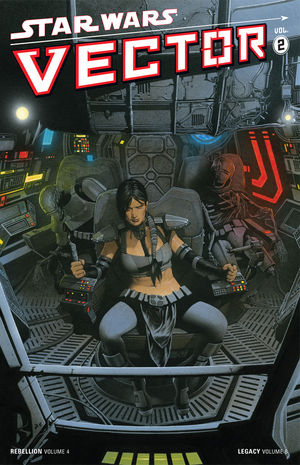
In Vector Volume 2, we get a little of the more modern bits with the 'star' of this time delayed crossover, Celeste Morne, is a jedi with a sith artifact that feeds her knowledge of the old rackghouls, entities first introduced in the video game Knights of the Old Republic (and don't quote me on that as I know there are some rabid Star Wars timeline guardians out there.)
Her apperance in the Legacy era though, allows he to meet Cade. Her impression? Close to the dark side but a desire to be left alone.
Remember that assassination mission I mentioned in my last Star Wars based post that the Jedi Council decided to pass on? She's intrigued enough by Cade's ability to heal the ravages of the ghoul plague to help out.
There's a massive battle, Celeste almost falling to her artifact, Cade taking up said artifact and destroying it, the fall of a sith lord, not at the hands of Cade, but at the hands of one of his own, and a future that well, despite the 'success' of the hero, looks bleak.
But as always, what does that mean for your game?
One, if it's a game system based on ye old Dungeons and Dragons rules, it probably has multiple settings. Don't be afraid to mix and match elements to get a better game of out of the engine. I can't be the first person to use draconians in a non-Dragonlance game, and in 4e, they're not even based in Krynn anymore.
Don't be afraid to use 'official' materials to bring said worlds together. While there are whole settings devoted to the concept such as Spelljammer and Planescape, the author Michael Moorcock never had a problem using gates and other dimensional spanning devices, like the Ship the Sales the Planes, to have his characters such as Elric and Corum meet to have truly cosmic adventures. And don't let others tell you it's not 'old school' as the Judges Guild used to have a series of four sourcebooks that also acted as adventurers that included such classic as the Portals of Torsh, Irontooth, Twilight and another whose name escapes me at the moment. Each had a meta story that tied together but the actual ties to each other where shallow.
Don't be afraid to bring in characters that might not fit the setting. While character crossovers can be terrible if done ham fisted, when done in a manner where it all meshes, everyone can enjoy it. In the short stories collection of Elric/Eternal Champion based tales, Karl Wagner does a hell of a meeting between Elric and Kane.
In overall campaign arcs, love your NPCs but don't be afraid to let them die. Celeste, despite going through several phases and timelines, doesn't get an easy off. Darth Krayt, despite his power, suffers the same fate many who rely on evil minions do, the inevitible betrayal. Let the NPCs have their storylines, let them have their moment of glory, and then, let them go into that good night.
Have fun when mixing up the pace and let the NPCs do their duty before heading off into that final sunset.
Friday, September 4, 2009
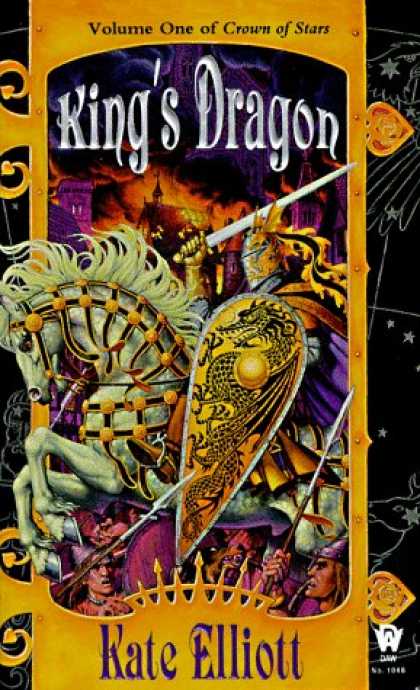
First and Lasting Impressions: King's Dragon by Kate Elliot

“A rider approached. Armed in bright mail, it guided its horse forward at a sedate walk, untroubled by the raging wind. ..The horse was beautiful, as white as untouched snow, almost blinding, and the woman- She was a woman of middle age, scarred on the face and hands, her boots muddied and scuffed, her coat of mail patched here and there with gleaming new rings of iron. Her long sword, sheathed in leather, swayed in front of him. A battered, round shield hung by her knee, tied to the saddle… Her gaze was at once distant and utterly piercing. If her eyes had color, he could not make it out. They seemed as black as a curse to him.” (p. 27 SFBC hardcover)
“Who are you?” he whispered. The sword, like death by pain, was lifted. Her reply rang out and yet was muted by the howl of the wind. “I am the Lady of Battles.” (p. 28 SFBC hardcover)
A good description goes a long way. Ask each player to not only describe themselves, but make sure they have a description written down so that they can refer to it for future reference. Do the characters dress in a certain fashion? Do they wear certain styles of cloth? Are their clothes new or old? Do they have fine silks or worn through materials? Are their weapons nicked from long use and battle or well oiled?
Having a good description for an NPC goes a long way too. Make sure that when doing so, you have the description ready if you plan on using the character again. Insure that things that are unique about the NPC are bolded so that the players can recognize these characters when meeting them in the future. When introducing them, give them a unique persona not only through what they wear and what they are, but by your own actions as a GM. Hand gestures and voice are some of the greatest tools you have at your disposal in such a case and making the same hand gestures in association with a certain NPC, will ingrain that habit into the minds of the players.
“It is necessary that we act. We must find another to consecrate at the altar. One who will not be missed.” (p. 170 SFBC hardcover).
This falls under the rule of no good deed goes unpunished. When attempting to push their own views of right and wrong on the setting, the GM has many options, especially when trying to showcase that the players cannot be everywhere and do everything at the same time. In this example, Alain has saved a savage humanoid from a gruesome death. In response, another is taken in place for sacrifice.
If the players are known defenders of one place, can they be at another? If the players champion one cause, do they directly or indirectly, oppose another and cause people who follow that cause hardship?
When trying to follow the old adage of no good deed goes unpunished, it’s not necessarily that you as the GM are trying to showcase that the world is a harsh and cruel place, but rather, that actions has consequences both intended and unintended. In some games, one of the standard methods here is the players freeing something long dormant from an ancient crypt in their running around and digging up the dead.
“But the blessed Daisan fasted and prayed for seven days! He didn’t suffer!”… “So the church taught falsely for years. So this truth was proclaimed as a heresy at the Great Council of Addai over three hundred years ago.” (p. 175 SFBC hardcover).
“Which fort?” she asked, then knew what he meant: This fort, the old Dariyan fort built by order of Arki-kai Tangashuan seven hundred years ago, reckoning by the calendars she knew. Now of course it was known as Steleshame, a small estate under the authority of the freeholder Gisela that was also an official posting stop for the King’s Eagles and thus under the king’s protection rather than that of the local count.” (P. 250 SFBC hardcover)
Depending on what campaign setting you’re using, either home brewed or store bought, the history may be so vast and grand that things players tend to take as everyday events and elements may be prone to change. One way to introduce these changes is to simply note that some time in the campaign’s past “THIS” is what had actually happened.
But then why doesn’t the campaign reflect it? Take the Forgotten Realms and it’s new incarnation for 4th edition. It incorporated many elements of the 4e default setting by taking a massive hammer to the setting and instead of allowing that unknown history to be discovered by the players, its thrust upon them. Have the characters be the ones who discover these ancient things. Have the players be the ones to discover that Lathandar is actually a different deity. Have the players discover that in prewritten history there was another land. Have the players discover these hidden facets of the setting so that they may be the new authorities and can be part of the change as opposed to just being battered about the head with it.
And as the second quote shows, sometimes the campaign will reflect it. People change. Monsters migrate. Fortress rise and fall. Things have multiple names and multiple purposes depending on who you ask and whose living there now. When dealing with something of great age, have multiple names for the old forts that stretch back into history. Have multiple names for the elves who have seen hundreds of years. Have variety when the players discover a long lost weapon that once served on the front line of battle against shadow and shade.
Subscribe to:
Posts (Atom)