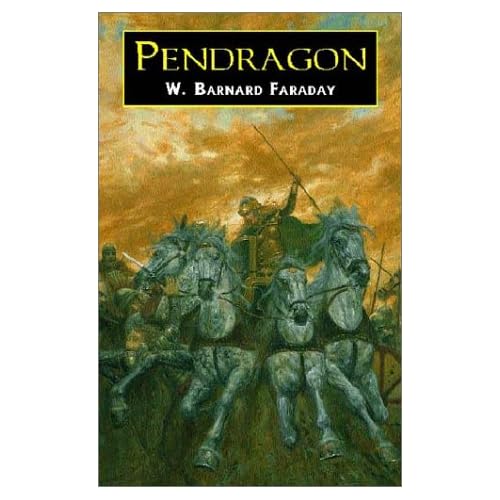
Having finished off Pendragon, I thought I would take a few moments on an actual day off, to post a few more thoughts on the book.
Even in a time when war with the Saxons and Pics if upon them, the land is not singularly united. This theme plays out in the book in several instances that would make for good role playing opportunities.
For one, Gwendaello, the actual Pendragon in this version, is not well loved. Her former leader was conspiring with the Saxons to take the lands and lords down in exchange for treasures and plunder. His plan didn't work out too well but did leave Gwen in charge of things. However, the other rulers are not pleased at this prospect and try to take away her lands and titles.
This results in a large meeting where diplomacy is at full bloom. The various lords and ladies vieing for attention and trying to determine who has the right of things. It works well in the novel, showcasing a deep amount of mistrust between the rulers as well as showing how things can quickly move from one assumed finale to another with the right placed bribes and blackmail.
3rd edition brought out a lot of rules, well, not a lot of rules, but some rules, to try and bring these role playing elements to the table top with dice rolls and for some, they work. Others, used to having to actually speak and interact with the other participants around the table, are able to talk a fantastic game. 4th edition brought this more into the game with skill challenges that allow different characters to bring different things to the game.
For example, a skill challenge here might involve some of the more obvious candidates like intimidation and diplomacy, but a GM who has players that know the setting and details of it, and have the appropriate skills like ancient history, should be allowed to persuade people through speaking of the land and its past and how those ancient lores may be effecting the here and now. Others may speak using their religion skill to detail how the gods will be angered or pleased by the path being taken here.
I can agree with this because it helps get people who might not have any will or desire to roleplaying, or worse, who have no skill at it, to still contribute to the game with a dice roll and some idea to me how they're trying to achieve their goals.
I also allow role playing 'stunting' for those who get into it. I'll allow them to make a speech and detail what they have in mind and why they think it'll work and provide a bonus to the roll. Now if there are things that the characters don't know, like their speech is hostile to the locals around them, or that they've gotten several things wrong, or if they just flub it, I'll give them a penalty. Of course, the natural 1 always rolls around as well so perhaps while they were talking, they choked on a chicken bone or something of that nature.
For those who don't enjoy such politics though, and are more action based, what about assassination? In this instance, Artorious learns of an attempt on Gwen's life. Of course he does! He's the main character of the book. This is the same deal players can expect for their characters when the DM wants the characters to be able to effect the game. While hearing about an assassination is powerful stuff because it potentially reminds everyone at the table that they are mortal, being the ones to stop such an event carries with it the promise not only of stopping a murder, but the thanks of whatever lord they saved. Finding out who did the deed and what to do about it then become further adventure seeds.
Another issue that arises when the land is in turmoil, is bandits. Artorius notes during his journey, that by travelling alone, if necessary, he can usually hide from such bandits, but a small group is easy pickings as the bandits ten to travel in groups of ten to one hundred. Seeing this in print makes me smile because I don't feel bad when I do it to the players. I'm sure the AngryGM would love having that quote above his DM Screen so that he could point out the 'semi-historical' accuracy of a hundred man bandit attack.
Despite some of the problems in these times though, people do tend to pull together and the rulers must respect those that do so. While talking about the problems with bandits, he recounts how a well liked merchant sought justice for the loss of his goods to bandits and had to pay a legal fee, that was provided by his fellow merchants who wanted to see justice done. When nothing was done and the fee not returned, social unrest sprouted up.
In Usagi Yojimbo, there is an instance where a Samurai tests his sword on a beggar, killing the man instantly. The surviving beggar, the father of the slain one, goes to his guild and they pool their funds together and hire an assassin who kills the son of the samurai.
In short, just because one person is not a problem, does not mean that one person lacks the means to become a problem, even if they themselves are never wielding a sword or casting a spell.


