While I found the Hammer didn't involve a lot of material in terms of fighting, combat, or other standards of fantasy role playing games, there is still plenty of rich material to mine.
The first thing to review, is base campaign assumptions. In this setting, Gig, the third son of the noble exiled family, has no expectations on him that are standard. If the family was not exiled, he would have been sent off to the priesthood because the eldest stands to inherit, the second is a back up so to speak, and the third... well, he's extra and even historically, they were often sent off to the church. What happens in noble families in the setting you're using? Are they given command of legions that they are no qualified for? Are they made heads of guilds through marriage? Do they form unique organizations like Pathfinders?
In that vein though, what happens with other people? Teuccer, a young lady from the mainland, fresh to the colony island, wants to be a doctor. Back on the mainland, that would never happen because it wasn't a woman's place. In her new home though, while some may consider her eccentric, they trust her abilities and treat her like the specialist she is. In some ways though, this is part of what Dungeons and Dragons has suffered a little from.
I don't want to say that the game is politically correct, but when looking at most eras of history, things are hard for the common man. Slavery is a common occurrence. Strength of law is enforced by actual strength. Women in many instances, are limited in what jobs they can take. They face real social barriers and have real hindrances.
By being so modern in its outlook, Dungeons and Dragons takes away some of that potential struggle. Now if your game is all about going into the dungeons and collecting the loot, that is appropriate. After all, you don't want to make it more difficult for one player than you do another in terms of buying equipment and getting solutions that the other players have.
But if its about role playing struggles and every one is the same and everyone has the same benefits and the same flexibility, then you might want to look at some of the old social limits. This includes something like looking at the wearing of certain colors, the use of weaponry outside of the nobility. One of the ideas that the old d20 Excaliber book mentioned as a role playing bit was that only knights could use swords. This didn't prevent other social status characters from making fighters, but they would be known by others weapons. Indeed, some weapons are distinctively peasant in nature or not meant for the higher ranking soldiers.
Another aspect of the colony life, is whose paying for it? Is there a single organization that pays for the people to move there? To pay for the people to live there? what are the obligations of the people who live there? In The Hammer, the colonist are expected to turn off a certain amount of beef in exchange for the necessary tools for living like nails, hammers, hoes, clothing and other farming tools. The isolation of the setting means that often the characters have to make due with what they have. In this book, there is 'the Company', but we don't find out too much about them in this book. Considering I'm reading another book by the same author called, 'The Company', it wouldn't surprise me if that some how all tied in together.
The Hammer is a book that is filled with characters breaking their standard background roles and fighting against the limitations imposed on them from society. It is worth reading to see how island life might cause innovation among the least likely people.
Showing posts with label The Hammer. Show all posts
Showing posts with label The Hammer. Show all posts
Tuesday, January 17, 2012


Monday, January 16, 2012
The Hammer by K. J. Parker or more blathering about 5h Editio
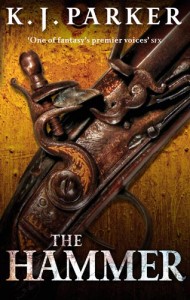
In terms of pricing, well, I bought it during one of the Borders Bookstore closings with others at something like 4 books for ten dollars so say, $2.50. Which is a shame because I see the ebook is something like $10 in and of itself. A further shame because my local Half Price has numerous books by the author, and while I'd love to directly support the author, as Cage the Elephant would say, "Ain't no rest for the wicked, money don't grow on trees' so instead of paying $9.99 for an ebook, I'll pay $3.49 for a paperback that the author gets zero of. Not what I want to do but hey, the publisher has right now four books on sale for $2.99 so they are fully aware of the pros and cons of various models of pricing.
Anyway, onto gaming thoughts.
Like The Folding Knife, I initially didn't see a lot of room where the material could be considered inspiring outside of getting the reader thinking and engaged with the book and working on the readers own thoughts and awareness.
But as I continued to read, and this might, in part, be caused by all the talk of 5th Edition of Dungeons and Dragons, I came to some interesting observations about what one might look at in terms of making the new edition more playable, that takes its pages from some of what 4th edition did.
In the Hammer, Gignomai or Gig, is a member of the met'Oc, a family of nobles in exile on an island colony. This island colony pays dues to 'The Company'.
Gig though, hates his family. They are not good people. Having been out of contact with the mainland for so long, they have grown decadent and survival is a daily struggle in the overall reach of things. The implications of such struggle are showcased through a variety of methods but...
Looking at 4th edition, there was a bit of a setting called a 'Points of Light' setting. It was supposed to be where things were dark and dangerous and could be problematic.
The problem was that actual game play didn't necessarily feel like that in the games I played or those I've heard of. This is for the most part mind you. In older editions, there were tons of random encounters and these random encounters didn't necessarily rely on the player character's level, they relied on where they were at. Only 3rd level and going to the old dwarf ruins some two weeks travel out of the city? Wandering encounter says you encounter a group of stone giants with two cave bears. Roll for imitative.
The sheer random chance of such an encounter was part of the danger inherent in the setting. On the other hand, you could encounter a group of giant rats or one cave bear by itself. There needs to be more random elements to things while providing players, in the option of the stone giants, with the opportunity to retreat if and when needed.
Another aspect of The Hammer, is that Gig is different. The whole 4e thing should have been the players were rising in a world of decay, not one that was necessarily full of decadence or evil, but one that needed new blood, new ideas and new methods to get things moving. In some instances, this might not even be new methods or new ideas, but motivation and energy. By having the players be the ones who are adding and changing the scenery, the GM is giving them far more power than giving them a slightly magical sword or dagger.
For example, in The Hammer, Gig creates a factory and with it, guns. This isn't new technology to the setting. It's not a new method. But no one has done it before because no one thought of it. No one took the time to do it. No one was interested in it. Everyone was interested in keeping things the exact way they were, fighting that inevitable decline of their ways as society collapsed slowly, ever so slowly about them.
This, the spirit of exploration, the spirit of fighting against the standard, is what D&D can be about without changing game mechanics and instead working on the settings.
But in order to do that, there would have to be some changes to the core structure of the game.
As much as I enjoy magic, and magic item shops, and schools of wizardry, to get the new feeling, to get the 'shinny' feeling, Dungeons and Dragons has to drop kick it to the curb. Oh sure, in an appendix, perhaps next to the wandering harlot one, put some notes about adding colleges of magic and magic item shops, but for the most part, in order to keep magic different and new and special, it has to be extremely limited and random.
When you provide the opportunity for players to buy anything other then the most mundane of magic items, you've destroyed magic. Now mind you, for many genres and games, this is perfectly acceptable. Magic in and of itself becomes another form of technology.
But then you need to drop the whole concept of a dark savage age where a few independent city states struggle for survival because when players can go to a magic shop and pick up an enchanted sword, if the local government isn't doing something with that magic to safeguard the people in the first place, that logic is flawed.
And magic colleges? Part of the problem with spellcastersspellbooks, and the numerous costs associated with all of that ranging from the inks used to copy the spells, to the spellbooks themselves.
On the altar of game balance, those flavor elements have been fairly neutralized but in exchange, the wizards have become nothing more than fighters that don't use a sword to attack people but rather use spells that do similar damage and have similar effects.
Limiting spell selection, limiting the ability to buy spells, limiting the number of spellcasters in the setting, these all go a long way in making magic, well, magical again.
As I think of it, limiting the scope of what the players can access, when they can access it and how the can access it, is far more of a campaign element than what rule system you're using. If plate armor is something that only the highly skilled can create, then towns and villages won't have it. If players are looking for magic items, they have to hunt down rumors of such and hope that the gods are kind to their request when they hear of haunted ruins where an ancient elf crafted drifted in madness but may, mind you may, just have something similar to what the seeker wants.
And speaking of seeking out magic items, here is another area where I think earlier editions were able to throw in a bit of fun. Magic items tended to be a little more random in their power and abilities prior to 3rd edition and this allowed paladins, who always seemed to have holy avengers, have this iconic weapon with them, despite the fact that it was such a powerful magic item and probably level inappropriate. It allowed White Plume Mountain to be stacked with items of vast and great power. It allowed rings of wishes to wind up as random treasure.
Game balance may have to take a couple of blows to the face in 5th edition if Wizards of the Coast is serious about uniting fans of all editions and that's not necessarily a bad thing.
Subscribe to:
Posts (Atom)


