Clockwork and Chivalry is a relatively young game that's already gone through an edition change. A very good one in this case as the new edition actually brings all the rules together in one spot as opposed to relying on say, Mongoose Runequest which you know, is now Legend and blah blah blah.
I was pretty familiar with the BRP system (Basic Role Playing) that is the core of C and C so didn't have too worry too much about messing around with the character sheets. I even copied out all the spells that the characters in the setting can use ahead of time so that they weren't flipping back and forth a lot.
The adventure for the con was the Dragon of Naseby which ties directly into the setting. The pregenerated characters had a lot of versatility to them not necessarily in their abilities, but in their motivations and goals. It was a little bit of a cheat in that one of the characters was 'very experienced' and the rest were above the starting goal. Still, the point is to have a good time right?
The characters come from both of the main factions in the game. The overall theme of hunt the dragon that's burning the towns to ash made for a good super hero moment where the two teams must put aside their mutual hatred in order to overcome the greater foe.
My first game went pretty smooth save for one thing. The party avoided almost every fight until they got to the dragon. When they did get to the dragon, they managed to use a familiar and some spells to spot out a weak point in the dragon's armor. They also noticed the dragon's egg. Threatening the dragon's egg is one of the few ways that the dragon will 'stay' and not take off. Well, the party rolled fantastic in terms of damage on their 'critial shot' and the most experienced character used his elemental to drop freezing potions on the dragon with assistance from his loyal ally. Suffice it to say that the dragon was quickly knocked out and about.
The group in this instance was a little pacified in not going that extra mile to try and achieve the goals of the characters.
In the second game, it ran all the way till the end as the players role played out the conflicts of the characters more. This group included Ed, Hanse, Gary, and Mikhal, three of which made it to another game of mine. Unlike group one, I won't say they reviled in getting into the conflicts, but they didn't shy away from them. The dragon also got punked in this encounter, but that happened by ramming, some excellent damage dice, and some great rolls to control their tank in order to get some more cannonfire against the dragon.
In this session, the characters DID follow their backgrounds and it was almost a civil war not only as the two factions broke down to try and claim glory after the ending, but also as each member of that faction tried to fulfill their specific goals. It was fun to see from my side although as it ended in a stalemate, mostly due to time than anything else, I'm not quite sure what the players were thinking at the end of it all.
I was glad to have run Clockwork and Chivalry. It's a pretty tried and tested game system and I'm sure if the players had a better feel for how powerful their characters were in terms of the game and in terms of each other things might have been even MORE interesting.
For someone looking to run BRP in an alternative history setting where the English are in a civil war, I'd recommend this game. The add ons aren't obtrusive enough to make you not recognize the game system and they can be fun when pitting the characters against different factions and cults that seek to steal their 'zeal' and convert them to the cause.
Thursday, August 23, 2012


Wednesday, August 22, 2012
Games I Ran At GenCon Two: Yggdrasill
Brand new for the convention, Yggdrasill was run twice by me. Well, I should say so brand new that it wasn't actually at the first day of the convention when I ran it.
I'm not going to blather about Yggdrasill too much but since it's a new game will mention a few things. It's a d10 based game that uses a target number. Characters roll a number of dice equal to their stat plus the appropriate skill. Characters get multiple actions per round. Characters have a lot of options going for them at character creation including runes, gifts, weakness, furor, skills, combat feats, magic, and equipment. Some of these options are negative and not all options provide the same benefits even in the same category. Some of them are 'story' or background options.
In terms of layout, typical two column format with some fantastic sepia tinged pages and a few full color art pieces, like for the characters. A very decent looking book.
I didn't feel I did enough work on this one to start with. The game does an excellent job of providing background details and a wide variety of information that would be useful for any game system that was looking to bring some Norse action and excitement to their table. In some ways it reminds me of the best of the older games in that vein where there was enough sourcebook to make it valuable even if you didn't play the actual game engine.
In terms of not feeling I did enough, I'm thinking about the character sheets. The character sheets we were given were straight out of the book. In those terms, they don't include stuff that a con gamer should actually have like weapon damage, what feats do, or what spells do. For another game I ran, I knew enough that I copied those bits out and attached them to the character sheets. Not having run the system before I wasn't quite sure what I should copy.
Ugh. Suffice it to say ugh.
Still, the players caught on to the core system of having to hit a target number even though there are a lot of combat options to choke a cat!
The other problem was the adventure. It wasn't a bad adventure by any stretch of the imagination but it wasn't a con adventure. For me, a con adventure should have a pretty clear goal and a pretty clear way to get to it. This one is almost like a campaign start up where the characters have several areas to investigate and is based off the second act of the adventure as opposed to the first part.
In terms of gameplay, let me say the berserkers are going to be stealing a lot of the limelight until they wipe out the party.
My first game I didn't have the physical book in hand because it had no come out yet but did have the PDF on my Toshiba Thrive Tablet. The party did manage to complete the adventure at the four hour mark and things were good.
My second game was a bit strange. The group showed up an hour early and I had to wait until ten minutes after start time to make sure there were no generics or no ticket event holders that were going to show up. Three of the players, Ed, Hanse, and Gary, were in another game I ran the previous night. I had a 'feel' for how they might approach the game. Eloise was a French Canadian who loved the original French version of the book and was looking forward to it. We have another two players... Ed and Ian I want to say but don't hold me to it.
They did a pretty bang up job on most of the stuff but were a little annoyed at the rules. Because they got there so early they were able to get a fair reading in and noticed some potential 'transalation' errors. I wasn't going to go into it in terms of what might or might not be as I'm not the writer or anything and found some that may be similar to the errors they found. This things happen eh?
Anyway, because of the open nature of the scenario, they didn't even make it outside the city but still managed to meet some of the scenario's objectives. Having an open ended session like that allows for 'victory' under a lot of different circumstances.
Its always interesting to run a game multiple times and see how different people approach the exact same material. If you get the chance to run a Con adventure, try it out and see how those strangers play compared to your close knit group.
Tuesday, August 21, 2012
Gen Con: Games I Ran One: Doctor Who
My experience with this year's Doctor Who was interesting.
I don't own the rulebook in a dead tree format. I ran games last year from my tablet. Silly me though took those PDFs off my tablet so I picked up the dead tree version from Cubicle 7 to run it.
Had a blast. I was fortunate enough to have Kurt from GameGeeks pick up and play the Doctor himself and while I don't want to say that his performance encouraged other players to pick up the slack or anything like that, they certainly feed into the game in an organic matter that seemed to me that it would've fit the show perfectly.
The actual organization of the game was a bit wacky though. See, a few of the actual ticket holders were late, but not so late that I couldn't take their tickets, so some waiting to use their generics, couldn't play. And that was after I handed out an extra character that was 'gender neutral' and so had a male and female version, which I just decided were husband and wife. The bad thing though, is that during the game, two of the people had to leave so I could've taken the other individual with the generic tickets. Ah well, outside my control.
Anyway, the game involved some characters coming from a modern time to the 'Victoriana' age so to speak where a certain reptile woman lurks with a few other standbys. The introduction to get all the players together was fairly quick and no one seemed to mind as it was a good flow to get all the characters from different times together without having to actually have everyone start off in the Tardis at once.
The players managed to avoid most combats by use of quick wits and fast talking, as well as some excellent reminders from Kurt that the Doctor is not one to be trifled with.
With I say everyone had a good time, I'm speaking from my own observation. I can't tell you what people were thinking or actually feeling, but the involvement level of almost all the players was pretty high even when they were playing a father desperately worried about his son.
In terms of the game itself, most people seemed very impressed with the new edition. I'm not certain how much has changed between editions because I don't actually play or run enough Doctor Who to break it down, but apparently there is some PDF with the main changes on it. Everyone was impressed with how nice the book looked, the free dice, the billions of story points, the nice cards, the numerous pregenerated characters and most importantly, how sturdy the box was. Apparently the old box wasn't anywhere near as sturdy so people had some gruff concerns about that, but Cubicle 7 took care of that issue by attacking the root cause of the problem.
Sunday, August 12, 2012
August Kickstarter Notes
Well, it's August and I can tick down the Kickstarters again or go with what my gut is telling me.
RPGs and Kickstarters are not a good combination. When the game companies themselves can't make their release dates for various reasons, for Joe and Jack Smoo to boldly seize the Kickstarter model and put a date on that there has NOTHING to do with reality, well, it's time for me to realize that as much as I'd love to support the hobby directly and as much as I admire some of the people involved with the games coming out and as much as I'll miss some really cool stuff, it's just not my thing on the RPG side.
I can tick off three that are months late and the people running it have already said, "Uh yeah, it's going to be done when it's done." So business as usual. Why would an individual running stuff have a better track record then a company that usually missed it's deadlines? Or any gaming company that missed them? Ah well. Hopefully the whole thing doesn't turn into another 'Razor Coast' fiasco because some of these individuals are decent people and I'd hate to see them ruin their online reputations. If people start asking for refunds, that will be the real test.
So I'm pretty much done with RPG kickstarters. A little annoying really and maybe when the RPGs I've backed finally do come through maybe I'll be like, "Oh wow, that was so awesome having to wait months and months and months for it that I'll support your project in the future."
But probably not.
But for whatever reason, I'm still doing the miniatures:
http://www.indiegogo.com/drakskullsmenace Picture a Games Workshop Vampires Count Army. Now picture it with Games Workshop Orcs but still for Vampire Counts. Some pretty cool stuff coming out here.
http://www.indiegogo.com/pirate-goblins Pirate goblins? Pretty good prices? Yeah, down with that.
http://www.kickstarter.com/projects/1513061270/reaper-miniatures-bones-an-evolution-of-gaming-min?ref=live People want to see Reaper Miniatures come out with more Bones, their inexpensive plastic variants of their miniatures. This Kickstarter is going to be friggin' huge.
http://www.kickstarter.com/projects/1103158358/red-box-games-helsvakt-horde?ref=history Tre Manor is a Reaper sculptor who has his own line of goods. He's switching over to a new material.
Historical note here: I thought that as soon as Games Workshop went to 'Finecast' that it was over for metal. I posted on RPG.net about it. The price is too much in flux and almost always going on way. Looks like I'm pretty much right on the money. It'll be interesting to see what happens as this trend can only continue.
Wednesday, August 1, 2012
The Old Ways by David Dalglish

It's another solid book and plays well into the previous series and even brings back the baddies from the first book.
Now onto spoilers.
1. Watch the Magic. The 'evil' priest here manages a sacrifice and is rewarded with VAST friggin' power. Too much power for the amount of sacrifice in my opinion. The reason why I say watch the magic is that if you make it too easy to get power, then the players are going to want to know why when they do the same thing it doesn't work. The other problem is that it cheapens the methods used if you're just going to have the heroes block everything the baddies have. What good was all that power eh? You just got Punk'd.
2. The God's Will Is Not Your Will. David hit this a little last book but it hits again this book. When the gods are real in the setting, thinking your method of worshipping the god, of what the god wants, may get smacked upside the head when you see something that doesn't jib with your morale or perhaps even your entire foundation of the religion. If you didn't get that right, is anything about your religion right?
3. Gods Have Servants. On the cover of the Old Ways, we see some servants of the evil god of order here. They're like fiendish lions made of obsidian with lava for blood.
4. The Supernatural Has Limits. There is a wraith introduced here as well as the demonic loins. None of them can cross water. It makes a nice change of pace from seeing the can do this and that and and and and... Putting some limits on monsters allows you to have some perhaps more powerful monsters but creatures that have limits.
An affordable fantasy series that should provide some inspiration for those who run paladins or have them in their campaigns, the Old Ways brings a lot of threads together even as it expands the setting.
Saturday, July 21, 2012
Clash of Faiths by David Dalglish
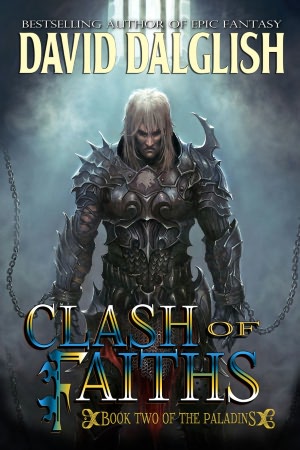
The book continues the focus on high action stakes but raises the background focus a little this time. Instead of just being on a small town, we have a locality, 'The North', where it's a wild and lawless land where a good king has passed on his inheritance and an evil king, his younger brother, is abusing his rank and privilege.
Overall its a satisfying book with enough action to keep fantasy readers happy and its also fairly low magic. The big magic that does occur tends to happen from one 'GMNPC' so to speak and its usually not flashy and not in the heroes favor when its in play.
Below I'll be going into some spoilers so reader beware!
1. Faith is Not Its Own Reward. One of the interesting things here is that David Dalglish plays with the idea of how faith is rewarded and how its interpreted. Imagine your whole life spent believing your faith was pushing you one way but you went another and hey, since the gods are real in this setting, you quickly discovered your error. In D&D, the Dungeon Master has a lot of power over how he lets the players that have divine ties act. The gods can quickly take away their power. A paladin without his spells isn't too but one that loses all his abilities and has a holy sword that he can't use anymore? Yeah, he's going to have problems.
2. Build Slowly But Surely. As mentioned above, the focus of the setting moves up a little. This is again reminiscent of older D&D games where the characters start small and by the end may be travelling the planes and fighting lost gods and dragons of epic renown. Theres no need to add all of those things unless the game requires it at that second.
3. Religious Orders and Royal Knights. While note the focus of this book, the fact that the paladins are accorded a bit of respect and leeway in how they handle things is an interesting bit to note as it showcases how they may be interacting with the laws and lay of the land.
4.And Then An Attack Happens. When things are moving too slow, throw some competition or some enemy fire into the game. Nothing gets players to stop playing with their toys like having to actually roll the dice and pay attention to the game.
After having read the second book, I suspect I'll be looking at the other books by this other very shortly.
Thursday, July 19, 2012
Night of Wolves by David Dalgish

Night of Wolves is the first book I've read by David Dalgish and it was good enough that I went back to Amazon and bought the other two books in the series. The second one is an easy sell as its only .99 cents while the third book soars in price to $2.99. Still, three books for under four bucks? Good deal.
The person who is going to like this book is one who likes a small cast that is always engaged in action. This isn't to say there isn't any character development or that the world isn't larger than what we see in the novel. However the focus is on action and on survival of man versus monster and of course some of that man versus man bits there. Its a relatively short novel and moves at a good clip and is a good way to see if you'd be interested in further books by David Dalgish.
Below I'll start hitting some of the spoilers of the book so if you don't like those, read no further!
1. Starting Small. One of the things that many early D&D adventurers have in common is that its up to the characters to save the small town or to explore the small town. Here that remains true as well. Events move up a little in the chain of importance but for the main characters in this book, saving the town and surviving the uprising of the wolves is the primary goal.
2. Paladins are more than just warriors. Several times during the novel the paladins provide encouragement and prayer to those under their care. They are there for more than just being knights and valiant warriors.
3. Players and their Orders: There are two paladins in the book, a 'light' one and a 'black' one. The former is more like the healing and beneficial style cleric we all know and love while the later is heavily militant based and focused on bringing order to the world. The two in this novel get along well to the point where when ordered to attack the 'white' paladin, the black one does not. This should be a model for player characters. While it can be fun to have betrayal and other backstabbing elements in the game, its often better to keep the player characters together and have the NPCs doing the dirty work. It's okay if the PCs are mad at the GM and not quite so good when they are against each other.
4. Paladins are fun. Dragon magazine once had an article along the lines of a plethora of paladins. Paladins often have unique mounts ranging from their horse to nightmares to pegasi to other beasts. Paladins often, regardless of their level, have unique weapons and armor suited for their mission. In older editions of the game, due to their high stat requirements, paladins were often some of the most powerful characters in the game. When looking at the role of paladins in your own game, do they follow the Deeds of Paksenarrion? Are they well known? Do they have organizations? Do they war with one another along the lines of their gods?
5. Enemy with a Cause. While no one wants the wolf men of the novel to win, David does a good job of providing some rationale as to why they are acting the way they do. Why they are such fierce creatures. When looking at the main foe of your campaign, pepper them up a little so that they are more than just statistics for the players to burn through.
Night of Wolves is well worth a read at its price point and its page turning action should encourage some great werewolf battles in your campaign.
Subscribe to:
Posts (Atom)


