All too often you can hear critics of the younger people. It's become such a standard accusation, there's a meme for it. Telling them to "Get off my lawn."
Depending on which side of the fence you're on, you'll probably thrill to movies like Grand Torino where a grizzled war veteran played by Clint Eastwood has to teach these young pups a lesson. This is similar to another Clint Eastwood movie, the western Unforgiven, where what appears to be a docile old man is in reality, the fiercest killer of them all.
If you're on the other side of the fence, you may see the youth of fiction such as Harry Potter and his 'wild ways' being a specific type of hero to handle specific foes. That the world weighs on his young shoulders but he is able to bear that burden responsibly.
Traditionally, America is a youth oriented consumer driven culture. In most older tales, the 'heroic journey' starts with a youth who has to learn and be doing so, learn and become wiser.
As America continues to gray, that focus is starting to shift. While such actors as Clint, and other aging power houses, continue to showcase that there is an audience for movies like the Expendables, Red, and others, its started to hit other venues like fiction.
Take for example, Druss the Legend. David Gemmell, long before it was cool, used both young foolish heroes, and battle hardened vets in his tales. He even took Druss, whose first appearance is a grizzled aged warrior, and went to the well many times with him.
Other authors like Joe Abercrombie, have taken a page from fantasy and westerns and crafted new stories like Red Country.
I've rambled between youth and old age. I've even pointed out several instances in which the older, wiser, more world weary character is called on to save the world.
But the future belongs to the youth. After all, sooner or later the old people will be dead no?
For those who are starting to gray like me, what's the youth of your region like? Are we looking at an upcoming golden age or are we going to have to rely on old war horses coming out of retirement to save us one last time?
Tuesday, April 28, 2015


X is For X-23

X-23: Target X was another book featured by both Amazon and Google Play recently as part of their 'girl power' sale on superheroes.
X-23 is a clone of the Marvel Comics mutant hero Wolverine. At this point, with numerous solo movies and being a part of a team, X-Men, with multiple movies, I'm not going to go into who Wolverine is. X-23 retains three claws, but only two of them per hand, and that third claw is in the foot. This gives her a bit of a surprise factor when fighting people used to battling Wolverine.
X-23 shares similarities to Firestar and Harley Quinn in that she was initially a character that appeared in cartons before her appearance in the comics. Since her initial appearance, X-23 has been in many solo series, team books, and limited series.
One of the strengths of Target X, is it puts X-23 firmly into the Marvel Universe. In her initial training, X-23 was trained to go into berserk rampages when hit with a 'trigger' scent. This is an odd 'weakness' but it has come into play several times.
But its important to note, some characters have a 'trigger' weakness that has nothing to do with going into a killing frenzy.

Here Captain America has come across a 'survivor' of a massacre. Too late as Cap puts her into an ambulance, does he realize that this 'survivor' is none other than the killer. Cap's desire to help has costs other people their lives even though he himself did not take them. Cap's need, his demand for acting the hero, was triggered.
X-23 also has her own nemesis here. the strange thing about the nemesis, is that in almost every encounter, even when X-23 gets the upper hand, this nemesis trounces X-23. So here's my question. Why make it a 'huge' deal to make clones of Wolverine when you can make an individual so powerful that they can trounce that clone?

That lady pounding on a young X-23 there? That's Kimura. She's indestructible. It's almost like one of those old poems where neither blade nor bullet nor whatever else you got punk is going to do anything to her. Kimura is also malicious and takes great joy in bringing pain to others, especially X-23.

X-23 grows in the volume in that her previous training and abilities as an assassin do come into play, but are also countered by her efforts at normalcy. Her time in high school gets her sent to the principal's office on numerous occasions as she has an almost Data or Spock like logic in answering questions posed to her, and with her wide body of knowledge, accumulated for the purpose of murdering people, her answers tend to fall on the rather shocking side.
For me, the volume was a hit on several areas. The art was good. The story was well paced. It took a former loner character and firmly put her into the Marvel Universe without overwhelming her with it. That is often a problem with a comic has a firm direction, like the original Runaways or Young Avengers, and it's so mashed into the greater setting, that the characters are overwhelmed.
The writers captured not only the things that make Captain America tick, but also Daredevil and Wolverine providing X-23 a great set of characters to compare and contrast to.
In the end, we're left with an X-23 whose on her own and has allies and perhaps even friends.
For myself, while I'm not a huge collector of comics, I've enjoyed her appearances in Avengers Arena as well as her stint in X-Force. The former a direct homage to Battle Royal and the later a tribute to the old New Mutants comic that evolved into X-Force, now come full circle to a hidden branch of the X-Men specializing in assassination.
Are there any particular story arcs others would recommend featuring X-23? Any particular dogs to avoid?
Monday, April 27, 2015
W is for Women Warlords
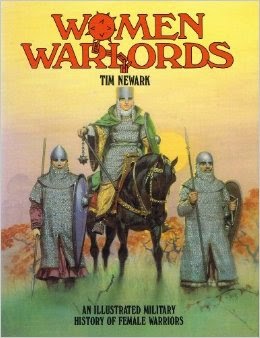
I don't remember where or when I picked up Women Warlord by Tim Newark. It's another case of a subject, women who don't follow the standards, that I said, "I'll read that sooner of later." The cover is of Matilda, the Countess of Tuscany with her warriors and is painted by Angus McBride. The book is published by Blandford, but the size, 144 black and white pages, and style, photos of ancient weapons, armor, and art, remind me of Osprey Publishing.
Written by Tim Newark, the book is broken into the following chapters:
The True Amazons:
When talking about the Amazons that the Greeks battled, Tim makes a case for them being an actual historical group.Sometimes these 'Amazons' are attributed a different name. For example, "There is a Scythian race,' wrote Hippocrates, 'dwelling around Lake Maeotis [the Sea of Azov] which differs from other races. Their name is Sauromate [Greek for Sarmatians]. Their women ride, shoot, and throw javelins when mounted. They remain virgins until they have killed three of their enemies and only then may they marry once they have performed the traditional sacred rites." (pg 12)
As I read a variety of material, I look at the supposed meeting between Thalestris, Queen of the Amazons and Alexander the Great. The two supposedly lay together for 13 days after which she left. Her sole purpose? To get a child of Alexander. I can see either a super hero comic or a modern thriller where the descendants of those two strive to live up to that legacy. Perhaps without knowing it, good old Doc Savage could be one of their children.
Amazons of the Jungle:
Brazil and Dahomey. When searching for the lost city of gold El Dorado, beware the amazons lead by Conori. The 'problem' is that even thought this is happening around 1545, confirmation is still not easy to come by. First, it's across the ocean. The failures of the Spanish initially might have needed a little... 'boost' to explain that it was not normal failure and that victory was just around the corner.Now that takes care of Brazil. In West Africa? Warrior women were not unknown. "A further four (women) stood behind him, carrying flintlock muskets on their shoulders. They were naked from the waist upwards, wearing gold rings around their arms and beads around their neck and in their hair. They were members of the king's elite bodyguard, composed completely of women. And this is during the 1850 era of slave trade.
There's some interesting quotes here. One of them reminds me of how mercenaries treat war. "War is our great friend,' said one. 'Without is there is no cloth, no armlets. Let us to war, conquer or die.' (pg 44)
The author of Imaro, Charles Saunders, had done enough research in his creation of Imaro to have enough material to create Dossouye, a warrior woman based off of West Africa body guards of kings, similar to the above.
Historically, it appears that ehre were four kinds of warriors as follows:
The Agbaraya or blunderbuseers: Veterans of the army and called into action only when urgently needed. The biggest and strongest warriors of the force, each accompanied by an attendant carrying ammunition.
The Gbeto, or elephant huntresses: The bravest warriors that carried out dangerous hunting expeditions and bore feocious scars of close encounters with wounded elephants.
The Nyekplehhentoh, or razor women. They carried a hinged sword about 18 inches long that shut into its scabbard like a razor. The blade was used for decapitation.
The Gulonentoh or musketeers, the majority of the armed warriors. (pg. 48)
Braver Than Her Husband:
Artemisia and Zenobia.
Artemisia, Queen of Halicarnassus, goes back in time. From the time of the West African Amazons, the author takes us to the time of Xerxes in 480 B. C. Those who've been to the movies might recognize the name Xerxes as he's the villain in Frank Miller's novel and movie, 300. Turns out Artemisia was a skilled strategist who might have turned a few of the failures of Xerxes to victory had he but listened to her.
Zenobia was wife and advisor to Odaenathus, ruler of Palmyra. Here we have a scenario that sounds like it played out of George R. R. Martin's Game of Thrones. Zenobia and her husband did much together. She was well respected. She was known to the soldiers. She was 'reputed' to be a descendant of Cleopatra.
But her husband was going to leave the kingdom to his son Herodes, and this son was from a previous marriage and well, wasn't too useful. Listed as worthless and spoilt.
So apparently Zenobia has Maeonius, the ruler's cousin, kill him. The cousin is in turn killed by Zenobia's soldiers. Herodes disappears after his father's death.
Zenobia rules as regent for her son, Vaballathus. She was not a modest regent either. She took a troop of some odd 70,000 soldiers into Egypt and defeated the Roman-Egyptian forces there. Mind you, those forces had their own problems with Goth Pirates from the Black Sea. Timing is everything eh?
Unfortunately for Zenobia, Rome came under new leadership, Aurelian, Roman Emperor between 270 and 275. And to all things that rise, they must fall. Despite some daring stopping maneuvers, Aurelian won the conflict.
Celtic Queens:
Medb, Cartimandua, and Boudica are included here. While I'm familiar with Medb and Boudica, I'm no scholar on either of them and it's good to see information on all three in one spot.
The author starts off with a brief telling of The Tain Bo Cuailnge. Medb having a confrontation with her husband about who was better off before they married the other. The husband has a slight advantage that Medb seeks to immediately redress by in her way the warrior known as Cuchulainn. She soon learns why they call him 'the Warped One' as when she seeks to trap him, he turns into a super human mass of muscle and power and tears through those setting the trap like tissue.
Lots of people turn up dying in this instance for one bull. Hundreds if not thousands. Heroes inflicting mass carnage and spilling gore of hundreds upon the land.
Cartimandua lives in the first century AD. She was the leader of the Brigantes, a confederation of tribes and was made richer by Roman governor Plautius who made her a client ruler.
Unfortunately, a falling out with her husband Venutius, winds up with Venutius leading Celts against Cartimandua who tries to rely on the strength of Rome to hold her position.
This indirectly leads to the rise of Boudica a few years later. When Boudica protest her treatment at Roman hands, she is whipped and her two royal daughters cornered and raped by Roman soldiers.
In exchange, Boudica gathered forces, spoken encouragement, waited while the Romans fought against the strength of the Druids in north Wales, and when the time was right, burned the colonial settlement at Colchester to the ground including all the men, women, and children.
When the legion IX Hispana was sent to bring order, only their leader, Petillius Cerealis and a few cavalry escape with their life.
Boudica continues her vengeance with some reports of deaths of Romans rising as high as 70,000.
It took several legions and one mass battle to decide the fate of Boudica and history at this time casts Rome as the winner. That 70,000 number of Romans supposedly killed is matched in horrific manner as "no less than 80,000 Britons died".
Women of Christ:
Included here are Aethelflaed, Matilda of Tuscany, and Eleanor of Aquitaine.
Aethelflaed of Mercia is well known to me not necessarily because of any actual effort I've put into reading history. Rather the writer Bernard Cornwell's Saxon Tales gave the eldest daughter of Alfred the Great quite a starting role in several of the books.
Aethelflaed, after her husband's death, works with her younger brother, Edward, to make England more united than it had been previously, and in so doing, make it a stronger England able to withstand the Viking invasions.
She was a political creature at heart. She didn't name herself queen, but rather, Myrcna hlaefdige (Lady of the Mercians). An official title that doesn't put her at odds with her brother, King Edward.
Despite the threat of the vikings, the people of Mercia were under attack from numerous forces including Irish, Norwegian, and Welsh. Aethelflaed responded by building more burhs and fortifications and sending armies against those who would do her people harm.
Matilda, Countess of Tuscany, doesn't have the same historical problem that Aethelflaed did. For the Lady of Mercia, her brother had to be seen as the guiding power, the crafty hand, the sole mover of events.
Matilda did not have the issue. Rather as the sole remaining child of Boniface of Canossa, who was assassinated in 1052 through the plotting of Emperor Henry III, Matilda was trained to excel.
She did so through not only courtly learning, but that of arms.
And while Matilda had no love for the German emperors, she did however, have loyalty to the papcy of Rome.
Her own private life was not easy. Married to Godfrey the Hunchback, she suffered the loss of a child who died in infancy. She separated from her husband who'd been rumored to attempt an assassination on the Pope. In 1076, Godfrey was murdered.
At this point, Matilda's loyalty to the pope is tested as Henry IV sought to depose of the pope, rising an 'antipope'. But the threat of excommunication gave Henry IV pause not necessarily because of what he thought, but of how his enemies could use that event against him. Matilda allowed the Pope to stay at the castle of Canossa and humbled the German emperor but it was a temporary humbling at best as in three short years, Henry IV elected an antipope.
Henry's initial forays worked well and Matilda suffers greatly during this period. The only thing preventing a total victory by Henry is the weather as the summer forces the soldiers to retreat north to Tuscany.
The pope secures the assistance of Robert Guiscard and his Norman warriors. Claiming other business, Henry retreats to the north.
Not one to waste such an event, Matilda uses the confusion to lead a small force of soldiers including horsemen and foot-soldiers and using a classic night ambush, dispatches several of her foes.
When times passes and Henry lays siege to her again, she proves a worthy warrior and leads her elite men out of a secret entrance of her castle and using a dense fog as cover, panics the forces of Henry who retreat rapidly.
Closing out this section, Eleanor of Aquitaine inherited a vast estate in 1137 at the age of 15 upon the death of her father. Due to this amount of wealth she controlled, the Capetian dynasty made her the Queen of France. As she grew older, she grew more involved with the politics of day to day. She traveled with Louis when in 1146 he 'took the cross', travelling the Holy Land.
Things didn't go well for Louis. Eleanor perhaps not taking the trip seriously, dressed in armor and carried weapons, as did her maids. Eleanor's favorite vassal, Geoffrey of Rancon, moved too far out of the other warriors and Turks ambushed them killing many. Geoffrey was held accountable and sent back to France.
Worse for Louis when in Antioch they meet Raymond, the prince of the city and Eleanor's uncle. Supposedly the two had something greater than he being her uncle between them. Conflict between Louis and her spread from that point until their marriage was annulled in 1152.
But she would be alone only a short time. So vast her wealth, she quickly took another husband, Henry Plantagenet, who might be more familiar as Henry II King of England.
But that relationship also went sour. She have five sons and three daughters by Henry. Richard I and John, the last born, would also become Kings of England. With some suspicion of her being the 'ringleader' of a rebellion against him, Henry brought Eleanor home and had her imprisoned for some odd 15 years and it wasn't till his death that she was freed.
She didn't let age slow her down though and remained very active, including gathering the random for Richard I release from the Duke of Austria as well as supporting John when he became king.
Hundred Years War Women:
While I'm reading for the new information, such as Jeanne of Montfort and Christine de Pisan, I did know Joan of Arc.
Jeanne is literally a leader. When he town is under siege, she dons armor, rides through the streets, encourages the people to fight. To take stones from the buildings and throw them at the enemy.
She leads a group of 300 horseman into the enemy's deserted encampment and sets it aflame.
When she escapes the French, she returns with reinforcements!
Because of her efforts, her town holds out long enough for the English army sent by King Edward to arrive.
That wasn't the only bit of action Jeanne had. She later wound up assembling 1,000 men-at-arms and 8,000 foot-soldiers to La Roche Derrien to fight against the encroaching French.
Further on timewise, Christine de Pisan was a writer who wrote Treasure of the City of Ladies in 1405. Her writings are a call to arms or rights if you will, for those women to take what is rightfully theirs and to seek "to protect her rights boldly by law and reason'. Another book mentioned here is Feats of Arms and Chivalry and compiles material from ancient military authors as well as modern ones.
Christine de Pisan died around 1429 and right before then, around 1428, Joan of Arc at the age of 16, is instructed to help the King of France. In 1431, after a brief and brilliant time as a symbol of France, Joan is burnt at the stake.
Because its covering such a wide swath of history, if you wanted more details on any of the subjects and individuals brought up, further research is recommended. Thankfully Tim includes a great bibliography and there are many new resources these days as well as more information comes to light and research becomes easier and more expanded.
Sunday, April 26, 2015
V is For Viking
I've long collected the various series by Osprey Military that include the Warriors Series and the Men-At-Arm series. With the +HISTORY channel just finishing airing Vikings Season Three, I decided to delve into my Warrior Series Volume 3, Viking Hersir 793-1066 AD: Weapons>Armor.Tactics. Note the cover below is not the current cover, but is is the one I have.

Vikings are a popular. Part of this is the warrior heritage. They are individual who 'do' things. It's easier to involve characters into stories when they are active in that story.
They are also not restricted to their own time. Marvel Comics for some odd forty years has been getting good mileage out of reimagining the adventures of Thor, one of the gods of the Vikings. This has included numerous versions of Thor in both the past and far future, as well as individuals with the power of Thor, thanks to an enchantment placed on Thor's hammer.
Even DC, which has mainly stayed with the Olympian Pantheon via Wonder Woman, has gotten mileage out of names such as Wotan, a mystical super villain who battled Dr. Fate.
In terms of writing, there are numerous tales of the Vikings which come to us, often hundreds of years after the events take place such as the saga of Vinland that I recently blogged about.
But for more modern audiences, writers like Bernard Cornwell are getting their milage out of the era. Bernard currently has eight books in his Saxon Tales, the latest being the Empty Throne, a first person narration and while I'm behind one book in the series, it's another look at the vikings that I've enjoyed.
The viking presence is also felt in role playing games. While I don't have the specific issue of Dragon Magazine in front of me, Dungeons and Dragons has taken it's own look at some of the berserkers from Viking lore.
Later on, during the 2nd edition era of Advanced Dungeons and Dragons, TSR started doing 'historical' books. The first one they did was HR 1 Vikings Campaign Sourcebook. This was a green faux leather cover book and while no longer available in print, DriveThruRPG is selling it in PDF format for $9.99.
This doesn't count other companies like I.C.E. who had their own historical line that brought different eras to Rolemaster. Their own book Vikings was another look at how to implement the mundane and fantastic mythological elements into MERP and Rolemaster. Makes perfect sense since at the time, I.C.E. was also doing Middle Earth Roleplaying, the aftermentioned MERP, and there are quite a few nods to the Norsemen in Middle Earth.
In short, Vikings were, and still are, a popular subject, especially to write about.
Part of this is their mythology. They have a full cycle. They know what is supposed to happen at the end of the world. They know that if they fight and die, they will go to join the king of the gods Odin.
Part of it is the unique elements they possess. For example, naming weapons and armor. Good weapons and armor will go down in history. Those who do legendary deeds, will do the same.
One thing that Viking Hersir pointed out that I did not know before, was that with the fragility of weapons versus time, especially over an era covering almost three hundred years, that if a sword broke, but it was a good quality sword, it would be reforged into a spearhead. The good metal too important to let sit rusting somewhere.
Other bits that Viking Hersir point out, that perhaps should be obvious, are that that scabbards do not survive. They often becomes melded through time into the weapons themselves. In fantasy campaigns, having a shealth that survived the tides of time would be a sure indicator that there was something not normal about sword and scabbard.
I admit one of the reasons I like the Warrior Series by Osprey, is the art. This volume is no exception. Gerry Embleton. He's a fantastic artist whose work can be found here. Gerry brings us twelve different full color plates.
As someone who also paints miniatures, one of the things I enjoyed was a full page of shields. While there are several 'normal' shields, there are also several patterned shields. While some cultures may have very elaborate and impossible to design by hand shields in 28mm, that's not true of the Vikings who often had one to three bright colors and simple designs.
Outside of Gerry's art, there are numerous photographs of actual items from the era ranging from swords and axe heads to helmets and scans of ancient art that has survived into the modern era. Makes for a great immersion even though the book is relatively short.
If you're a fan of the Vikings show and want to dip your toe into something that's going to provide a little more information and is written easily enough to follow with a ton of material referenced at the end, Viking Hersir is perfect.
Vikings are a popular. Part of this is the warrior heritage. They are individual who 'do' things. It's easier to involve characters into stories when they are active in that story.
They are also not restricted to their own time. Marvel Comics for some odd forty years has been getting good mileage out of reimagining the adventures of Thor, one of the gods of the Vikings. This has included numerous versions of Thor in both the past and far future, as well as individuals with the power of Thor, thanks to an enchantment placed on Thor's hammer.
Even DC, which has mainly stayed with the Olympian Pantheon via Wonder Woman, has gotten mileage out of names such as Wotan, a mystical super villain who battled Dr. Fate.
In terms of writing, there are numerous tales of the Vikings which come to us, often hundreds of years after the events take place such as the saga of Vinland that I recently blogged about.
But for more modern audiences, writers like Bernard Cornwell are getting their milage out of the era. Bernard currently has eight books in his Saxon Tales, the latest being the Empty Throne, a first person narration and while I'm behind one book in the series, it's another look at the vikings that I've enjoyed.
The viking presence is also felt in role playing games. While I don't have the specific issue of Dragon Magazine in front of me, Dungeons and Dragons has taken it's own look at some of the berserkers from Viking lore.
Later on, during the 2nd edition era of Advanced Dungeons and Dragons, TSR started doing 'historical' books. The first one they did was HR 1 Vikings Campaign Sourcebook. This was a green faux leather cover book and while no longer available in print, DriveThruRPG is selling it in PDF format for $9.99.
This doesn't count other companies like I.C.E. who had their own historical line that brought different eras to Rolemaster. Their own book Vikings was another look at how to implement the mundane and fantastic mythological elements into MERP and Rolemaster. Makes perfect sense since at the time, I.C.E. was also doing Middle Earth Roleplaying, the aftermentioned MERP, and there are quite a few nods to the Norsemen in Middle Earth.
In short, Vikings were, and still are, a popular subject, especially to write about.
Part of this is their mythology. They have a full cycle. They know what is supposed to happen at the end of the world. They know that if they fight and die, they will go to join the king of the gods Odin.
Part of it is the unique elements they possess. For example, naming weapons and armor. Good weapons and armor will go down in history. Those who do legendary deeds, will do the same.
One thing that Viking Hersir pointed out that I did not know before, was that with the fragility of weapons versus time, especially over an era covering almost three hundred years, that if a sword broke, but it was a good quality sword, it would be reforged into a spearhead. The good metal too important to let sit rusting somewhere.
Other bits that Viking Hersir point out, that perhaps should be obvious, are that that scabbards do not survive. They often becomes melded through time into the weapons themselves. In fantasy campaigns, having a shealth that survived the tides of time would be a sure indicator that there was something not normal about sword and scabbard.
I admit one of the reasons I like the Warrior Series by Osprey, is the art. This volume is no exception. Gerry Embleton. He's a fantastic artist whose work can be found here. Gerry brings us twelve different full color plates.
As someone who also paints miniatures, one of the things I enjoyed was a full page of shields. While there are several 'normal' shields, there are also several patterned shields. While some cultures may have very elaborate and impossible to design by hand shields in 28mm, that's not true of the Vikings who often had one to three bright colors and simple designs.
Outside of Gerry's art, there are numerous photographs of actual items from the era ranging from swords and axe heads to helmets and scans of ancient art that has survived into the modern era. Makes for a great immersion even though the book is relatively short.
If you're a fan of the Vikings show and want to dip your toe into something that's going to provide a little more information and is written easily enough to follow with a ton of material referenced at the end, Viking Hersir is perfect.
Saturday, April 25, 2015
U is For Unique
In comics, books, and roleplaying games, there are often new characters, villains, and technology introduced with great frequency.
Sometimes these things are merely copies or built upon ideas formerly launched in the past. The recent run of Spider Man with it's whole Spider Universe for example, brought in numerous variants of Spider Man including some of whom have gone on to get their own series like Spider Gwen and Silk.
On the other hand, often there are new characters or monsters introduced that are unique.
Look at fantasy role playing games. New magic items, new spells, new classes, new variants to generate that 'unique' feel people want.
One of the original things people looked at when reading Elric for example, is that he was the opposite of Conan. He was not a barbarian. He was not a brawny thief. He was a spellcaster who worshiped a chaos god and used a magical sword. Not just any magical sword but a soul drinker. Perhaps not the first of its kind but quickly imitated in mass from that in games like Warhammer Fantasy and others.
Games like Dungeons and Dragons don't come out with numerous Monster Manuals and Fiend Folio's and have 3rd party supplements because people want the same old same old.
People want the unique. They want the unusual. They want the different encounters.
Sometimes this will be a hit. The original Fiend Folio from Advanced Dungeons and Dragons for example, has the race of Gith, the Elemental Evil Princes, Death Knights and other entities that stand the test of time for the last twenty years. On the other hand, some like the Flumph, while enjoyed by some, have not stood out quite so well. Pathfinder by Paizo even did a book to 'redeem' a lot of those monsters.
But don't be afraid to take risks. People may get a chuckle out of a failed unique encounter, but when it hits the right bars and that magic comes together to create a great encounter, you've got a home run.
Sometimes these things are merely copies or built upon ideas formerly launched in the past. The recent run of Spider Man with it's whole Spider Universe for example, brought in numerous variants of Spider Man including some of whom have gone on to get their own series like Spider Gwen and Silk.
On the other hand, often there are new characters or monsters introduced that are unique.
Look at fantasy role playing games. New magic items, new spells, new classes, new variants to generate that 'unique' feel people want.
One of the original things people looked at when reading Elric for example, is that he was the opposite of Conan. He was not a barbarian. He was not a brawny thief. He was a spellcaster who worshiped a chaos god and used a magical sword. Not just any magical sword but a soul drinker. Perhaps not the first of its kind but quickly imitated in mass from that in games like Warhammer Fantasy and others.
Games like Dungeons and Dragons don't come out with numerous Monster Manuals and Fiend Folio's and have 3rd party supplements because people want the same old same old.
People want the unique. They want the unusual. They want the different encounters.
Sometimes this will be a hit. The original Fiend Folio from Advanced Dungeons and Dragons for example, has the race of Gith, the Elemental Evil Princes, Death Knights and other entities that stand the test of time for the last twenty years. On the other hand, some like the Flumph, while enjoyed by some, have not stood out quite so well. Pathfinder by Paizo even did a book to 'redeem' a lot of those monsters.
But don't be afraid to take risks. People may get a chuckle out of a failed unique encounter, but when it hits the right bars and that magic comes together to create a great encounter, you've got a home run.
Friday, April 24, 2015
T is For Trouble
When I say T is For Trouble, I'm not exactly talking about Big Trouble in Little China.
But I could be!
No, T is for Trouble in that your hero, your protagonist, could be minding their own business. They could be going about their daily chores. They could be, for all intents and purposes, dead to the world.
The world will not return the favor.
I've blogged about Usagi Yojimbo before. Published currently by +Dark Horse Comics , one of the hooks Stan Sakai uses to get Usagi into the action, is having his ronin rabbit stumble unto trouble as it's occurring.
Which is why I mentioned that I could be talking about Big Trouble in Little China. When it comes to an everyman whose bringing the audience into the action, you can't get much better than Jack Burton. Not only is he an entertaining SOB, he's got a few traits of survivability.
He's such a normal guy, he drives 'The Pork Chop Express', a semi.
But his friends? They know some weird people.
And when Jack goes with his friend to pick up said friend's girlfriend? Well, it leads into all sorts of interesting supernatural situations. What turned into the horrific real world enslavement of another person, becomes something more fantastic as Jack has to pit his wits, what few he has, against the ancient evil that has endured all that China's gods can throw at it.
Trouble comes in all shapes and all sizes. Trouble may look like it wants intervention but may not. One horrific thing that happens with much more frequency than it should, is when someone is being physically and verbally beaten and if someone goes to interfere, instead of being grateful, the person who is being beaten is outraged that an outsider would dare bring themselves into this private thing. "He doesn't mean it!" may be heard by any helpful outsider.
In such a situation, what is the hero to do? Taking on more responsibility as such a point may actually be irresponsible unless the character is willing to become fully enmeshed in the activity that drew his attention. How much time, how many resources, is the character willing to spend on what to all intents and purposes is some off change encounter?
Trouble has a way of showing up when you least expect it. Below are some examples:
Disease: Without warning, a disease that no one is prepared for exploded unto the scene.
Mugging: The characters have taken a short cut and in doing so, are witnessed to a mugging or worse.
Mistaken Identity: When the characters are entering the city, they are mistaken for another group of characters. This could range in circumstance. For example, one of the character could look exactly like another character or the characters as a whole could meet the metaphysical description of a group that is supposed to save the city, country, planet, universe, or something even grander like the multiverse.
Challenged: While minding their own business, perhaps even shopping, the characters are challenged. If one of the characters is a renowned swordsman, another swordsman has come to test that claim.
One in a lifetime opportunity: While out and about, the character discovers something that they never knew before which changes everything. This could be an opportunity to study in another country, or a deal on something they've wanted for a long time, but the "deal" is still so expensive that they have to sell everything else they own.
Trouble is always around the corner and it's the quickest way to get the characters moving when they appear to only want to stay home and bake peach pie.
But I could be!
No, T is for Trouble in that your hero, your protagonist, could be minding their own business. They could be going about their daily chores. They could be, for all intents and purposes, dead to the world.
The world will not return the favor.
I've blogged about Usagi Yojimbo before. Published currently by +Dark Horse Comics , one of the hooks Stan Sakai uses to get Usagi into the action, is having his ronin rabbit stumble unto trouble as it's occurring.
Which is why I mentioned that I could be talking about Big Trouble in Little China. When it comes to an everyman whose bringing the audience into the action, you can't get much better than Jack Burton. Not only is he an entertaining SOB, he's got a few traits of survivability.
He's such a normal guy, he drives 'The Pork Chop Express', a semi.
But his friends? They know some weird people.
And when Jack goes with his friend to pick up said friend's girlfriend? Well, it leads into all sorts of interesting supernatural situations. What turned into the horrific real world enslavement of another person, becomes something more fantastic as Jack has to pit his wits, what few he has, against the ancient evil that has endured all that China's gods can throw at it.
Trouble comes in all shapes and all sizes. Trouble may look like it wants intervention but may not. One horrific thing that happens with much more frequency than it should, is when someone is being physically and verbally beaten and if someone goes to interfere, instead of being grateful, the person who is being beaten is outraged that an outsider would dare bring themselves into this private thing. "He doesn't mean it!" may be heard by any helpful outsider.
In such a situation, what is the hero to do? Taking on more responsibility as such a point may actually be irresponsible unless the character is willing to become fully enmeshed in the activity that drew his attention. How much time, how many resources, is the character willing to spend on what to all intents and purposes is some off change encounter?
Trouble has a way of showing up when you least expect it. Below are some examples:
Disease: Without warning, a disease that no one is prepared for exploded unto the scene.
Mugging: The characters have taken a short cut and in doing so, are witnessed to a mugging or worse.
Mistaken Identity: When the characters are entering the city, they are mistaken for another group of characters. This could range in circumstance. For example, one of the character could look exactly like another character or the characters as a whole could meet the metaphysical description of a group that is supposed to save the city, country, planet, universe, or something even grander like the multiverse.
Challenged: While minding their own business, perhaps even shopping, the characters are challenged. If one of the characters is a renowned swordsman, another swordsman has come to test that claim.
One in a lifetime opportunity: While out and about, the character discovers something that they never knew before which changes everything. This could be an opportunity to study in another country, or a deal on something they've wanted for a long time, but the "deal" is still so expensive that they have to sell everything else they own.
Trouble is always around the corner and it's the quickest way to get the characters moving when they appear to only want to stay home and bake peach pie.
Wednesday, April 22, 2015
S is For Supergirl
+Amazon.com and +Google Play both recently had numerous comics featuring leading ladies on sale. I managed to pick up quote a few deals at $2.99 per volume. Supergirl was another character that received a reboot in the new 52 with the first volume being Supergirl Volume 1: Last Daughter of Krypton.


Weighing in at 160 full color pages, this reintroduction to Supergirl is a win for me on several levels. About the only place it's not a win? The costume.
I'm not talking necessarily about design or anything but there's a lot of skin on the legs exposed yes?
So when reading the actual comic and it puts some information in perspective, you have to wonder, WTF?
For those who can't read it, "It's not clothing, it's armor!"
So you send your daughter through space and time with no armor on her legs or head? Now mind you, when I think about it, I have to wonder why the big S doesn't have a mask of the same material. Were the super advanced people of Krypton that vain? "Let us shield our soldiers and people but not the face!"
One of the bonus features of this volume was a sketchbook showing numerous designs. One of my favorites is probably the all white version. Mind you I could go for it in the traditional colors but the coverage, especially for armor, seems more appropriate.
I'm not going to get into the history of Supergirl. I'm not necessarily the best scholar of such. She's gone through a lot of changes and in most of her incarnations, has had some good writers and some bad runs. The DC staff mandate has changed from Superman is the only Kryptonian to "Hey, we put Zod back in the movies so let's not waste this opportunity!" although to be fair they've been using Zod in various ways in various incarnations for a while now.
The good news is that this is a strong introduction to the character. One of the problems I've often though female leads have is that they lack strong enemies. This Supergirl does not have that problem. Not only does she have a scientist trying to determine who and what she is (as if the Big Red S isn't a huge clue eh?) but she has foes directly tied into her Kryptonian heritage. Enemies that are as strong, if not stronger than her.
The variety in enemies, from characters that are soldiers in power armor, to generically engineered creatures on Earth, to those created from Kryptpton, as well as the solid designs on them, allow Supergirl to finally stand away from Superman in that she has a bit of her own mythos, her own reason, he own motivation. She's not just Clark but with legs.
If you're a fan of superhero comics and the opportunity to pick up at least the first volume in the New 52 happens your way, you won't be disappointed with this volume.
Subscribe to:
Posts (Atom)


