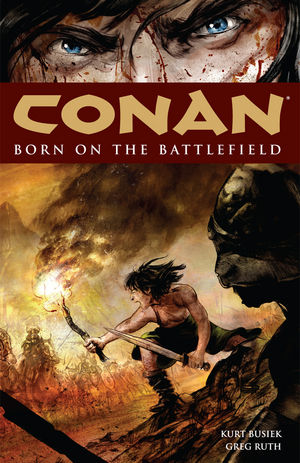
Dark Horse comics has been publishing Conan comics for a while now. Not only have they done brand new stories, as well as stories based on Howard's original material, but also reprints of Marvel Comics own Conan stories as well as the stories of Conan from the magazine via the Savage Sword reprints.
In this volume, Born on the Battlefield, labeled 0, Kurt Busiek writes of Conan's youth with illustrations by Greg Ruth. Greg does a great job of illustrating Conan in his various stages of life. I've always been one who thinks more of Conan in his 'pantherish' style rather than the hulking style that is often incorporated into some of the icongraphy associated with Conan.
This volume itself is a nice collection as, like many of the Dark Horse collections, it not only has a great introduction, this time by Ed Brubaker, but has a nice set of additional materials including various sketches by Greg at the end of it. It's a bit of an odd task as Conan is a fairly well known character but it is not the first time Conan's early years and birthing even, have come under scrutiny. I'll be talking about some of the spoilers specific to the book below so if you don't want any information ruined for you, read no further.
First off, as a Dungeon Master, I am not that interested in starting backgrounds for some games. This may sound cold or callous but in a AD&D 1st or 2nd edition game, I'm not too worried about building in too much until the survivability factor comes into its own. If you're a first level wizard with four hit points, I don't need to see six pages of how and why you came to learn sleep and magic missile.
In more... I hate to say story driven games, because I've played plenty of D&D games where it wasn't about dungeon crawling at all, but in games like Hero or GURPS, even starting characters in those games, and others like them, tend to have a little better survivability factor and more reason to have a certain set of skills and a background story can flesh that out some.
As a player, the more complex the game system is without survivability, like Rolemaster, the less likely I'm going to invest any time into making a detailed background myself. For a convention character, I might whip a few paragraphs together if he's not starting past first level.
On good old RPG.net, when the question of background comes up, there are some who prefer only what is revealed during actual game play. It makes the characters more organic and real to them. I can see that point.
I suspect that many Dungeon Masters fear that players try to build too much into their background. That player's are looking for that 'gimmie'. In some aspects, its not a goal without effort. While writing may come naturally to some people and like pulling teeth for others, it still involves some effort to write it down, to provide it in context of the setting, and to present it to the Dungeon Master. Is that worth a reward? Depends on how the DM is going to run the game and what the long term intentions are.
Anyway, most of Conan's background doesn't really lend itself too well to a RPG outside of the events of his birth where his mother is fighting on a battlefield, hence the title of the volume. Events like these can fall under an 'omens' table if you will. The old Central Casting: Heroes of Legend provided a few different types of tables to roll on for these bits. Mind you though, there are differences between where your born and what happens when your born. The battlfield for example, is merely a location. Making the birthplace an unusual local isn't a bad thing mind you, but what if it'd been in a castle during a siege? What if it happened in jail or a brothel?
Adding other details like a twin tailed comet being visible to all on that night, or all the milk turning sour or the birth of farm animals with hideous mutations? That's an omen.
For much of the material, Conan's personality traits tend to emerge, but that would be somewhat difficult to mine for much outside of modeling a character directly on them.
However, the importance of Conan's grandfather is reinforced here. I say reinforced because while this is volume 0, it is certainly not the first in the actual printed publication and Conan's grandfather has been referenced as the one who helped instill the wanderlust in Conan.
This bit of background building, of relatives who help mold the character, are useful in a few ways. It allows the player to claim to have some knowledge of X, but that knowledge of X is coming from a third party, is coming from a perspective that's some odd twenty to thirty years off, and may be embellished to provide entertainment. This can easily smooth over any differences between what the player thinks he knows and what the setting actually is.
Perhaps more importantly, Conan's grandfather dies at the end of this volume. While that may sound harsh, it does allow Conan to go wandering without too many ties left to his home country.
For gaming purposes, Brita's Vale from its initial description alone makes a worth addition to a setting, "Dark forces seep from the blood-soaked ground. The vale attracts wizards, madmen who feast on human flesh, and worse they say." Now many game settings already have such a location as the Battle of the Bones in the Forgotten Realms, but its good to have a spot where the fields of the dead are stacked high and strange things wander.
The closer one gets to such a location, the more things can be of the 'other'. In this comic for instance, Conan dreams of a panther he has slain providing him with dire omens. When he gets to the vale itself, breathing in the dust of the dead provides him with visions of how the fighting went. In the midst of that he is forced to fight for his life against a cannibal and sees a bone-witch who appeared in other comics that series wise, take place later, although again, the printing chronology make that reversed in when the reader initially saw them.
Having such a location allows the setting to have graveyards that aren't man made but yet, are visited by men. In settings that are soaked in superstition, many sword and sorcery ones for example, the Game Master can run counter to those traditions and have it be where individuals meet to discuss various business matters as normal people stay away from these 'haunted ruins'. It could also be a place where survivors of the wars come yearly to pay their respects to the dead. It could also be a place where certain items have been rumored to be lost ever since the original conflict.
One 'moral' lesson of this series though, is an old one; No Good Deed Goes Unpunished. Conan, as a youth, sees strangers coming to his homeland, a wizard and her daughter. The daughter grows up even as Conan does and the two becomes lovers. While playing, the daughter falls into a field and startles a bull. Conan leaping in to save her winds up putting the strange girl in front of his fellow villagers and that in turn brings her wizard father. The two sides do not see things eye to eye and soon the civilized lands know of the value of ore and other valuables in Conan's home.
That in and of itself leads to a war where Conan takes a place among the men and the end result? The girl and her father are dead. Not at Conan's hand mind you, but the end result is still the same. The very thing Conan sought to prevent, the death of the girl, comes about in a long drawn out way that costs many their lives on both sides, because Conan tried to do the right thing. Are there events and elements in your own setting that can trigger a negative? Something that should be done for the greater good but isn't because the current cost of doing that would be too high?
The destruction of the invaders and their fort though, follows another example of one of Howard's themes that barbarism is the natural state of the world and that it will sweep away civilization.
Born on the Battlefield is an interesting take on Conan's early years. It makes him a little "too" much in my opinion as he's always killed various animals, experienced the supernatural and taken part in a war, well before leaving the homeland, but at least its not so far out there that future adventures he has are reduced to repetition or lesser actions. If you're interested in seeing how Kurt Busiek, known his his initial tenure on the story, The Frost Giant's Daughter, back in 2005, this is a good volume to pick up.
Friday, October 19, 2012
Wednesday, October 17, 2012
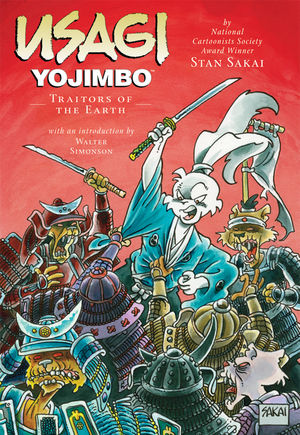
Traitors of the Earth: Usagi Yojimbo 26 by Stan Sakai
Usagi Yojimbo, a long running series about a ronin rabit, continues in volume 26, Traitors of the Earth. Below I'll be discussing the spoilers of the book and my thoughts on it so if you wish to avoid such spoilers, read no further.
This volume starts off with Usagi as a youth getting a lesson from his mentor. Turns out a farmer was skipping stones into a Kami's pool in anger because he dropped his axe. The kami offers him a silver axe, a gold axe, and his normal axe. When the wood cutter denies ownership of the treasures, the kami gives him the golden axe. Usagi assumes this is a reward for the axecutter's honesty, but his mentor informs him that it was a death sentence. See, with a gold axe, you can't cut the trees down and the guy freezes to death. If you can incorporate rewards that may not be all they seem, as Stan did with that tale, you can make your players question more about their treasures.
After that we get to meet Kitsune and her apprentice, Kiyoko as they are moving through the city, doing their regulard thieving ways. This isn't the first time Kistune picks up an odd item that has significance as she gets a netsuke of a skull. Turns out this one controls an ancient undead army. If there is a character that continuously steals from various NPCs, it can lead to whole adventure arcs as they steal something they were not meant to. In many ways, its a perfect player driven adventure seed.
The only trick is not to over use such an abuse. Its like playing out how many times the characters get caught doing it and that turns into a big deal. Later in this volume Kiyoko is noticed stealing and has to endure a few chases but those things won't haunt her later down the road. Failure should be an opportunity to open further ventures as opposed to bringing it to a dead stop. What's more entertaining, the thief getting caught right there and then or busing out the dice and using some chase methodology?
Indeed, it is this very chase that leads to a different adventure. While she is hiding from the police, she hears a plot to assassinate a merchant. Using the players own initatives to provide them with adventure seeds can provide them more interaction with the world and provide them more opportunities to experience adventure seeds they may not normally.
Stan has woven mystic and supernatural elements into his tales before and when he does that, he often brings in Sasuke, a demon queller who has worked with Usagi many times in the past. He is able to do so again as Sasuke's ghost mentor sends him towards the action. When you have players who can't always make it, having reasons for them to be part of the group is important. In this case, we have random chance for Kitsune, but the ghost mentor allows a much firmer reasoning for characters to met.
It may get old after a while but if the characters aren't meeting each other that often, it allows that guiding force to be mysterious and to let the players know that this is the in meta reason while the in game reason itself may still be mysterious. The repetition of Sasuke having another mission immediately after showcases how to get rid of such characters as well. Instead of sticking around and hanging out when the player himself can't, that player's character can be given another mission right away.
The last of the tales this volume goes back to the earliest parts of the rabbit ronin's tale. He has an opportunity to battle against Lord Hikiji, the one who slew his lord and set him on his ronin path. These long term seeds are sprinkled throughout the series and Usagi has still yet to come across the man who gave him the crescent scar again but he has fought Hikiji's allies and spoiled many of that lord's plans time and time again. Having a long term goal, one either embodied by this unreachable nemesis or one that's a personal self goal, such as Usagi's training on the open road, can also provide the Game Master with various opportunities.
The trick in such a situation, especially one in a long running game, is not overplaying your hand. If Hikiji was to start sending assassins after Usagi in every issue, it would only be a matter of time before Usagi would have to go for a final confrontation. Because of Lord Hikiji's standing and status though, that's not something Usagi would do unless his very life depended on it.
Usagi Yojimbo continues to blend traditional elements of Japanese history with mythology and nods to modern events. If you want a different take on undead samurai, Traitors of the Earth is for you.
This volume starts off with Usagi as a youth getting a lesson from his mentor. Turns out a farmer was skipping stones into a Kami's pool in anger because he dropped his axe. The kami offers him a silver axe, a gold axe, and his normal axe. When the wood cutter denies ownership of the treasures, the kami gives him the golden axe. Usagi assumes this is a reward for the axecutter's honesty, but his mentor informs him that it was a death sentence. See, with a gold axe, you can't cut the trees down and the guy freezes to death. If you can incorporate rewards that may not be all they seem, as Stan did with that tale, you can make your players question more about their treasures.
After that we get to meet Kitsune and her apprentice, Kiyoko as they are moving through the city, doing their regulard thieving ways. This isn't the first time Kistune picks up an odd item that has significance as she gets a netsuke of a skull. Turns out this one controls an ancient undead army. If there is a character that continuously steals from various NPCs, it can lead to whole adventure arcs as they steal something they were not meant to. In many ways, its a perfect player driven adventure seed.
The only trick is not to over use such an abuse. Its like playing out how many times the characters get caught doing it and that turns into a big deal. Later in this volume Kiyoko is noticed stealing and has to endure a few chases but those things won't haunt her later down the road. Failure should be an opportunity to open further ventures as opposed to bringing it to a dead stop. What's more entertaining, the thief getting caught right there and then or busing out the dice and using some chase methodology?
Indeed, it is this very chase that leads to a different adventure. While she is hiding from the police, she hears a plot to assassinate a merchant. Using the players own initatives to provide them with adventure seeds can provide them more interaction with the world and provide them more opportunities to experience adventure seeds they may not normally.
Stan has woven mystic and supernatural elements into his tales before and when he does that, he often brings in Sasuke, a demon queller who has worked with Usagi many times in the past. He is able to do so again as Sasuke's ghost mentor sends him towards the action. When you have players who can't always make it, having reasons for them to be part of the group is important. In this case, we have random chance for Kitsune, but the ghost mentor allows a much firmer reasoning for characters to met.
It may get old after a while but if the characters aren't meeting each other that often, it allows that guiding force to be mysterious and to let the players know that this is the in meta reason while the in game reason itself may still be mysterious. The repetition of Sasuke having another mission immediately after showcases how to get rid of such characters as well. Instead of sticking around and hanging out when the player himself can't, that player's character can be given another mission right away.
The last of the tales this volume goes back to the earliest parts of the rabbit ronin's tale. He has an opportunity to battle against Lord Hikiji, the one who slew his lord and set him on his ronin path. These long term seeds are sprinkled throughout the series and Usagi has still yet to come across the man who gave him the crescent scar again but he has fought Hikiji's allies and spoiled many of that lord's plans time and time again. Having a long term goal, one either embodied by this unreachable nemesis or one that's a personal self goal, such as Usagi's training on the open road, can also provide the Game Master with various opportunities.
The trick in such a situation, especially one in a long running game, is not overplaying your hand. If Hikiji was to start sending assassins after Usagi in every issue, it would only be a matter of time before Usagi would have to go for a final confrontation. Because of Lord Hikiji's standing and status though, that's not something Usagi would do unless his very life depended on it.
Usagi Yojimbo continues to blend traditional elements of Japanese history with mythology and nods to modern events. If you want a different take on undead samurai, Traitors of the Earth is for you.
Labels:
Adventure Seeds,
Orient,
Stan Sakai,
Traitors of the Earth,
Usa
Monday, October 15, 2012
Barrowmaze II and Rappan Athuk have arrived
So Barrowmaze II, which I also got Barrowmaze the original, and Rpapan Athuk were both at my door today.
Dudes from Frog God, please see if you can use the guys who did the Barrowmaze dice. They look nice and apparently didn't hold up the project.
Your special die is essentially a d6 with the Necromancer Games logo. Theirs is a little more colorful with a few icons.
The shipping packages were both the same type but apparently someone told the USPS dude to go hog wild on the Rappan Athuk boxed set.
The shinny one under it? Yeah, Barrowmaze. Ugh.
So overall, I would do another Indiegogo for the guy who did Barrowmaze. The material arrived on time. The price was reasonable. The goods were neat. Unless Frog God really kicks up its game with its next Kickstarters, I will only buy their product on the shelf or from Paizo when I want the PDF/Print combo and discount and discounted shipping.
I've gone over the reasons why before but a brief recap.
1. Selling it at Gen Con. Now mind you, selling it at Gen Con in and of itself isn't bad. But when miniature companies like Blackwater Gultch and RPG companies like the guys who did Shadows of Esteren, where you could pick up a book with a customized picture in it...
2. Delayed Shipping. This isn't too bad to be honest. August to October is only two months. Some people were like, "But you get the PDFs and other freebies!" to which I could point out many people who backed it going, "Like the PDFs but waiting for the hardcopies." Mind you, the real pisser for me, is that as a Paizo subscriber, if I ordered from Paizo, I'd get the PDF. I'd also get a discount. I'd also get a better shipping price. Not some of the freebies like the dice, which caused another delay but I'd get the book and PDFs.
3. Shipping Charges. Many of the projects I've backed had no shipping charges. I fully understand that's not always possible. Charging people for shipping well before you have the product to ship out? Simply put, not cool. Not cool at all. If you don't have the package, you dont' send a shipping invoice. Period. End of story. Mind you, I can see the reason why they did it. How are they going to know that they're going to be boned by the dice people? If it had been me? I'd have made the dice people ship out those dice specifically to the customers but that may not have been possible. If they had held off on the shipping charges, are they going to scramble at the last minute waiting for everyone to pay when even now they're waiting on people to pay?
4. The damn thing was damaged. Not huge damage. Not something I'm going to cry about or ask for a refund, but the front corners were crinkled on the top and bottom. Ugh.
'Outside' observation though is that whenever you bring up some disatisfaction someone else will pipe up that they love the company. I'm not saying burn Frog God Games to the ground or anything like that. It could just be the nature of the Internet that some of these posts sound 'angry' or something. But really, s0ome of the time when you mention dissatisfaction with X, Y, or Z and so many people jump in to 'defend' the company, I have to say, applause to you. Fans like you are a great resource for the company to rely on and its great that such fans enable the companies to keep pumping out material.
Both books will go on the bookshelf. The Frog God one will go next to the other two mammoth tomes I have from them while I may put the Barrowmaze ones by the reprinted 'preimum' copies of the AD&D 1st edition stuff.
Sunday, October 7, 2012
The Harsh Lessons of DMing: Level Balance
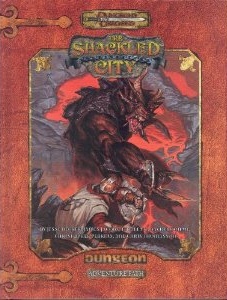
My friend Tom Wright is running several of my friends and I through the Shackled City using Pathfinder as the rule engine. He's got some rules and notes and is fairly consistent in the way he runs. It's one of his greatest strengths.
However, he had a vision about how the game was going to work this time. He was going to incorporate various ends and odd bits of our characters backgrounds into the game. To accomplish this and still run the campaign, he decided to use the slow advancement table.
One of the great things about roleplaying games is the ability to modify things so that they work the way you want. However, if you are going to do that in a manner that keeps the pace with a prewritten adventure, you need to verify that your doing the right thing.
At the end of the first adventure, we were too low level to handle the big bad who wiped out a few members of the party and the rest of us managed to retreat. How did that happen? No side quests. When the xp goal was changed without bringing in additional xp, the end result has to be characters that are lower level.
After that, he decided he was going to use the medium or normal level of advancement. He's very good about listening to player feedback in terms of it not being 'his' game but 'our' game. But he also decided that new characters would start a level lower than the standard characters. Does anyone see any potential problems here?
So when we got to the big bad in the next adventure... yeah, essentially another TPK.
Take the time to read through the adventurers. Take the time to review the character sheets. Review not only their abilities that are level based, but also their choice of 'fiddy' bits like feats and spells. Make sure that if there are encounters coming up that rely on magic items or silver items or something of that nature, that if the party doesn't already own them, they can own them. Make some routes of escape.
Mind you, in a freestyle campaign where you let the first level party know, "Over here are rumored to be dragons and giants" and they go there anyway, well, I'm old school enough to say kill away. But if you're running an adventure and it says, "Party should be level X when they reach area Y" and they get blitzed by the baddies? Well, was party level X? Did party have level X equipment?
In some games, its easier to tell when players are min-maxed then others. Try to keep onto of it and don't wait till the last minute to find out that the party didn't have a wand of cure light wounds and that the party didn't have a method of deciphering that ancient script. DMing can be a great thing but it also often requires some homework. Do that homework!
However, he had a vision about how the game was going to work this time. He was going to incorporate various ends and odd bits of our characters backgrounds into the game. To accomplish this and still run the campaign, he decided to use the slow advancement table.
One of the great things about roleplaying games is the ability to modify things so that they work the way you want. However, if you are going to do that in a manner that keeps the pace with a prewritten adventure, you need to verify that your doing the right thing.
At the end of the first adventure, we were too low level to handle the big bad who wiped out a few members of the party and the rest of us managed to retreat. How did that happen? No side quests. When the xp goal was changed without bringing in additional xp, the end result has to be characters that are lower level.
After that, he decided he was going to use the medium or normal level of advancement. He's very good about listening to player feedback in terms of it not being 'his' game but 'our' game. But he also decided that new characters would start a level lower than the standard characters. Does anyone see any potential problems here?
So when we got to the big bad in the next adventure... yeah, essentially another TPK.
Take the time to read through the adventurers. Take the time to review the character sheets. Review not only their abilities that are level based, but also their choice of 'fiddy' bits like feats and spells. Make sure that if there are encounters coming up that rely on magic items or silver items or something of that nature, that if the party doesn't already own them, they can own them. Make some routes of escape.
Mind you, in a freestyle campaign where you let the first level party know, "Over here are rumored to be dragons and giants" and they go there anyway, well, I'm old school enough to say kill away. But if you're running an adventure and it says, "Party should be level X when they reach area Y" and they get blitzed by the baddies? Well, was party level X? Did party have level X equipment?
In some games, its easier to tell when players are min-maxed then others. Try to keep onto of it and don't wait till the last minute to find out that the party didn't have a wand of cure light wounds and that the party didn't have a method of deciphering that ancient script. DMing can be a great thing but it also often requires some homework. Do that homework!
Labels:
Adventure,
Game Balance,
Game Master,
Pathfinder,
Shackled City
Friday, September 28, 2012
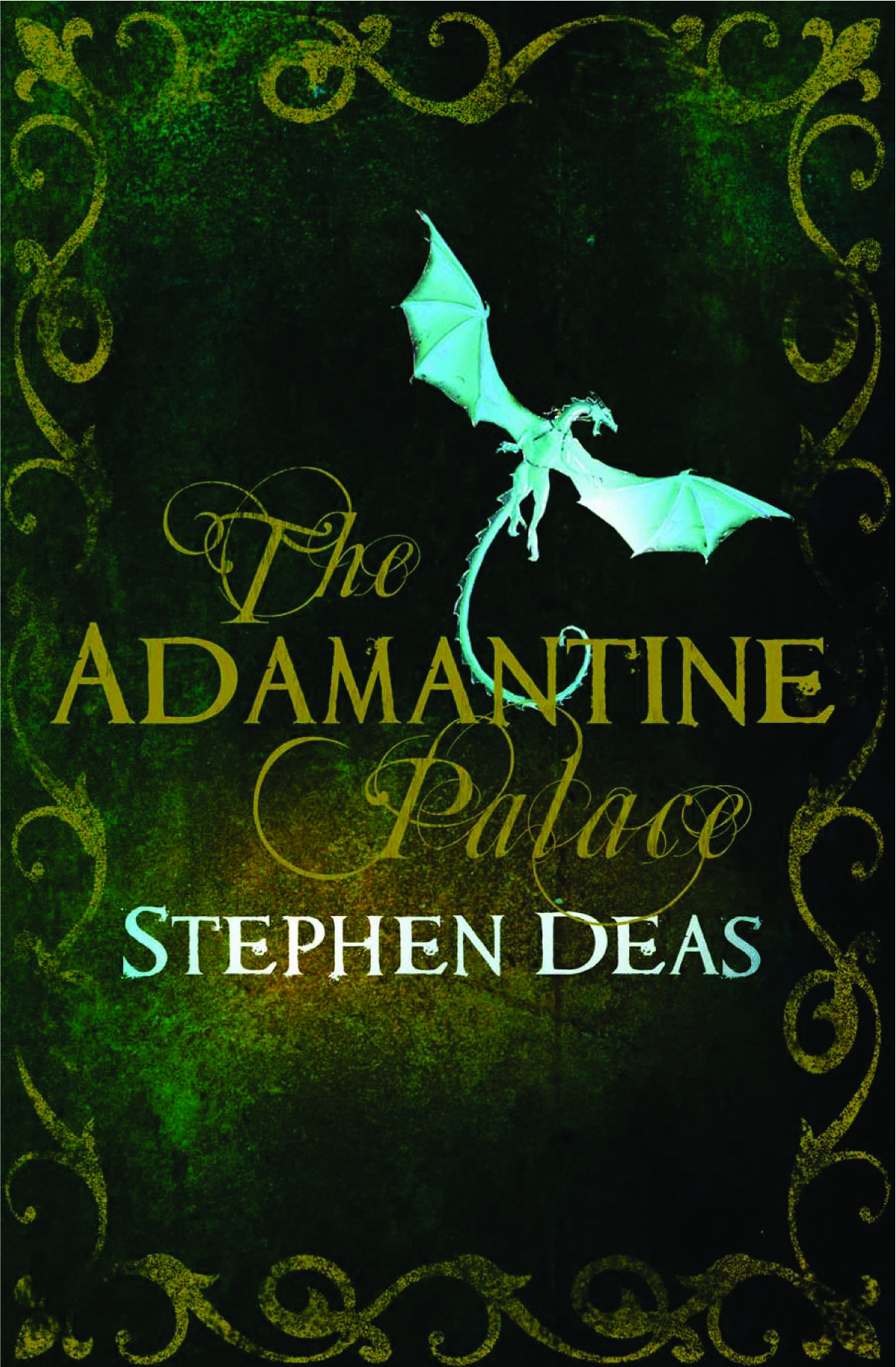
The Adamantine Palace by Stephen Deas
I know, another post without complaining about how late
kickstarters are? That’s okay, October is right around the corner so I’ll tally
up the process and see how things are going by then. If its based on anything
like previous months, no change.
However, despite working six and seven days a week, I did
manage to read another book. I had honestly forgotten how much I enjoy reading
with all the beating my mind has taken at work and various dreaded ‘real life
issues!’. Its good sometimes to sit back and read a book.
The Adamantine Palace by Stephen Deas is a fun romp into
dragon territory. While TSR and then Wizards of the Coast has plowed the field
with many standards that fit into a dragon society with Dragonlance and of
course the revered grand dame of Science Fiction Anne Mccafre has Pern, Stephen
still manages to make it an interesting and fast paced book.
From what I know, there are already other books by Stephen
Deas in the series and if time and finances permit, I’ll be sure to hit them up
as time allows. I’ll be doing my usual rambles below and that includes spoilers
so if you want to avoid those, read no further.
One of the things I enjoyed about the Adamantine Palace, is
that the author, much like George R. R. Martin, Glen Cook, and a few others,
isn’t afraid to kill off, what to that point, had been main characters. It
provides the setting with a quick slap in the face and makes the reader a bit
unsure of the standing each character has. One of the problems with long
running campaigns, is that unless the Game Master is willing to smash his toys,
the players may feel like actors on a stage rather then adventurers in a deadly
setting.
Another thing I enjoyed is the role of the dragons
themselves. Like in some settings, they have their place for their role in
society, including hunting, war, sports, and status, they have a darker origin.
It seems, from the flashbacks, which are not complete yet, that the dragons
were the rulers and that mankind uses alchemist to subvert their minds and free
will so that they are slaves.
Yet strangely enough, it doesn’t take too much to knock one
out of that stupor. Indeed, it seems shockingly easy but no sane person would
want to do that. Initially I was highly skeptical of it. I thought, what
society would dare try to harness something that could turn on them so easily?
And then you look at the ‘real world’ and remember that during the first big
old bomb testing they were worried it was going to ignite the sky. But hey, test away right? That doesn’t count
reliance on nuclear power and the price Japan paid for that during their recent
issues or the myths that have grown up around Russia, mainly in the comics
about their own incident.
So in the end, harnessing a power that can turn against you?
Easily something man does all the time in both the real world and the of
fiction. I’ll be curious to see where Stepehn Deas takes the ideas that he
presents here as if one ‘accident’ involving a single dragon can cause so much
potential harm, what the final resolution of this harnessed power will be.
In a role playing game, most creatures that are above animal
intelligence will have their own motivations and means of working with or
against the characters. In the Forgotten Realms, many of the main races already
have their motivations lain out for them. For dragons, the elves use of making
the dragons go into a rage and destroying their ability to work magic on a
regular basis is what brought the elves into power while humanity’s numbers
brought them into power.
But what if you were staging a game during that time when
dragons ruled? What if instead of a temporary madness the initial plan was one
that made the dragons creatures of mindless rage at all times? Or that ‘star’
mages or another type of magic was used to control dragons?
For those looking for a book where the heroes are all slick
and happy, this is not the book for you. One of the main characters, Jehal, is
a master manipulator. He manages to play all sides and still comes across, at
least to me, as an interesting character. He has some internal conflict and
that’s enough to make you wonder where he’s going. His arrogance and pride make
him do things that put him in positions he may not be able to control, but that’s
part of the ‘charm’ of the character.
Others in the book range in their motivations and methodologies
but many of them have an overriding motive that makes them easy to identify
with or at least follow and that makes them good archetypes. The interesting thing to me though, is that
these goals and motivations are things that don’t necessarily fall into ‘alignment’
patterns that are familiar in games like Palladium and Dungeons and Dragons. If
you’re main goal is to advance your family, murdering off a rival that stands
in your way may not be good, but it is something that would be taken into consideration.
Personal happiness goes to the side when planning out not only your future, but
your family’s future, even if that means alliances that would normally be
taboo.
Labels:
Dragons,
Fantasy,
Stephen Deas,
The Adamantine Palace
Thursday, September 27, 2012
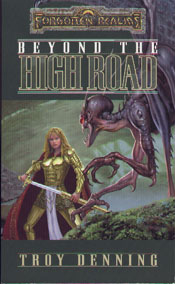
Beyond The High Road by Troy Denning
Because I have several Half-Price Bookstores within driving
distance, I’m rarely at a loss for reading material. Time on the other hand…
but reading material? Inexpensive reading material? The Half Price store on
Touhy has a nice dollar spinner rack and I buy a book or ten from it every now
and again. It’s one of the reasons I have a hard time paying some of the prices
that Kindle books are marked at when not on the Daily Deal or the monthly deal.
In this case, Troy Denning brings us Beyond the High Road, a
Forgotten Realms novel set in the Forest Kingdom known as Cormyr. This is one
of those that I believe is set firmly during the 3rd edition era and
while it has a lot of bells and whistles and some efforts at political
materials, is really a good quick popcorn read. I finished it in a few hours
and enjoyed it for what it was.
When I look over at Amazon, it is available as a Kindle Book
, http://www.amazon.com/Beyond-High-Road-Cormyr-ebook/dp/B0060B6GRY/ref=sr_1_2?ie=UTF8&qid=1348787446&sr=8-2&keywords=beyond+the+high+roadfor
a little over $5 bones. Not a bad price but I’m more happy with the $1 paid
from the ole rack.
The novel does bring up a few interesting threads that can
be fun when throwing them into a campaign.
1.
The Old Evil. Yeah, overplayed extremely but if it’s
a well known old evil, that usually works out better in my opinion that some
whack job monster that is some ancient evil that no one has heard of or
bothered with before. In those cases I wish the author would just go to a “NEW”
thing. “Yes, I have brought about never before seen enemies and powers to deal
with you. Forget Orcus. You’re my bitch now.” Or something along those lines.
2.
Politics. While the book is certainly no Game Of
Thrones, Troy does bring in the problems of having a Royal Church, one approved
by the royal family, when the setting is home not to one faith, but home to
many deities, some of which have actually walked in the country before. It adds
a nice touch when the idea of having a royal church is first introduced and
then the feedback, both from other religious organizations wondering when they
can get their official royal church and from organizations already well
established that quickly seek to hold onto their current power by shutting out
any competition.
3.
Old Friends: While Cat and her man Grigori aren’t
the main stars or even really anything other than a cameo here, it’s always
nice to see a character well known in another series in the same setting make a
pop up here and there without taking over the story. If you have some NPCs that
the party knows are in the area, don’t go out of your way to hide or not-use
them but make it clear that those individuals are not there for the story, just
there to keep the continuity of the setting alive.
4.
Magic Items. If you’re playing in a high magic
game, use it. There are several individuals here who use the Cormyr armory to
armor themselves in magic. It makes sense in the context of the story because
the Forgotten Realms is a high magic setting and the Forest Kingdom is known
for its war wizards.
5.
Slap Magic Down. On the other hand, when magic
becomes too easy, there are often things in the game that are designed to get
around those limitations. Sometimes it’s a well placed Dispel Magic spell or an
Anti-Magic Shell or a monster with immunities to various common spells or a
monster that has a high magical resistance or a mirror like ability to reflect
attacks. In this instance, the monsters can absorb magic. It’s a good trick
that doesn’t make them exactly completely immune and doesn’t take place
instantly but does bring up the limits of magic.
6.
Magic Commonality: One of the problems with
magic follows the old saying if all you have is a hammer, all of your problems
become nails. In this instance, the head war wizard finds himself, while not
helpless, at least far less able then he should be given the resources at his
disposal. In a society where magic has replaced technology, imagine what
happens when it fails. It’s a similar theme we see in modern takes when
electricity or physics fail and man is forced to a more primitive life style.
Whatever is making you too comfortable then becomes a crutch you must endure
all to save.
7.
It’s a Dangerous World Out There. One of the
things that draws the characters out, is blighted farms. Initially its thought
that the orcs, often a dark and cave dwelling race, have brought some type of
fungus based blight to the lands they raid due to the various locals they
inhabit. In other venues, the characters come under attack by goblins. Most
Dungeons and Dragons settings are not for the faint of heart and a good
reminder of that every now and again with ‘random violence!’ is a good way to
remind the characters.
Troy Denning made Beyond the High
Road a quick read and while the Royal Family does come across as a bit spoiled
and out of their element in a market where A Game of Thrones and other novels
try to emulate a deeper and richer complexity, the magic and relationships of
the characters in the book to each other make it worth a read.
Labels:
Cormyr,
Forgotten Realms,
Game Master,
Politics,
Troy Denning
Friday, September 21, 2012
Heartstone by C. J. Sansom
Heartstone is the fifth book in the Shardlake lawyer series set in the 1500s. This one involves Shardlake going to unravel a mystery that involves many a party interested in him not finding out the root cause of the problem against the backdrop of war. I'll be discussing the book in full below so if you're eager to avoid any spoilers read no further. A quick review would be that C. J. Sansom is a solid writer and if you want to bring something like mystery to your games, you could do worse then read some of the Shardlake series for inspiration.
War is often written in fantasy genres as something that the main characters are themselves involved in. That they are at the forefront of. But sometimes the material fails to bring home some of the common practices of war preparation. For example, England has a rich history of archery. I've spoken of archery in the past and some of the battles England was involved with that were turned by the skilled English longbow man thanks to another writer of historical material, Bernard Cornwell, but there are still some differences.
For example, in Bernard Cornwell's archery books, the main characters are consummately skilled archers. They are at the forefront of things. Here not so much. Shardlake's servant, Barak, is almost recruited to the war effort because of his backtalk to a recruiter. Well, recruit is too kind a word. Drafted is more accurate.
And these soldiers are supposed to keep their own gear and weaponry. Many people didn't have them. So of the fees they earn, they have to pay back the crown. And those who are supposed to provide those equipment? Well, if you can charge a premium price for something and provide something old that's already paid for? You can pocket quite a penny in the process.
Another venue of war, is how much it takes. I'm not just talking about the manpower fighting in the war, but the manpower not fighting in the war. Depending on the length and duration of the war, the farming back home may not go well. Farming in these times is heavily labor dependant. In addition, the manpower recruited for the war may not be all that useful if it's made up of individuals not suited for such a life. Mind you it can be fun to have a campaign staring a 'Dirty Dozen' type of individual but that's not necessarily on a large scale such as portrayed here.
A third venue of war is the scope. On a huge ship with some odd five hundred people, Shardlake almost drowns when the ship sinks. The root cause of the ship's issue's aren't made known but could include incompetence. In the anima and manga series Berserk, one of the reasons Griffith, a charismatic and effective commander is able to rise so rapidly, is that most of the people at the top are grossly incompetent. Being wealthy and a noble does not provide some magical and mythical ability to rule wisely not command smartly. Too many people in this battle on both sides prove to be useless in terms of winning.
The size of the ship, with five hundred people, may not be that impressive if you think of something like the Death Star that had to have thousands and thousands of people on it, or indeed of the first planet destroyed by the Death Star where millions of people were. Imagine players being in those situations where something like a flying citadel is under attack and is going down regardless of what the player's do. It can provide them with an experience that actually repelling the attack may not.
Another bit about war and the resources it consumes, is how much money it all consumes and what it does to the economy. In his time here, the King has literally debased the money to pay for the war effort. Currency takes on a new name. Funds take on new values. People can tell the difference based not only on the look, but the feel of the coins. Players may come across silver and gold coins that aren't what they are supposed to be. Will people in the town accept them? Will they have to accept a lesser amount for them? Are they worthless? In the modern edition, coins like electrum and brass pieces have been given the boot to keep things simple. It's a worthy goal.
But in a long term campaign that isn't dependent on gold coins to be some type of magic fuel, it can be fun to throw a wrench into the works. "No lads, I'm sorry, these are Mulgin Silver. The darker red color means there's a lot of copper mixed in there. Takes three Mulgin to make a standard." Or something along those lines.
Of course the opposite can also be true. In most games. the age of the coins isn't a deciding factor but when talking about the purity of the coins, the older coins may be more pure or have more face value due to people having better ideas about what those coins are actually made of. All of the sudden a few hundred silver might be worth a few thousand silver.
For characters, both in terms of character development and the sign of the times, the notion of a woman's empowerment during these times is a theme that crops up at the end. Some find that its easier to pretend to be a man during these times and take advantage of the strengths that men have, not in terms of physical power, but in terms of social movement.
Mind you, in most fantasy games, there is a passing effort to make such issues moot to begin with but when actually looking at the setting, if you're not seeing stripper ninjas or what not, the social structure upon anything resembling a closer inspection tends to be based on the same old same old. This can be fun to play against if its something the group wants to explore.
For character growth, having a family will change a body. Barak for instance, has gone from a street smart agent of Cromwell to a husband and in this book, to a father. He is not quite so quick to put his life on the line. In a role playing game, that can be a difficult role to get a player to embrace and some Game Masters abuse the whole thing by giving the players contacts only to have them brutally taken away and then putting the min the position of vengeance seeker.
In terms of gaming inspiration, there is a investigative book out for Pathfinder called Lorefinder. It's a well done short book but in my experience, running a game as a mystery can be a little harder than just throwing some monsters into the balance. C. J. Sansom does a good job of providing a lot of characters, which is what makes a good mystery, into a very detailed setting, which helps cement where the mystery is taking place. If you're looking for something to add details to your campaign in the little things, this is a good book to read about the various events in a setting that could easily be a fantasy one.
Labels:
C. J. Sansom,
Game Master,
Historicals,
Matthew Shardlake,
Mystery
Subscribe to:
Posts (Atom)