Sunday, November 7, 2010
Carl Orff - O Fortuna
To me, perhaps from viewing Excaliber as a young man, this song has remained one of the most powerful and compelling pieces of classic music and much like the Conan soundtrack to the original movie, it still gets pulled out on occassion.


Friday, November 5, 2010
women At Work In Medieval Europe
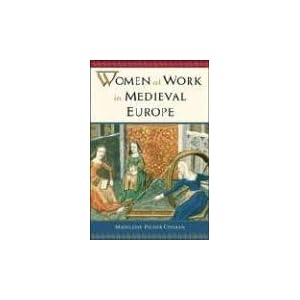
And one of those areas of interest is what were women doing. Not because when I GM I don't allow female paladins or anything like that. Rather, I'm curious as to what the actual socieites were like and what jobs they had.
While I've only just skimmed the book thus far, it's alays proven worth the price. Marie De France is a 12th century poet and one of the examples of her work is showcasing a woman using her mind to outsmart her husband who catches her cheating. She tells him that the man can't trust his eyes. After all, if he looks into a barrel of water and sees his reflection, he's not actually in the barrel. His eyes are lying to him! There's some other clever bits here too.
Ironically, before I got into the book, the preface mentions Dr. Barbara of Wissenkirchen, a battlefield truma surgeon in 14th-century Germany. That right there is a perfect NPC. While the gaming mechanics and whatnot would have to be worked out, the fact of a battlfield trauma suregon is awesome in and of itself.
When looking around at your table, if you have players whose characters roles and abilities you arent' certain would fit into your campaign, don't be afraid to do a little research and challenge your perceptions. Even if such characters are the rareities and exceptions, they can make good examples of 'true grit' so to speak.
Thursday, November 4, 2010
The Limits of Specifics
As I continue to read through the Baltic Crusades, too much of it focuses on the weapons. On the knowledge side, it's interesting no doubt. I like seeing how one handed axes and pole arms come together to form big old halbreds. I like seeing that cheap and effective, such as the spear and the 'kettle' helmet continue to work their way through the ages.
But as a role playing piece of information? Unless I'm setting out to historically model a part of the campaign after it, useless. Most fantasy games have this weird pseudo era they take place in where you have all of the latest innovations in armor up to plate mail, but on the weapons side? Well, crossbows are about it. Even though in this book, it notes that guns and cannons started coming in much earlier than most people would normally think of when they think of guns and the middle ages. "It was during the 14th century that gunpowder reached Scandinavia and the Baltic, the Teutonic Knights and Danish armies being relatively earlier than Sweden and Norway in the use of this new technology."
I'm one of those weirdo's who likes guns in his fantasy. Star Wars is space opera. Light sabres and guns and all sorts of great stuff. Thundar the Barbarian isn't some post apocalyptic fantasy, it's fantasy. Sure, you can run into some weird bits when you try to model the accuracy, firing speed, and damage potential of all of the technology, but it doesn't stop fantasy game designers from throwing dozens of variants of swords, maces, and axes in there alongside of armor from cloth and leather to plate armor.
If the guns aren't made too extensive and too overwhelming in their use, their impact on the campaign should be minimal.
This is something everyone needs to determine for themselves of course but it's always been a no-brainer for me. Knights and dueling pistols are a long part of games like Warhammer Fantasy, and even Dungeons and Dragons 2nd edition toyed with them.
I guess part of it for me, is that it's just part of technological evolution. I have a hard time seeing an elf using some compsoite bow after being alive for ten thousand years. Sure, there is magic and it has a huge place, but unless the setting has suffered one massive dark ages apocalypse after another, something that the elves shouldn't have lived through in the first place, their inability to move past the woods is simply annoying.
It's one of the reasons why when I see Privateer Press and the old Rackham elves using what amounts to high technology and magic methodology, that I clap. Those ancient races should be the baddest of the bad. Even if, like Warhammer 40K they're not making newer technologies, their mastery of the old world material should render them like unto gods.
In 2nd edition, outside of the Forgotten Realms and it's brief flitartion with guns, we had Spelljammer. During the various wars between elf and orc, the pace of weapon mastery should have been staggering. While a few prizes of that nature do show up, it's often indicated in the "yeah, that was once long ago." and never seen again.
Eberron takes an interesting approach in that things seem to almost be at an industrial age level but it has come about through magic instead of technology.
Anyway, I'm rambling. While I like some of the ideas in the earlier part of the book, when it starts talking about the sepcifics, they become less useful to me. That may not be true for everyone, but unless you've got a weapons hunger that needs specifics, there's a big chunk of this book you can pass over.
In terms of art, Angus knocks it out of the ballpark. His use of color doesn't overwhelm the eyes. There is one picture in particular, where a group of soldiers is leading their horses through the swamp and the look upon their faces is great. The illustration on the next page looks like it was ripped out of one of his Middle Earth books illustrating a Rider of Rohan speaking to fellows at a castle. Suffice it to say if you enjoy the cover, the interior is more of the same.
Inspiration can come from anywhere but be aware that in some instances, the specifics of a thing will render those parts useless for the specifics of what you want inspiration for.
But as a role playing piece of information? Unless I'm setting out to historically model a part of the campaign after it, useless. Most fantasy games have this weird pseudo era they take place in where you have all of the latest innovations in armor up to plate mail, but on the weapons side? Well, crossbows are about it. Even though in this book, it notes that guns and cannons started coming in much earlier than most people would normally think of when they think of guns and the middle ages. "It was during the 14th century that gunpowder reached Scandinavia and the Baltic, the Teutonic Knights and Danish armies being relatively earlier than Sweden and Norway in the use of this new technology."
I'm one of those weirdo's who likes guns in his fantasy. Star Wars is space opera. Light sabres and guns and all sorts of great stuff. Thundar the Barbarian isn't some post apocalyptic fantasy, it's fantasy. Sure, you can run into some weird bits when you try to model the accuracy, firing speed, and damage potential of all of the technology, but it doesn't stop fantasy game designers from throwing dozens of variants of swords, maces, and axes in there alongside of armor from cloth and leather to plate armor.
If the guns aren't made too extensive and too overwhelming in their use, their impact on the campaign should be minimal.
This is something everyone needs to determine for themselves of course but it's always been a no-brainer for me. Knights and dueling pistols are a long part of games like Warhammer Fantasy, and even Dungeons and Dragons 2nd edition toyed with them.
I guess part of it for me, is that it's just part of technological evolution. I have a hard time seeing an elf using some compsoite bow after being alive for ten thousand years. Sure, there is magic and it has a huge place, but unless the setting has suffered one massive dark ages apocalypse after another, something that the elves shouldn't have lived through in the first place, their inability to move past the woods is simply annoying.
It's one of the reasons why when I see Privateer Press and the old Rackham elves using what amounts to high technology and magic methodology, that I clap. Those ancient races should be the baddest of the bad. Even if, like Warhammer 40K they're not making newer technologies, their mastery of the old world material should render them like unto gods.
In 2nd edition, outside of the Forgotten Realms and it's brief flitartion with guns, we had Spelljammer. During the various wars between elf and orc, the pace of weapon mastery should have been staggering. While a few prizes of that nature do show up, it's often indicated in the "yeah, that was once long ago." and never seen again.
Eberron takes an interesting approach in that things seem to almost be at an industrial age level but it has come about through magic instead of technology.
Anyway, I'm rambling. While I like some of the ideas in the earlier part of the book, when it starts talking about the sepcifics, they become less useful to me. That may not be true for everyone, but unless you've got a weapons hunger that needs specifics, there's a big chunk of this book you can pass over.
In terms of art, Angus knocks it out of the ballpark. His use of color doesn't overwhelm the eyes. There is one picture in particular, where a group of soldiers is leading their horses through the swamp and the look upon their faces is great. The illustration on the next page looks like it was ripped out of one of his Middle Earth books illustrating a Rider of Rohan speaking to fellows at a castle. Suffice it to say if you enjoy the cover, the interior is more of the same.
Inspiration can come from anywhere but be aware that in some instances, the specifics of a thing will render those parts useless for the specifics of what you want inspiration for.
Wednesday, November 3, 2010
The Scandinavian Baltic Crusades 1100-1500

While I haven't delved very far into the book, a few things struck me as important world building bits from this Northern Crusades material.
One, religion is a huge motivating tool in a society. The author argues that many went on Crusade because it was the 'right' thing to do, not because the royalty and religious powers wanted all of the 'rough' men out of the country during times of peace. There were rewards to be sure, such as having all previous sins, and all those committed on the trail, forgiven, but it was done because it was a 'good' thing.
Two, the use of waterways is so vital that it can help establish not only cultural similarities due to bleed, but is essential in the spread of news. This allows those individuals who are notable and noteworthy to have much greater and more reliable methods of finding out what is going on in the world. In a campaign setting like the Forgotten Realms, news in the Moonsea region, despite the hostility many of those independent city states hold towards one another, probably travels much quicker than it would merely up and down the Sword Coast, which is a huge stretch of coastline.
Three, religious pilgrimage. It's a common enough event for these times but one frought with danger. For example, King eric I 'Ever Good' of Denmark maded an armed pilgrimage to Palestine but did not make it back home.
Four, crusade is often used, at least in the times I've heard it referenced, almost in exclusive contact with the Holy Land. Here, the text makes the distrinction that it's against any religious hersey, even when its against members of the same faith who practice it a different way. Looking at the Forgotten Realms again, the Twilight War by Paul Kemp put this to good use with the sun god unergoing his change at the time and the new face of the faith taking place. The victor of the battles will determine what is the actual heresy. In some fantasy settings, perhaps the followers turn away from their god if the god does physically make new decrees and laws that those of his faith simply do not wish to follow.
Fifth, the environment plays a vital part in any military matters. While it was mentioned in the old mercenary book how one of the commanders used superior tactics involving the surrounding country side through use of scouting and planning, that idea is hammered home again here where the rugged landscape here isn't necessarily one that is suitible for the standard mounted men with the infantry taking a larger and more important role.
When looking at your gaming maps, try to keep in mind what type of armies can realistically funtion there. Now the rough terrain may not be an issue for those who ride griffons or giant eagles. It may not be an issue for those who use flying ships and fortressess. But for those who are using a more earthly campaign or more rooted in standards of reality, when the mountainous terrain and the badlands become too common, the use of horsemen is out.
The Baltic Crusades brings a lot to mind without even getting into the specifics of it. When reading material, try to keep the mind open. Try to think what can be applied to your own campaign. Try to think how you might be able to use the material. Keeping such things in mind as you read may open the campaign in ways you never initially thought about.
Tuesday, November 2, 2010
Condottiere: More Thoughts on Mercenaries
While reading over Condottiere, one of the things I found interesting, is that part of the influx of mercenaries comes from soldiers that fought during the Hundred Years War. In your own campaigns, if there have been large battles recently, what happens to the soldiers after the wars are over? Even in today's 'modern' society, there are difficulties making sure that those who served in war time are treated right when they come home. How much harder in a society that has not the modern lifestyel or the modern thinking?
But all things turn. Even as the mercenaries rose from outside sources in Italy, they fall to outside sources that have adopted to war quicker and with more efficiency than those in Italy. The rise of national armies against divided city states proves one method superior to the other.
In terms of mercenary use, when the land is rich with them, different methodologies may crop up. Much like discussions of Democrats and Republicans in American society, these teachings tend to break into different factions and are almost politics in and of themselves. When crafting some of the background of the setting, think about some simple philosophies that different mercenary companies would follow and how they interact with each other.
In terms of Graham Turner's art, he's good. His work lends a solid feeling that isn't fantastical but is stylized. If you like the cover, which is from the battle of San Romano, 1432, then chances are you'll enjoy the interior art by him as well.
Lastly, I'd like to mention the cover. The commander isn't wielding a sword. Instead, he's wielding a batton, an instrument to denote his rank and his leadership. In a game with magical items, something that augmented command or charisma or allowed a user to influence a large group of soldiers, wither issuing them commands, fortifying them from magical fear, or showcasing the user's own ability, would be desirable and perhaps even common to those with the funds to purchase them.
When I look at different books for ideas and inspiration, I'm also looking for different ways and methods I might use that inspiration in the first place. Of course in a historical material, there would be no magical rods of command, but it's an old school magical item and fits the theme well.
When looking at material, try to think about not only what its teaching or its original use is, but how it may beenfit in different ways than originally intended.
For example, what if the humanoid hordes are finished with their wars and instead of turning on the humans, seek out employeement with them by the thousands? Instant mercenary armies. And if what the book mentions here is true, there would be many parallels. For example, the mercenary armies were often devastating to the surrounding landscape, engaging in acts of pure carnage and rapine of both land and people. At the same time, the employers of the mercenaries were often worse, assassinating the leaders and refusing to honor the contracts that they themselves had drafted.
Now with hobgoblins, orcs, and other races doing these vile acts, the poor treatment of the employees almost seems justified eh? A few tweaks here and there and things like half-orcs and half-hobgoblins become that much easier to explain. A history of hogoblin nobles arising from their mercenary roots becomes more tangible. An integration of these races to the setting, only to have them crushed later by other national armies, becomes part of the background.
But all things turn. Even as the mercenaries rose from outside sources in Italy, they fall to outside sources that have adopted to war quicker and with more efficiency than those in Italy. The rise of national armies against divided city states proves one method superior to the other.
In terms of mercenary use, when the land is rich with them, different methodologies may crop up. Much like discussions of Democrats and Republicans in American society, these teachings tend to break into different factions and are almost politics in and of themselves. When crafting some of the background of the setting, think about some simple philosophies that different mercenary companies would follow and how they interact with each other.
In terms of Graham Turner's art, he's good. His work lends a solid feeling that isn't fantastical but is stylized. If you like the cover, which is from the battle of San Romano, 1432, then chances are you'll enjoy the interior art by him as well.
Lastly, I'd like to mention the cover. The commander isn't wielding a sword. Instead, he's wielding a batton, an instrument to denote his rank and his leadership. In a game with magical items, something that augmented command or charisma or allowed a user to influence a large group of soldiers, wither issuing them commands, fortifying them from magical fear, or showcasing the user's own ability, would be desirable and perhaps even common to those with the funds to purchase them.
When I look at different books for ideas and inspiration, I'm also looking for different ways and methods I might use that inspiration in the first place. Of course in a historical material, there would be no magical rods of command, but it's an old school magical item and fits the theme well.
When looking at material, try to think about not only what its teaching or its original use is, but how it may beenfit in different ways than originally intended.
For example, what if the humanoid hordes are finished with their wars and instead of turning on the humans, seek out employeement with them by the thousands? Instant mercenary armies. And if what the book mentions here is true, there would be many parallels. For example, the mercenary armies were often devastating to the surrounding landscape, engaging in acts of pure carnage and rapine of both land and people. At the same time, the employers of the mercenaries were often worse, assassinating the leaders and refusing to honor the contracts that they themselves had drafted.
Now with hobgoblins, orcs, and other races doing these vile acts, the poor treatment of the employees almost seems justified eh? A few tweaks here and there and things like half-orcs and half-hobgoblins become that much easier to explain. A history of hogoblin nobles arising from their mercenary roots becomes more tangible. An integration of these races to the setting, only to have them crushed later by other national armies, becomes part of the background.
Monday, November 1, 2010
Condottiere 1300-1500: Infamous medieval mercenaries
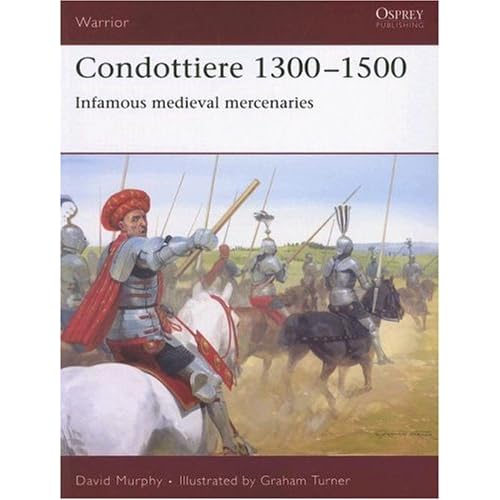
But in the modern era, when I want some information on something, I generally know where to look. For example, if I want a thin book with some, usually, great art in it, about a caste of a certain warrior type, I'm pretty sure Osprey Publishing will have it.
I've long had an interest in mercenaries on the battle field. Part of this is from the old book The White Company, part of it when I discovered Glen Cook's The Black Company, and part of it when I discovered Berserk and Griffin's Band of the Hawk. Each one organized around mercenaries.Other books, like the ones written by Elizabeth Moon, have used mercenaries,
Gaming books, ranging from AEG's own Mercenaries book to various other third party resources, like Born of Blood, have also been around. Although my memory does kick in and say, "Hey dude, the Flaming Fist." Yeah, I remember running many a Forgotten Realms campaign where the Flaming Fist were foes of the party, maily because the party memebers were always after new magic items and the quick way to get such items was to attack any NPC that might have 'em. Ah, the glory days of youth.
I haven't finished the Condotteire yet, but it made me curious enough to see what Wiki had to say on the subject. One thing I found fascinating, is that these mercenary armies, essentially in this book and resource if I'm reading it correctly, crop up to a very unique set of cirumstances. This gets into world building. When plotting out the dominos, make sure you know where things are likely to fall.
In terms of ideas, one of the things I like is the idea of a charter, so that these mercenaries can be identified and are not 'mere' mercenaries, but are condottiere.
Another idea I like is the use of famous mercenaries as statues or cast on gold coins. It doesn't always have to be a local member of the nobility, the religious caste, or some weird monster. Powerful individuals that can take a city get recognized here.
Lastly, I like the idea of collaterali. These individuals werestate official who oversaw the use of payment to the mercenaries. He was the one who oversaw the contracts. He was the one who overwent the 'daily admnistration of the mercenary armies.' Need to know how many men are in the army? Need to know what type of weapons they have? Need to know what level of training they have? Can't trust the mercenaries to be truthful so you have to have you own man on the inside job there.
And this is true today. In many instances, the stock market is a huge gamble that the goods and services these companies are offering are real. I've read many a 'bust' that happened because the promised goods weren't there. If that is happening know, where we have all of this digital technology about us, imagine how much easier it would be in a place where a famous soldier would be unknown in another country?
To prevent abuse it woudl require mercenaries that fully honored their contracts or collaterali who were so trustworthy that they'd likely be killed. I can easily see a game where a group of players, acting as collaterali, discover that the mercenaries in their lords employee are a sham but have enough strength to take down the players if they're not careful about how they go about reporting it. On the other hand, I've dealt with enough players where I can see them taking the mercenaies side and for a side cut of the gold, selling out the defense of the kingdom by falsifying units, weapons, and training that doesn't exist.
Imagine some lord's horror when the ogres attack and those mercenaries that do show up do so in ratty leather armor with spears instead of on horseback with shinny plate armor and bright lances? The players might have a little explaining to do at that point.
Sunday, October 31, 2010
Halloween
So outside of working today, I managed to drive home, finish off some miniatures and ponder what, if anything, I could speak of on my blog.
For example, today is Halloween. I'm not expert on the roots of the holiday or where its origins are or even some of the more interesting things that series like Ghostbusters with Samhain.
And that in and of itself was my idea.
Today's populace isn't versed in the origins and roots of the holidays. In a fantasy setting or in a setting that's old and incredibly ancient, this can be a dangerous hubris. It may be during these holidays that the dances and celebrations and rituals are designed to keep things our or to keep things the way they've always been. They may be times when things from outside push against the boundries of reality in terms of being ready willing and able to serve.
For example, in Warhammer, demons are pure magic. The reason they don't dominate the world is that the world is magic poor. During certain holidays, perhaps that's no longer true and on those times, the demons are out.
There could be visitations by ancient entities from those origin points. If something dark and horrible and cyclopean staggered through time into our era, in America, would it be pleased to see how commercialized it's all become? Would it ponder why another holiday is already in mid celebration even though another holiday is before that? Or would it simply shrug it's shoulders and go looking for some candy?
Anyway, when thinking about the holidays in your campaign, don't forget their real origins for your campaign and what the current people think those holidays mean. The two aren't necessarily one and the same.
For example, today is Halloween. I'm not expert on the roots of the holiday or where its origins are or even some of the more interesting things that series like Ghostbusters with Samhain.
And that in and of itself was my idea.
Today's populace isn't versed in the origins and roots of the holidays. In a fantasy setting or in a setting that's old and incredibly ancient, this can be a dangerous hubris. It may be during these holidays that the dances and celebrations and rituals are designed to keep things our or to keep things the way they've always been. They may be times when things from outside push against the boundries of reality in terms of being ready willing and able to serve.
For example, in Warhammer, demons are pure magic. The reason they don't dominate the world is that the world is magic poor. During certain holidays, perhaps that's no longer true and on those times, the demons are out.
There could be visitations by ancient entities from those origin points. If something dark and horrible and cyclopean staggered through time into our era, in America, would it be pleased to see how commercialized it's all become? Would it ponder why another holiday is already in mid celebration even though another holiday is before that? Or would it simply shrug it's shoulders and go looking for some candy?
Anyway, when thinking about the holidays in your campaign, don't forget their real origins for your campaign and what the current people think those holidays mean. The two aren't necessarily one and the same.
Subscribe to:
Posts (Atom)


