Friday, April 20, 2012
Temple Hill by Drew Karpyshyn
Another standalone book in the Forgotten Realms series, The Cities. I managed to pick up this book from the Half Price book store for the princely sum of $1! Cheaper then most e-books I'll tell you. Speaking of e-books, a quick search of Amazon shows that nope, no ebook version over there. Anyway, Temple Hill does a lot of things that I felt the other book I read in the series failed to do.
First off, most of the action actually takes place in, below, and around the city. This involves throwing several organizations in there including organized religion, some of the famous factions of the setting like the Harpers, the Cult of the Dragon, and an guild of protectors that falls and rises again within these pages.
Next off, a lot of the material makes more sense in the context of the story here. While there are some moments where I wonder how things are justified in terms of how the action rolls off, those are the 'gamer dice' rolling in my head and don't interfere with my enjoyment of the story. The characters here are competent and knowledgeable, they 'fit' into their setting. More impressive is that Drew takes a female and male pair and doesn't have them fall in love at the end of the novel! Applause to you Drew Karpyshyn!
In terms of gaming, the male hero of the tales, Corin, has a patron in the form of the gnome that raised his half elf employer, Lhasha Moonsilver. This allows him access to goods that he might not normally be able to have access to. This also works out well in a city based campaign because many of the enemies a player may have to face in a city based campaign are human or humanoid and those huge cash reserves that players may be used to stumbling over in a dungeon probably won't be found here.
This isn't to say that precious gems, jewelry, objects of art, and other valuable bits like magic items, can't be found but if the party has a patron who can supply them with 'loot drops' at appropriate times, it can help to curb some of the more outrageous bits that may pop up and more importantly, it allows the party members some access to a 'small' magic shop that the GM controls with a pretty sturdy hand if he so chooses.
Drew makes sure to throw in a lot of elements that make Dungeons and Dragons what it is. This includes evil life draining swords, a strange fierce enemy for Corin to battle, several groups that have their own unique leaders, one with a powerful mage, another with a Beholder, and the use of another magical creature, in this case, a Medusa, almost as a weapon of mass destruction. The utility of these setting bits, not setting bits to the Forgotten Realms, but to Dungeons and Dragons, gives the book a homely feel. If you can bring the elements that mean Dungeons and Dragons to your group, and those will vary from group to group, then you're doing your job right.
Labels:
Drew Karpyshyn,
Forgotten Realms,
Patrons,
The Cities
Sunday, April 8, 2012
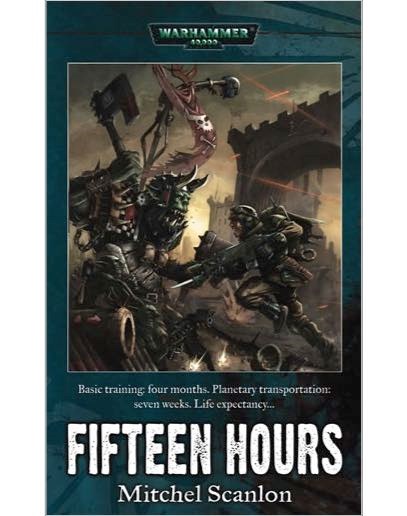
Fifteen Hours by Mitchel Scanlon
Another victory for the dollar spinner from Half Price Books. Did a quick check on Amazon and see no ebook there but no dice. On the other hand, the Black Library has a ton of stuff but their organization is crazy and most of the ebooks there go for $7.99 which is well outside my comfort range for most ebooks.
Anyway, Fifteen Hours isn't in a genre that I often read but let's be honest here, Warhammer 40K is about as far away from hard science fiction as you can get and still be sci-fi. It probably has more in common with Star Wars than Star Trek with it's prayers to machines, orks, and other assorted oddness.
Mitchel does a good job of bringing the setting to life with a hero who is indeed a farm boy but unlike so many of his fantasy counter parts, isn't actually the son of a god of a chosen one. Just some poor bastard who learns that war is hell. It's a solid novel and if you like the setting, it's another selling point. I'll be hitting some spoilers below so if you'd rather not know about the actual events in the book and how things shake out, read no further.
First off, the book uses a lottery of sorts to drawn and draft people into the Imperial Guard. This is a classic way of raising troops and with all of the brain washing that goes on in the Empire, it's often not problematic when those being called up for duty don't know any better due to their limited education. You see, despite being in a far future setting, most of the people have little technical knowledge.
Mind you, today we aren't much better off. Sure, many of us can drive a car or turn on a computer, but actual working knowledge of how these things do what they do and how to fix them? Well, much like the main character, Arvin Larn we might be praying to the machine spirits to start. I know in horror movies we see it all the time. "Come on you stupid car, don't fail now of all times!" and such other great sayings.
Anyway, the book's real strength is in showcasing how damning bureaucracy can be on all levels. As a person who works in a factory that at one time had over a thousand people, as an inhabitant of Chicago, as a person who has had to deal with phone customer support, yeah, we all know this one.
But when you're in the military? And that bumbling sets you off into a war zone that you were never supposed to be? And when the supplies and news and all information is FUBAR because of this poor management? Well, the fifteen hours of the book title is exactly how long new soldiers to this planet are supposed to last.
While some of the material here is mundane, and isn't appropriate for all campaigns in terms of tone and feel, some fantasy campaigns like Midnight, the OGL and d20 versions, got a lot of mileage out of the standard things in the setting. How are you set for supplies? How are you set for healings? How are you set for general knowledge? How dangerous is the world around you?
In a setting like Star Wars, you can easily see the Empire falling into this type of decadence. Poor training, unmotivated employees and a host of other problems effect many corporations in the day to day activities that go on around every day. How much worse when they happen in the military? Wars have almost been started due to false information or a lack of proper communication. Allies can quickly turn into enemies and live soldiers into dead heroes.
When looking at your own campaign, don't forget the bumbling bureaucrats. They can add layers of complexity that the players won't appreciate but will remind them of the real world for sure.
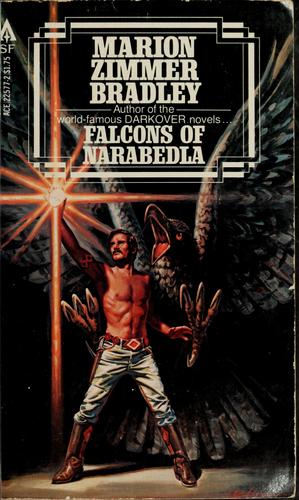
Falcons of Narabedla by Marion Zimmer Bradley
The dollar spinner at Half Priced books is filled with many items of antiquity and modern masterpieces as well as assorted garbage. I'm not the type to shy away from reading a genre or an author because they've had one dog. I recognize Marion Zimmer Bradley's name from the old school of doing things. An author who put out a few single books that were not thousands of pages long. So when I saw the Falcons of Narabedla for a dollar, I snagged it.
Interestingly enough, it's available as an e-book for $2.99. I read the book and enjoyed it so I spent another $2.99 on it. Why? Because I want to support that price point and I want to show case that even older material is worth bringing to this format. My cover notes that the price was $1.75 from 1979. Not bad that it managed to get a total of $3.99 from me, some of that even going to the author.
The book has more in common with John Carpenter of Mars than a standard sword and sorcery tale. The main hero, Mike, has an accident and that accident takes him from our world of Earth to Narabedla where he winds up in the body of a former tyrant. In many ways, the initial set up reminds me of the old manga Cobra or the movie Total Recall in that Mike is a stranger in this foreign body but has some of the memories, including the muscle skills, to not only be a capable swordsman, but also a master of horse and the unique weapons of this setting.
One interesting though for seeding a campaign, is that almost all of the original inhabitants were drawn from our modern times. I can't be the only person who gets tired of seeing this dark and gritty settings that have ultra-modern and politically correct attitudes strewn throughout them. Why not give them an actual reason to exist? Sure, those equal rights for everyone may fade in the wake of might makes right, but if the ideas and teachings are wide spread enough, it can at least provide the germ of the rational as to why slavery isn't completely wide spread and why people have one common tongue.
It also acts as a good way to bring in a temporary character for someone stopping by for a one shot. Much like Erekose the Eternal Champion, for some reason he is summoned and must do his duty and afterwards, may return to his home. This allows you to pop characters in and out in an unsteady group without having too much worry about the internal consistency or the why of it all.
In addition, where most old sword and sorcery style magic tends to be ritualistic, depending on illusions, necromancy, or summoning with little flash, the 'magic' here is that of the mind caused by mutations in individuals known as Dreamers.
The setting that Mike finds himself in also has another bit. Much like Planet of the Apes, it's actually the Earth but one that Thundar the Barbarian would be comfortable in. A few people live in near absolute power while the rest suffer horribly. In this two-sun world, the tyrant that Mike has taken over was trying to change that but perhaps had other plans within plans as he did so?
The name of the book does come into play because the falcons are artificial creatures. In the book they have blood are are organic, but the concept of bio-technology was probably a little ahead of when the book was written. This semi-science lends the book a slightly different feel that a standard fantasy but it works well.
In terms of these falcons though, one of the things I thought interesting as a side, was that the use of the falcons to hunt is something done in ancient Japan as well as in other societies. The act of hunting is done even by chimps and other animals as a group activity to build alliances and bonds. In the manga Berserk, in the 'Golden Age' arc, Griffen is a member of the knights who is on the hunt with the king and the other nobility, a great honor in and of itself.
These social activities are necessary in an era where there's no interent, no television, no phones and no instant gratification through instant communication. Hunting serves as both a social activity and a means of showing skill either through social interaction or through actual hunting ability.
When looking at your own game, don't forget the little things like hunting. While the players may not be seeing through the eyes of bio-engineered falcons that hunt men, they can still show off their abilities, especially when something unexpected crops up either the dreaded assassination attempt or the wandering encounter. Such events allow the players to really showcase how adventurers do it.
Falcons of Narabedla is more sword and sandal than sorcery but is a done in one that is well worth the $2.99 Amazon is asking for it.
Interestingly enough, it's available as an e-book for $2.99. I read the book and enjoyed it so I spent another $2.99 on it. Why? Because I want to support that price point and I want to show case that even older material is worth bringing to this format. My cover notes that the price was $1.75 from 1979. Not bad that it managed to get a total of $3.99 from me, some of that even going to the author.
The book has more in common with John Carpenter of Mars than a standard sword and sorcery tale. The main hero, Mike, has an accident and that accident takes him from our world of Earth to Narabedla where he winds up in the body of a former tyrant. In many ways, the initial set up reminds me of the old manga Cobra or the movie Total Recall in that Mike is a stranger in this foreign body but has some of the memories, including the muscle skills, to not only be a capable swordsman, but also a master of horse and the unique weapons of this setting.
One interesting though for seeding a campaign, is that almost all of the original inhabitants were drawn from our modern times. I can't be the only person who gets tired of seeing this dark and gritty settings that have ultra-modern and politically correct attitudes strewn throughout them. Why not give them an actual reason to exist? Sure, those equal rights for everyone may fade in the wake of might makes right, but if the ideas and teachings are wide spread enough, it can at least provide the germ of the rational as to why slavery isn't completely wide spread and why people have one common tongue.
It also acts as a good way to bring in a temporary character for someone stopping by for a one shot. Much like Erekose the Eternal Champion, for some reason he is summoned and must do his duty and afterwards, may return to his home. This allows you to pop characters in and out in an unsteady group without having too much worry about the internal consistency or the why of it all.
In addition, where most old sword and sorcery style magic tends to be ritualistic, depending on illusions, necromancy, or summoning with little flash, the 'magic' here is that of the mind caused by mutations in individuals known as Dreamers.
The setting that Mike finds himself in also has another bit. Much like Planet of the Apes, it's actually the Earth but one that Thundar the Barbarian would be comfortable in. A few people live in near absolute power while the rest suffer horribly. In this two-sun world, the tyrant that Mike has taken over was trying to change that but perhaps had other plans within plans as he did so?
The name of the book does come into play because the falcons are artificial creatures. In the book they have blood are are organic, but the concept of bio-technology was probably a little ahead of when the book was written. This semi-science lends the book a slightly different feel that a standard fantasy but it works well.
In terms of these falcons though, one of the things I thought interesting as a side, was that the use of the falcons to hunt is something done in ancient Japan as well as in other societies. The act of hunting is done even by chimps and other animals as a group activity to build alliances and bonds. In the manga Berserk, in the 'Golden Age' arc, Griffen is a member of the knights who is on the hunt with the king and the other nobility, a great honor in and of itself.
These social activities are necessary in an era where there's no interent, no television, no phones and no instant gratification through instant communication. Hunting serves as both a social activity and a means of showing skill either through social interaction or through actual hunting ability.
When looking at your own game, don't forget the little things like hunting. While the players may not be seeing through the eyes of bio-engineered falcons that hunt men, they can still show off their abilities, especially when something unexpected crops up either the dreaded assassination attempt or the wandering encounter. Such events allow the players to really showcase how adventurers do it.
Falcons of Narabedla is more sword and sandal than sorcery but is a done in one that is well worth the $2.99 Amazon is asking for it.
Wednesday, April 4, 2012
Ironclad
There are some classic tales that are retold time and time again. Sometimes these retellings are fairly obvious such as when the Seven Samurai became the Magnificent Seven and other times, such as with Ironclad, it's the theme of the elements, that of a small group holding against a larger one, that is lifted until a new telling.
Ironclad takes many liberties with history but remains an entertaining film painting the heroic defenders with broad strokes and showcasing the vital nature of skilled and passionate warriors against the nameless hordes. In many ways, it makes a great showcase of how a unique group assembled for their talents may have that one last glorious battle against overwhelming odds.
Such a methodology sounds like the makings of an excellent one shot. Several characters all of advanced years and abilities that may not know each other but do know the stakes in the latest game, all assembled together to protect something or someone.
Some of the things I enjoyed about the film include its visuals. For the most part, the inhabitants of the world are gritty and dirty and having thick bears or in need of a shave. This dark outlook paints the setting in ways that modern television often fails to. Few people look perfect, few people look like the actors they are. Instead they look like they could all use a bath and a good meal.
The nature of the siege also gets a few winks but not a ton of devoted efforts. For example, while there are some siege weapons brought into play both for offense and defense, it's more the nature of man against man that takes the spotlight. In terms of healing, no dedicated doctors here. Burn those wounds closed or choke off the blood flow and fight on. There is an innovative use of pigs where the pig fat burns so quickly and so hot that it essentially acts as a cannon being fired straight upward and that destroys a large chunk of the castle but that required some sapping, some digging under the castle proper to use.
And during the siege there are bits for individual heroic actions. For example, during the long part of the siege where the enemy tries to starve out the defenders, one of those defenders makes his way to the enemy encampment and steals some food. Nothing like a morale builder that comes straight from the enemy himself.
Ironclad uses the frame of a classic story and for those who enjoy seeing this style of movie, a fake historical fictional tale, it does so fairly well. For those whose enjoyment comes from historical accuracy or other details, this move should be passed unless you enjoy the gore feast that follows from the clash of steel on steel.
Ironclad takes many liberties with history but remains an entertaining film painting the heroic defenders with broad strokes and showcasing the vital nature of skilled and passionate warriors against the nameless hordes. In many ways, it makes a great showcase of how a unique group assembled for their talents may have that one last glorious battle against overwhelming odds.
Such a methodology sounds like the makings of an excellent one shot. Several characters all of advanced years and abilities that may not know each other but do know the stakes in the latest game, all assembled together to protect something or someone.
Some of the things I enjoyed about the film include its visuals. For the most part, the inhabitants of the world are gritty and dirty and having thick bears or in need of a shave. This dark outlook paints the setting in ways that modern television often fails to. Few people look perfect, few people look like the actors they are. Instead they look like they could all use a bath and a good meal.
The nature of the siege also gets a few winks but not a ton of devoted efforts. For example, while there are some siege weapons brought into play both for offense and defense, it's more the nature of man against man that takes the spotlight. In terms of healing, no dedicated doctors here. Burn those wounds closed or choke off the blood flow and fight on. There is an innovative use of pigs where the pig fat burns so quickly and so hot that it essentially acts as a cannon being fired straight upward and that destroys a large chunk of the castle but that required some sapping, some digging under the castle proper to use.
And during the siege there are bits for individual heroic actions. For example, during the long part of the siege where the enemy tries to starve out the defenders, one of those defenders makes his way to the enemy encampment and steals some food. Nothing like a morale builder that comes straight from the enemy himself.
Ironclad uses the frame of a classic story and for those who enjoy seeing this style of movie, a fake historical fictional tale, it does so fairly well. For those whose enjoyment comes from historical accuracy or other details, this move should be passed unless you enjoy the gore feast that follows from the clash of steel on steel.
Monday, April 2, 2012
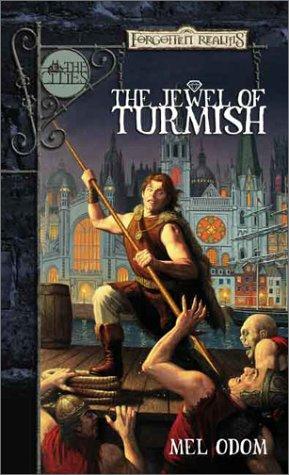
The Jewel of Turmish by Mel Odom
I've recently mentioned the perils of shared settings. That sometimes the setting can work against the author and that I try not to take such books as more than popcorn reading. Even with that in mind, Mel Odom's The Jewel of Turmish, unless you find it in the bargain bin for $1 like I did, is probably better off skipped.
In terms of things I didn't like as a book, some of those may work in a game as a prelude or a highlight of an upcoming menance.
For example, we are introduced to a group of young thieves and given a run down of their various hardships and how they stick together. They are horribly murdered. We are introduced to a group of priests where their leader is granted a vision by his goddess. These priests are horribly murdered. In killing off such groups well after numerous little bits have been introduced, the author was in my opinion, wasting time. In terms of a role playing game though, where you as the Game Master want to showcase a powerful villain, giving the players some premade characters and having them struggle against some unknown horror can bring out some anticipation for the players.
Another bit is misdirecting the audience. Don't label your campaign as a heroic high end super hero campaign and then have the players run into Wolverine, the Punisher, and other gun totting murderous villains and heroes whose only goal is to increase their body count. Don't talk about running a high magic and epic campaign and then force players to keep meticulous track of their rations and arrows and copper pieces. In that vein, this book called the Jewel of Turmish and part of a series called The Cities, failed, to me at least, to bring to light anything about the city itself.
Another aspect is beware of overusing old cliches that you've already used. In Mel's previous work that I've read in the Forgotten Realms, the one about the old sea monster coming back after many years of imprisonment, why is Mel's next book bringing out a villain who is coming back after many years of imprisonment? It's a common enough theme but don't be the same author bringing the same plot where gods themselves couldn't kill the villain but some dumb kid can.
Another bit is know where your action lies. If you know that the main thrust of the campaign is going to involve demons and undead and betrayal by once loyal allies, don't bog the players down in long drawn out fights against such mundane foes as man eating wolves and the difficult decesions they must make in terms of balancing the right and wrong of their actions.
Mel can do better than this and I've say this book is actually worse then Revan which makes it, the worst book I've read in 2012. Here's hoping the next one brings up the averages a little.
In terms of things I didn't like as a book, some of those may work in a game as a prelude or a highlight of an upcoming menance.
For example, we are introduced to a group of young thieves and given a run down of their various hardships and how they stick together. They are horribly murdered. We are introduced to a group of priests where their leader is granted a vision by his goddess. These priests are horribly murdered. In killing off such groups well after numerous little bits have been introduced, the author was in my opinion, wasting time. In terms of a role playing game though, where you as the Game Master want to showcase a powerful villain, giving the players some premade characters and having them struggle against some unknown horror can bring out some anticipation for the players.
Another bit is misdirecting the audience. Don't label your campaign as a heroic high end super hero campaign and then have the players run into Wolverine, the Punisher, and other gun totting murderous villains and heroes whose only goal is to increase their body count. Don't talk about running a high magic and epic campaign and then force players to keep meticulous track of their rations and arrows and copper pieces. In that vein, this book called the Jewel of Turmish and part of a series called The Cities, failed, to me at least, to bring to light anything about the city itself.
Another aspect is beware of overusing old cliches that you've already used. In Mel's previous work that I've read in the Forgotten Realms, the one about the old sea monster coming back after many years of imprisonment, why is Mel's next book bringing out a villain who is coming back after many years of imprisonment? It's a common enough theme but don't be the same author bringing the same plot where gods themselves couldn't kill the villain but some dumb kid can.
Another bit is know where your action lies. If you know that the main thrust of the campaign is going to involve demons and undead and betrayal by once loyal allies, don't bog the players down in long drawn out fights against such mundane foes as man eating wolves and the difficult decesions they must make in terms of balancing the right and wrong of their actions.
Mel can do better than this and I've say this book is actually worse then Revan which makes it, the worst book I've read in 2012. Here's hoping the next one brings up the averages a little.
Saturday, March 31, 2012
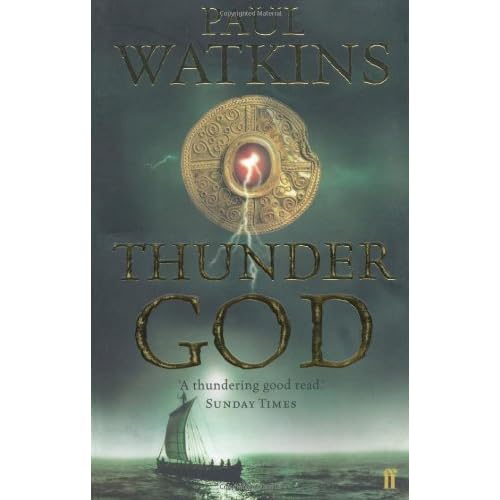
Thunder God by Paul Watkins
Thunder God is another selection from Half Price Books dollar spinner rack. When I went to compare the prices to any ebook versions, Amazon came up with no Kindle versions.
The short review is that it's an entertaining first person tale of religion, exploration and many of the things that people still struggle with today such as trying to make the past fit the present, trying to live with the current realities and trying to strive for a better future. Paul's writing is crisp and flows quickly. If I see another book in this vein by him, I'll pick it up.
But what about for gaming purposes?
Exploration plays a bit of a theme here. Not necessarily the standard exploration of go to location X, meet person Y, and do action Z. But the different places that are visited by the main characters allow the reader a quick glimpse into some of these different venue.
For example, when starting off in the small village, you get an idea of the daily life. When the character's village comes under attack from raiders and he is kidnapped, the travel to the city of what is know Istanbul, when it was still the Holy Roman Empire, allows you to get a feel that in that time, the city of Constantinople, you get a feel that it's a huge city where people of different races, ethnicity, religions, and ways of way come to trade merchandise from all around the world.
Latter on, when the character travels back, you get a feel for the perils of travel. Still later, as the characters are on a different quest, they are thrown off by a huge storm and wind up in the Americas. Here's they run into the Mayans. It's not that they life there their whole lives, but they get to experience the differences between places. And in so doing, especially told in the first person, it allows the reader to get a peek into what life might have been like in these times and places.
Outside of that, the book, much like the last historical book I read, has a treasure and that treasure is guarded not by a ton of armored knights or by powerful warriors, but rather by its lack of prestige. A small church built into a spire so that its not visible to raiders and one would almost have to know exactly where it was prior to raiding it.
When designing defenses, it doesn't hurt to allow a 'win' for the characters every now and again by having places that no one would know about be unguarded. Well, perhaps unguarded for the most part with the most fantastic and powerful treasures having their own summoned guardians.
Another bit that crops up is coincidence. The main character has a habit of running into those he's befriended, or running into those related to those he knows. These by products of relationships should be useful in your own games as well.
If the players are part of an adventuring group for example and are known for their harsh treatment of their hirelings, this information may wind up coming back to haunt them. On the other hand, if the players have backgrounds that involve other bits, like a fighter who retired from a military unit, perhaps when out on the road and coming across other military units, they meet those who have relatives in their old unit and can trade stories and make a positive impression on those other guards.
Religion crops up another notch here as it does in several of Benard's series. In this case, a king pushes forth a religion and uses tax men, who in some ways, act as a connection between the kingdom to collect taxes and pass laws. In an era where there is no Internet and no method of passing information back and forth securely, safely, or even insuring that the information is passed, these collectors are an interesting option that might make for an interesting change of pace for players to take the roles of.
In the old Legend of the Five Rings, one of the assumptions was that the players can be Magisters. But what if the players are tax collectors or perhaps tax assessors? They are there to list the wealth of the town and make sure that information gets back to their lords and leaders? This can lead to all sorts of side deals being cut out as the players are bribed to look aside from certain wealth in the town in exchange for their own cut.
Thunder God isn't filled with external conflict, but it does press the characters and push the story forward and is filled with enough potential ideas to get a campaign well underway.
The short review is that it's an entertaining first person tale of religion, exploration and many of the things that people still struggle with today such as trying to make the past fit the present, trying to live with the current realities and trying to strive for a better future. Paul's writing is crisp and flows quickly. If I see another book in this vein by him, I'll pick it up.
But what about for gaming purposes?
Exploration plays a bit of a theme here. Not necessarily the standard exploration of go to location X, meet person Y, and do action Z. But the different places that are visited by the main characters allow the reader a quick glimpse into some of these different venue.
For example, when starting off in the small village, you get an idea of the daily life. When the character's village comes under attack from raiders and he is kidnapped, the travel to the city of what is know Istanbul, when it was still the Holy Roman Empire, allows you to get a feel that in that time, the city of Constantinople, you get a feel that it's a huge city where people of different races, ethnicity, religions, and ways of way come to trade merchandise from all around the world.
Latter on, when the character travels back, you get a feel for the perils of travel. Still later, as the characters are on a different quest, they are thrown off by a huge storm and wind up in the Americas. Here's they run into the Mayans. It's not that they life there their whole lives, but they get to experience the differences between places. And in so doing, especially told in the first person, it allows the reader to get a peek into what life might have been like in these times and places.
Outside of that, the book, much like the last historical book I read, has a treasure and that treasure is guarded not by a ton of armored knights or by powerful warriors, but rather by its lack of prestige. A small church built into a spire so that its not visible to raiders and one would almost have to know exactly where it was prior to raiding it.
When designing defenses, it doesn't hurt to allow a 'win' for the characters every now and again by having places that no one would know about be unguarded. Well, perhaps unguarded for the most part with the most fantastic and powerful treasures having their own summoned guardians.
Another bit that crops up is coincidence. The main character has a habit of running into those he's befriended, or running into those related to those he knows. These by products of relationships should be useful in your own games as well.
If the players are part of an adventuring group for example and are known for their harsh treatment of their hirelings, this information may wind up coming back to haunt them. On the other hand, if the players have backgrounds that involve other bits, like a fighter who retired from a military unit, perhaps when out on the road and coming across other military units, they meet those who have relatives in their old unit and can trade stories and make a positive impression on those other guards.
Religion crops up another notch here as it does in several of Benard's series. In this case, a king pushes forth a religion and uses tax men, who in some ways, act as a connection between the kingdom to collect taxes and pass laws. In an era where there is no Internet and no method of passing information back and forth securely, safely, or even insuring that the information is passed, these collectors are an interesting option that might make for an interesting change of pace for players to take the roles of.
In the old Legend of the Five Rings, one of the assumptions was that the players can be Magisters. But what if the players are tax collectors or perhaps tax assessors? They are there to list the wealth of the town and make sure that information gets back to their lords and leaders? This can lead to all sorts of side deals being cut out as the players are bribed to look aside from certain wealth in the town in exchange for their own cut.
Thunder God isn't filled with external conflict, but it does press the characters and push the story forward and is filled with enough potential ideas to get a campaign well underway.
Labels:
Adventure Seeds,
Character Design,
Paul Watkins,
Thunder God
Sunday, March 25, 2012
Harlequin by Bernard Cornwell
The first book in the Grail Quest series by Bernard Cornwell, Harlequin is another look at one of England's greatest weapons, an archer and his adventurers.
Without going into too much detail, if you like adventure based historicals, this one has plenty of it and is a meaty tome. It took me a few days of reading between the overtime and the dreaded real world, but I was pleased by how well the book worked out and how open it leaves itself to the sequels.
Now on for some specific mentions so those who want no real spoilers so read no further!
One of the things I've usually enjoyed about Bernard Cornwell's material, is that it doesn't shy away from the harsh realities of life in these dark times. For example, families are huge in theory, but so many people die of so many mundane issues that in practical terms, they are boasting a few members aside from those lucky ones. One discussion talks about the plague. Another talks about how a simple cut from a farming implement becomes infected and the person dies. The state of doctors is terrible so wounds that might not be fatal in our time are essentially a death sentence here.
The other thing I enjoy, is how comfortable Bernard seems to be in describing everyday things like the red herrings that the English eat, or how archers are fairly limited to England because of the time and training it takes to master the bow. How things like cannons are starting to roll out here but aren't at their peak yet.
There is the occasional interjection of the idea of chivalry in terms of trying to gain honor in combat. Often it meets with the brutal realities of having to win in combat as opposed to showcase combat prowess.
In terms of character development, Cornwell does a few interesting things that are worth noting for Game Masters who have players engaged in more than only dungeon crawls. For example, Sir Simon is a powerful knight of great skill and ability for the English. He is a noble born. Thomas on the other hand, is low born and an archer and a bit of a wild card. The two do not mix and through various bits and pieces, the two become enemies that seek to kill one another to the point that Thomas is hung and Sir Simon defects from the English to the French.
By having Sir Simon be noble born, it prevents Thomas from just decking him out in the street, although it does not prevent him from trying other methods. But by being noble born, there are certain expectations of status put upon Sir Simon and his own actions make him enemies enough that he is banished. By providing characters with enemies whose role isn't only on the battlefield, the Game Master is able to push them in ways that a sword in the face can't necessarily cure, or at least, can't cure right at the time it happens.
Another useful reminder, is the background about the characters. With a climactic battle at Crecy, which is the start of the Hundred Years War, Bernard Cornwell makes sure that his characters are going to be in the thick of things. There will be wars, and opportunity due to the chaos of war. In the manga Berserk, it is this chaos, this turmoil, that allows the Band of the Hawk to rise to nobility. The same can happen in any role playing game.
When I think about the various event changing novels that Wizards of the Coast often threw out on the Forgotten Realms, as a fan of the setting I often though, "Man, another epic tale eh?" and not in a good way. As someone who looks around at modern history these days and sees things like the Arab Spring and other world changing events, the pace of history stops for no man. Indeed, the real problem with those game changing novels from Wizards of the Coast isn't that they changed the setting, it's that they often went to a near status quot at the end.
Imagine if you take the bits from the Threat from the Deep where the oceans and seas become more dangerous, and add in the threats from the Nehtril Shadow Wizards, and add in the reclusion of the Elves, and add in the dragons rampaging across the realms, and add in Thay becoming an undead nation with negative energy all over the lands and Sembia becoming a Thrall state to Nethril and and and... It may sound like a lot, but when you think about everything that is going on all the time, isn't there some sense in a setting as large as the Forgotten Realms having multiple crisis points going on all the time?
Part of this though, is how the Forgotten Realms works. In Harlequin, the English think they have God's blessing. The French also believe this. As do other countries. And yet, the 'heroes' of this tale are murderers, they are rapists, and they are thieves. In short, they are complex. Thomas watches his father killed and eventually allies himself to the ally of the man who killed his father because that man too has been betrayed. A woman Thomas loves uses him during her time of need and moves on but tries to keep him close like a chess piece. Various priest speak of old threats and heresies even while being part of war and partaking of those benefits and plunder.
And the problem is that the Forgotten Realms novels tend to work in a manner familiar to the game system so the paladins are usually good and trustworthy, the clerics god fearing folk, and most of the people with views and outlooks that encapsulate the best of what we currently think we are. In short, it can be damn boring at times.
The one problem I can see happening with players who read this book, is they're going to wonder why the long bow is so lame in whatever game system you're playing. As described here and in other works and through the victory at major battles, the longbow should be a killing weapon almost unequalled in any game. It should far surpass the crossbow and even any early guns introduced in terms of killing power.
But then there's that training issue. If the longbow becomes an ultimate weapon, what are all the players going to make to maximize their character's damage output? Yeah, that one is pretty much a no-brainer. It's game balance on a generic and bland scale but its necessary in some forms.
If you're looking for some high action reading with character based plot and motivations, The Harlequin will provide much fodder for the imagination of both player and Game Master.
Labels:
Archers,
Bernard Cornwell,
Game Master,
Grail Quest,
Harlequin,
Historicals
Subscribe to:
Posts (Atom)