I've mentioned before that my sweet spot for e-publications is around the $2.99 point. Amazon has various daily deals that meet my standard in addition to hundreds, if not thousands of free books. Hell, I'm reading the invisible man now that was free. Tor has some steambooks on sale for the $2.99 and took some of their biggest fantasy franchises to the $2.99 price point for the first book in the series. I've seen a few others, like a recent steampunk fantasy anthology for $2.99 as well as others, that makes me ponder that my 'mythical' price point isn't that far out of line.
What does that have to do with anything?
On RPG.net, someone start a WIR, short for where I read, and the book in question was Black Company, by Glen Cook. Go over to Amazon and hey, no Kindle copies at all, regardless of the cost. But the new stuff? Yeah, it's there. This is another case of author not taking control of his e-rights and insuring that his existing material is creating another revenue stream for him.
But then on an art blog, I see this fantastic drawing of Death Dealer, a Frank Fazetta character. It inspires me to look up one of my favorite authors of sword and sorcery fiction or semi-modern times, David Gemell. All of his books cost around $7.99 in kindle format.
Uh... listen estate of Dave, if you didn't make the money necessary to earn profit on those books while he was alive, then it might be a little late now and because the author is dead, it might be easier to spread information about him and his works at a much lower price point since as I started off, there are thousands of e-books out there for free.
I dread looking up what something like the Amber series would cost.
And one reason for that, is at the end of the series, sometime well after it, there was a nice trade paperback collection of the whole series. And Glen Cook's Black Company is also in collection edition. So how would the e books go in that instance? $7.99 per each of the original Black Company or Amber books or one reasonable price for a collection? While many of Bernard Cornwell's e books are around paperback price, the trilogy covering Bernard's version of King Arthur, the Warlord Chronicles, covers all three books and runs $5.14 for The Winter King, Enemy of God, and Excalibur under one file.
Once again, this tells me that my preferred price point isn't out of whack with reality and that if living authors like Bernard can do it with collections of their work, that someone needs to step up to the black and first make sure we have e books that take the existing work already out there and two, make it affordable to the masses.
Sunday, October 16, 2011


Wednesday, October 12, 2011
The Lincon Park Zoo
One of the nice things about living in Chicago, outside of having one of the most expensive set of taxes, parking tickets, public transportation, gas, and electricity, is there is a lot of free stuff to do and a lot of it is cool if you're willing to either take public transportation there or be gouged on 'public' parking.
I went with the later option knowing that I was going to be doing some further driving down the road and went to the Lincon Park Zoo. Turns out that after thirty years the zoo is going to be, in theory, temporarily removing the penguins due to the age of the machines in the park. They are some odd thirty years old.
Bad news? A few of the beasts were no where to be found. A lot of the cafes were closed. The price for a bottle of water or soda was $3.00. My girl friend smoked me in terms of walking. Sure, I've got a broken toe, but when we hit the gym I'm usually able to do the cardio far longer then her. The reality of walking up and down and moving in the outdoors came into play here. Embarrassing! I'm sure there are a few other petty annoyances I could think of but...
The good was that it was a fantastic day in Chicago. The crowd's weren't too bad. There were plenty of places to sit so that when my girlfriend was leaving me in the dust, I was able to gather my wits. My camera actually lasted most of the trip so I had opportunity to take a lot of pictures, or at least, my girlfriend did after I showed her how to work the thing and she stopped worrying about dropping it.
But why post this type of stuff here on Appendix N? What about it brought out any gaming inspiration?
Lots of things.
For one, despite it being a public and free zoo, it has a lot of variety there. Sure, you're typical fantasy campaign setting may not be appropriate to throw all of the animals that you can see gathered in one spot at a zoo, but it does allow you to get an idea of just how diverse animal life can be.
Differences in animals of the same type and the same breed can be vast. This one should be a no brainer. I'm six and a half feet tall and a fat bastich. I tower over a lot of my co workers and outweigh many of them. You'd think some of them were from pygmy tribes if you didn't know we were all human.
The same is true of animals but even more so. For example, one set of birds I saw had different lengths and colors of beaks. The sizes between male and female can be vast, and not always in the male's favor. The coloration of animals can vary by age. In one exhibit on fish, the smallest of the fist started off as yellow with blue stripes and grew to be blue as they grew larger. And the smallest of these fish were perhaps in the two to three inch range while the largest were over a foot in length and almost as wide.
Adding little details like that can either be boring or fascinating for your group, depending on the preference of the players. For example, knowing that an ape should be approximately so many pounds and knowing that whatever they're following appears to be an ape, but one much larger, is mostly background noise leading to a confrontation with a giant ape, but what if the nature sense people can tell that even at the giant size, it's still a young ape? Now you're setting up foreshadowing.
Animals also have their own needs and cares. One of the bears had surgery on its mouth so that its tongue slightly protruded. The animal would have died without it but thanks to modern science it was saved. These distinguishing marks can be the sign of a druid or other animal lover in the region or noticing issues with the animals in the first place, could be the start of a separate campaign dealing with plague.
The movie reviewer, Ebert, noted that the Hunted, wasn't some tricky fighting movie but that its characters looked like they had weight and that they felt ever blow and cut between each thrust and attack. When looking at some of the animals here, especially some of the lions or the rhino, its important to think about how weight can be an issue. A charging rhino may not have all that jazz of a demon or undead, but the sheer weight of it should be enough to ensure that all but the most heavily armed and armored character strive to remove themselves.
The important thing though, is that with all of the things animals can have going for them, in terms of superior senses, using the environment, pack tactics, and a host of other bits, that if the GM goes out of his way to make them 'realistic' and the players are feeling like they're in a slash fic remake of The Ghost and the Darkness, then what happens when the GM starts using supernatural elements like demons and devils or animals that are well, greater animals such as dire or legendary?
I'm not saying ditch all the cool elements that an animal can bring to the game, but don't become so bogged down in how much more dangerous hippos are than crocodiles that you make them tougher than stone giants. Respect the animals but in most fantasy games, know their place.
I went with the later option knowing that I was going to be doing some further driving down the road and went to the Lincon Park Zoo. Turns out that after thirty years the zoo is going to be, in theory, temporarily removing the penguins due to the age of the machines in the park. They are some odd thirty years old.
Bad news? A few of the beasts were no where to be found. A lot of the cafes were closed. The price for a bottle of water or soda was $3.00. My girl friend smoked me in terms of walking. Sure, I've got a broken toe, but when we hit the gym I'm usually able to do the cardio far longer then her. The reality of walking up and down and moving in the outdoors came into play here. Embarrassing! I'm sure there are a few other petty annoyances I could think of but...
The good was that it was a fantastic day in Chicago. The crowd's weren't too bad. There were plenty of places to sit so that when my girlfriend was leaving me in the dust, I was able to gather my wits. My camera actually lasted most of the trip so I had opportunity to take a lot of pictures, or at least, my girlfriend did after I showed her how to work the thing and she stopped worrying about dropping it.
But why post this type of stuff here on Appendix N? What about it brought out any gaming inspiration?
Lots of things.
For one, despite it being a public and free zoo, it has a lot of variety there. Sure, you're typical fantasy campaign setting may not be appropriate to throw all of the animals that you can see gathered in one spot at a zoo, but it does allow you to get an idea of just how diverse animal life can be.
Differences in animals of the same type and the same breed can be vast. This one should be a no brainer. I'm six and a half feet tall and a fat bastich. I tower over a lot of my co workers and outweigh many of them. You'd think some of them were from pygmy tribes if you didn't know we were all human.
The same is true of animals but even more so. For example, one set of birds I saw had different lengths and colors of beaks. The sizes between male and female can be vast, and not always in the male's favor. The coloration of animals can vary by age. In one exhibit on fish, the smallest of the fist started off as yellow with blue stripes and grew to be blue as they grew larger. And the smallest of these fish were perhaps in the two to three inch range while the largest were over a foot in length and almost as wide.
Adding little details like that can either be boring or fascinating for your group, depending on the preference of the players. For example, knowing that an ape should be approximately so many pounds and knowing that whatever they're following appears to be an ape, but one much larger, is mostly background noise leading to a confrontation with a giant ape, but what if the nature sense people can tell that even at the giant size, it's still a young ape? Now you're setting up foreshadowing.
Animals also have their own needs and cares. One of the bears had surgery on its mouth so that its tongue slightly protruded. The animal would have died without it but thanks to modern science it was saved. These distinguishing marks can be the sign of a druid or other animal lover in the region or noticing issues with the animals in the first place, could be the start of a separate campaign dealing with plague.
The movie reviewer, Ebert, noted that the Hunted, wasn't some tricky fighting movie but that its characters looked like they had weight and that they felt ever blow and cut between each thrust and attack. When looking at some of the animals here, especially some of the lions or the rhino, its important to think about how weight can be an issue. A charging rhino may not have all that jazz of a demon or undead, but the sheer weight of it should be enough to ensure that all but the most heavily armed and armored character strive to remove themselves.
The important thing though, is that with all of the things animals can have going for them, in terms of superior senses, using the environment, pack tactics, and a host of other bits, that if the GM goes out of his way to make them 'realistic' and the players are feeling like they're in a slash fic remake of The Ghost and the Darkness, then what happens when the GM starts using supernatural elements like demons and devils or animals that are well, greater animals such as dire or legendary?
I'm not saying ditch all the cool elements that an animal can bring to the game, but don't become so bogged down in how much more dangerous hippos are than crocodiles that you make them tougher than stone giants. Respect the animals but in most fantasy games, know their place.
Sunday, October 9, 2011
John Carpenter's The Thing
As Halloween comes around, I tend to watch more horror movies. So far this month I've knocked out Trick 'R Treat, the original Wolf Man with Lon Chaney, and today, John Carpenter's The Thing. I watched this one because of a few reasons.
One, it's a classic. It's almost thirty years old. There are some good things still going on here.
Two, there is a remake that is also a prequel coming out.
Three, there is a Dark Horse digital free comic; http://www.darkhorse.com/Blog/629/thing-returns-dark-horse-comics-free-digitally-now Some good stuff there, especially since it's in a dark ages setting.
The Thing relies on several common elements of horror.
The first of these, is isolation. By placing it in a far flung location that is physically isolated from the rest of the world, the director forces the characters to rely on only the possessions and knowledge that they have and can expand in a limited direction.
The second, is man against the elements. This isn't some tropical island where if they didn't have issues with an alien capable of assimiliating them all that they could just go play some golf. Survival itself is at stake here.
The third, is fear of the unknown. Like a good Call of Cthulhu adventure, the characters go about learning more and more about the nature of the enemy they face until its time for the final showdown.
John Carpenter's The Thing is definately worth a second look and could easily be a campaign in and of itself. Imagine that instead of the Far Realm sending out specific entities to the prime material plane, the 'Thing' arrives as a disease. Can players either stop it from escaping the planar workshop they are in or must they destroy the gates on the other side to insure that no one escapes?
One, it's a classic. It's almost thirty years old. There are some good things still going on here.
Two, there is a remake that is also a prequel coming out.
Three, there is a Dark Horse digital free comic; http://www.darkhorse.com/Blog/629/thing-returns-dark-horse-comics-free-digitally-now Some good stuff there, especially since it's in a dark ages setting.
The Thing relies on several common elements of horror.
The first of these, is isolation. By placing it in a far flung location that is physically isolated from the rest of the world, the director forces the characters to rely on only the possessions and knowledge that they have and can expand in a limited direction.
The second, is man against the elements. This isn't some tropical island where if they didn't have issues with an alien capable of assimiliating them all that they could just go play some golf. Survival itself is at stake here.
The third, is fear of the unknown. Like a good Call of Cthulhu adventure, the characters go about learning more and more about the nature of the enemy they face until its time for the final showdown.
John Carpenter's The Thing is definately worth a second look and could easily be a campaign in and of itself. Imagine that instead of the Far Realm sending out specific entities to the prime material plane, the 'Thing' arrives as a disease. Can players either stop it from escaping the planar workshop they are in or must they destroy the gates on the other side to insure that no one escapes?
Saturday, October 8, 2011
Berserk 35 by Kentaro Miura
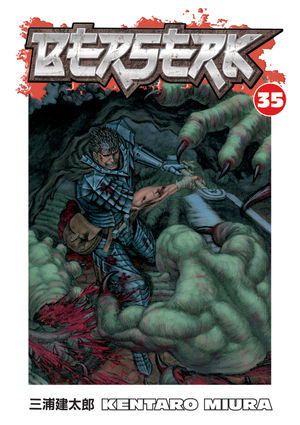
When I read Berserk, the high energy of Miura's art inspires me. For me, his style is similar to another favorite of mine on the Super Hero comics shores, George Perez. It has a ton of detail and a lot of movement to it.
In this volume, we see further ramifications of past events continue to unfold. This provides some good ground work for those who run episodic adventures with an other all theme or arc. In this instance, Guts efforts to save Caska by taking her to the isle of the fey comes under complication when a pirate ship falls pray to the new madness and in turn becomes an enormous threat. In D&D 3rd edition, this could easily be done through the addition of templates, class levels, or other such goods. In other versions of the game, depending on how serious the GM is taking it, he might just rewrite the material and hand wave the reasoning.
In addition, since the ship takes some damage in their battle with the monster ship, the group is forced to make landfall on an island.
Islands are great bits for fantasy games for several reasons.
1. They can be isolated. This allows the GM to throw in things that are older than the standard setting in terms of dress, eating, religion, weapons, attitudes and outlook.
2. They can be isolated physically. Sure, the weird natives might be giving off a Wicker Man vibe and setting up all sorts of unpleasant events, but the real problem is that there's no damn way off an island outside of repairing the wreck you came in.
Movies like Cast Away or television shows like Lost showcase some of the other problems with an island. Equipment may be hard to come by for example. Isolation from the mainland may cause strange mental illness to forment on those isolated too long.
But in a fantasy game, there could be other issues.
For one, the island itself could be alive.
For another, the island could be slowly moving through the planes.
For another, the island could be at a center of power that attracts all sorts of weirdness to it as individuals try to harness this energy in ritualistic manner.
Another useful thing about islands, is that if you're not making them a continuous stop or part of the setting, it's not that big a deal to wipe out the inhabitants to showcase how vile a particular monster is. In this case, the creature that's coming after Guts and his party has destroyed the village and absorbed them, making them new monsters that come against the party.
Another thing to note about islands though, in all this talk of flesh eating and isolation, is that they make a good point in a sea campaign to introduce new players. In this instance, Isma, a native to the island whose mother is supposedly a mermaid and whose life is outside the town, showcases how to introduce a new character that has reason to trust the party (isolated from the other inhabitants of the island) and is full of the desire to explore and leave the small town behind. It works well in this instance and provides more fuel for the unusual side of the Berserk saga.
Berserk 35 isn't going to bring in any new fans to the series but it doesn't disappoint the old fans. The kinetic art and action provide a lot of fodder for the imagination and the new character brings more complications to the young 'ens of the cast.
Thursday, October 6, 2011
Prince of Thorns by Mark Lawrence

I love the cover of this book. It's a simple piece that would work fantastic as a miniature with a character in apparently some type of light armor with a nice fancy hilted sword with a hooded cloak where the cap is moving. Dynamic but static.
In terms of the book, it's got a lot of grit going for it but I'm a little undecided if I like it or not. the main character is a little too competent either through blind stupid luck or through bad assery that makes me think this kid could bitch slap Elminster and while that would be amusing, it just rubs me wrong in some ways.
In terms of spoilers, they'll be coming below because I'm going to talk about intangibles as they relate to setting the tone of a campaign.
Prince of Thorns isn't heroic. It's not even friendly. the character isn't even an anti-hero. But how could you do this in a role playing game? How could you model having 'brothers', a group of murderous bandits, working with the Prince, a player, and showcase the tone you're trying to set?
First off, let's discuss the brothers. By being part of a bandit group, Mark Lawrence has provided the main character with a group of characters he can easily kill off and most people aren't going to care or blink an eye. This almost harkens back to older editions of Dungeons and Dragons with hirelings. "You there peasant, take this mighty one silver and take up arms against yon ogre for a further single piece of gold!" Of course morale was a game factor too in the day eh?
But in terms of showcasing a setting, you can crib the following without having to resort to game mechanics.
1. Life is worthless. The main character is almost assassinated by an enemy from one of the Hundred Kindgoms that make up the setting and his father, instead of taking vengeance against the murderer or his wife and his youngest son, makes peace through concessions from the enemy king.
2. Life is worthless. Kill some of the 'brothers' or bandits, or hirelings in standard tasks or fights. For example, in the book, while the characters are climbing a mountain, one of them falls to his death. Another character suffers a cut from a farming implement and dies as a result of infection.
3. Life is worthless. Introduce a whole new race of creatures and entities that the players interact with a bit and have a few of those new found humanoids join the player characters. Then destroy the rest of the race while the players continue their trials and journeys.
4. Life is worthless. Have the players use every means at this disposal to win, even if that win results in mass overkill and the destruction of hundreds of people. Some may argue that the method used in the book needs rules when Jorg, the Prince of Thorns, destroys another kingdom. They may note that it is science that destroys it! Humbug. In Eberon and the Forgotten Realms we've got numerous scars and blisters on the land that are the direct result of magical armagedon. Rules only matter when destroying a kingdom if you want them to matter.
5. Life is worthless: In having the players use every means at this disposal, push them against the boundaries of the standard fantasy tropes. This is done twice in the novel. The first time, Jorg kills a man so skilled with the blade that this knight is able to out fence Jorg's champion, who himself is a master duelist. Jorg however has no problem provoking the knight, running into a guard, snatching a crossbow and putting one through the blademan's skull. This is allowable because Jorg is the King's son and the king is impressed with this show of ruthlessness. In another venue, Jorg is in a knightly tournament and goes for the kill on numerous knights. Because Jorg not only survives in that arena but takes out the king of that realm, he is able to avoid repercussions from it.
6. Life is worthless. Have the 'brothers', the brigands that you've been so eager to kill off in the most minor of fashions to showcase how fragile life is, ready to turn on the players if they're not always at the peak of the game. It's not just that life is worthless for them, it's worthless for the players if those slip and showcase mercy or weakness. Have some of the 'named' brothers challenge the players after a particularly tough battle or when a loved one dies as an opportunity for the player to man up or be put down.
By focusing on the things you want the campaign to convey, regardless of the game you're running, you can do a far better job than if you sat around making up rules for diseases that lice may be carrying or what the chances of players catching infections from having sex with villager's unwilling daughters. Focus on the mood. Focus on the atmosphere. Focus on the tone.
Sunday, October 2, 2011
Samurai Champloo
One of the benefits of actually having two days off in a row, is I caught up on Samurai Champloo. I'd been hearing good things about it for a while now, especially in compassion to Cowboy Bebop. While I enjoyed it, I'd have to say that the larger cast in Cowboy allowed it to tell more within its frame work as Samurai Champloo uses only three main characters and towards the end veered off into some weirdness that topped anything Bebop did.
In terms of character, I'll let Wikipedia do the work;
Mugen: A brash vagabond from the Ryukyu Islands, Mugen is a wanderer with a wildly unconventional fighting style. He wears metal-soled geta and carries an exotic sword on his back. In Japanese, the word "Mugen" means "infinite" (literally, "without limit" or "limitless").
Jin: Jin is a reserved ronin of 20 years who carries himself in the conventionally stoic manner of a samurai of the Tokugawa era. Using his waist-strung daishō, he fights in the traditional kenjutsu style of a samurai trained in a prominent, sanctioned dojo. Jin wears glasses, an available but uncommon accessory in Edo era Japan. Spectacles, called "Dutch glass merchandise" ("Oranda gyoku shinajina" in Japanese) at the time, were imported from Holland early in the Tokugawa period and became more widely available as the 17th century progressed. In Japanese, the word "Jin" means "benevolence" or "compassion."
Fuu: A feisty 15-year-old girl, Fuu recruits Mugen and Jin to help her find a sparsely described man she calls "the samurai who smells of sunflowers." A flying squirrel named "Momo" (short for momonga, "flying squirrel") accompanies her, inhabiting her kimono and frequently leaping out to her rescue.
Mugen, is, in many ways a player character to the bone.
He is interested in showcasing his strength and little else. This demonstration of physical prowess isn't necessarily limited to just swordsmanship though. When there is a contest for eating, he joins. When there is a graffiti contest, he joins in. When there is a baseball game against Americans, he wins it. When not being able to read becomes something his comrades are able to harass him about, he learns it. In this, he is much like Guts of the manga Berserk in some of the early material. His goal is to find strong enemies so that he himself may become stronger.
His adventuring spirit though, isn't just killing. It's living life the way he wants to. He has no use or need for social conventions. He's perfectly happy fighting against lawmen as well as bandits. This allows him to be put into many situations that a paladin or other good type of character would inherently avoid.
Jin on the other hand, like Usagi Yojimbo from the graphic novels and comics, suffers a bit because he's a true believer of the samurai caste and its meanings. Because of this, and the fact that the lands are now at peace, the true value of armed men is diminishing and doing so rapidly. Who needs a standing army of soldiers when there is no war? This theme of a soldier without a war is used often when dealing with Samurai in films such as Hari Kari, an old classic of soldiers out of luck and needing support to comics such as the already mentioned Usagi Yojimbo.
It's one of the reasons why having characters active in a time of danger, in a time of trouble, is often more viable. There are things to do when the country is at war and when times are tough. When things are good, its time for another type of character such as yakuza or nobles or rising merchants. For a warrior, things are difficult in these times because they're not needed nor wanted.
Jin finds himself fighting against what he sees as the corruption of the samurai spirit starting from the first episode, asking if its worth serving a corrupt lord when service is part of the samurai creed, but to do so to those who are foolish or greedy or otherwise unworthy of that service, renders that need to serve false. It is why he walks the road alone as opposed to being the head of his own school.
The two are an interesting contrast in many ways.
The former, a wild fighter looking only to test his strength, and the later willing to walk the line of Bushido even when its inconvenient to do so.
The show has several other bits going for it that a GM might want to crib for his own game.
For one, there is a showdown between Jin and a blind assassin. The battle takes place on a narrow wooden bridge. This prevents a lot of movement and fancy footwork. The environment becomes its own thing.
On another showdown between Mugen and an assassin, they fight on a boat. The small boat capsizes and puts the battle underwater. Try to keep some options available for those scenes where it needs to be dramatic and needs to move fast paced.
In terms of pacing, while the series does follow an overall goal of finding a specific individual, most of the episodes are very self contained. This type of campaign would be an easy model for a GM to run with an over arching goal and various encounters that the GM puts together between sessions to keep things moving along.
Samurai Champloo does mix a lot of modernismsbling or having other aspects of 'gangsta' life hit the points of let default setting that 4e uses.
Samurai Champloo is worth a viewing and Netflix has it for those with that service.
In terms of character, I'll let Wikipedia do the work;
Mugen, is, in many ways a player character to the bone.
He is interested in showcasing his strength and little else. This demonstration of physical prowess isn't necessarily limited to just swordsmanship though. When there is a contest for eating, he joins. When there is a graffiti contest, he joins in. When there is a baseball game against Americans, he wins it. When not being able to read becomes something his comrades are able to harass him about, he learns it. In this, he is much like Guts of the manga Berserk in some of the early material. His goal is to find strong enemies so that he himself may become stronger.
His adventuring spirit though, isn't just killing. It's living life the way he wants to. He has no use or need for social conventions. He's perfectly happy fighting against lawmen as well as bandits. This allows him to be put into many situations that a paladin or other good type of character would inherently avoid.
Jin on the other hand, like Usagi Yojimbo from the graphic novels and comics, suffers a bit because he's a true believer of the samurai caste and its meanings. Because of this, and the fact that the lands are now at peace, the true value of armed men is diminishing and doing so rapidly. Who needs a standing army of soldiers when there is no war? This theme of a soldier without a war is used often when dealing with Samurai in films such as Hari Kari, an old classic of soldiers out of luck and needing support to comics such as the already mentioned Usagi Yojimbo.
It's one of the reasons why having characters active in a time of danger, in a time of trouble, is often more viable. There are things to do when the country is at war and when times are tough. When things are good, its time for another type of character such as yakuza or nobles or rising merchants. For a warrior, things are difficult in these times because they're not needed nor wanted.
Jin finds himself fighting against what he sees as the corruption of the samurai spirit starting from the first episode, asking if its worth serving a corrupt lord when service is part of the samurai creed, but to do so to those who are foolish or greedy or otherwise unworthy of that service, renders that need to serve false. It is why he walks the road alone as opposed to being the head of his own school.
The two are an interesting contrast in many ways.
The former, a wild fighter looking only to test his strength, and the later willing to walk the line of Bushido even when its inconvenient to do so.
The show has several other bits going for it that a GM might want to crib for his own game.
For one, there is a showdown between Jin and a blind assassin. The battle takes place on a narrow wooden bridge. This prevents a lot of movement and fancy footwork. The environment becomes its own thing.
On another showdown between Mugen and an assassin, they fight on a boat. The small boat capsizes and puts the battle underwater. Try to keep some options available for those scenes where it needs to be dramatic and needs to move fast paced.
In terms of pacing, while the series does follow an overall goal of finding a specific individual, most of the episodes are very self contained. This type of campaign would be an easy model for a GM to run with an over arching goal and various encounters that the GM puts together between sessions to keep things moving along.
Samurai Champloo does mix a lot of modernismsbling or having other aspects of 'gangsta' life hit the points of let default setting that 4e uses.
Samurai Champloo is worth a viewing and Netflix has it for those with that service.
Saturday, October 1, 2011
Dai-San by Eric Van Lustbader
I bough Dai-San from Half-Priced Books for the royal sum of $1.00. Despite the fact that it's the third in a series, and unlike today's mammoth telling, is actually the end of a standard trilogy, I didn't have a problem following what was going on for the most part. There were a few times when the sparse descriptive writing of Eric left me wondering what exactly I was supposed to be 'seeing', but for the most part, not a problem. Eric's writing style in other aspects of the book was meaty and good for those who are playing fighters or other martial types in describing the physical attributes of the act of combat, such as taking deep breaths to oxygenate the body or adrenaline coursing through the veins and other bits.
For gaming purposes, there were a few things I'll try to remember.
As characters gain levels, they become more powerful in many ways. Here, Ronin, the Sunset Warrior, undergoes a physical transformation. In 3rd edition D&D, I recall an adventure where the characters, at 20th level, can enter a pool that provides them with abilities and opens the door for the new then epic rules.
In 4th edition, the characters are broken into three tiers; heroic, paragon and epic.
What if when the characters reach these new levels they actually undergo a physical change? That hair, eye, even physical frame, all change. In earlier editions character's stats didn't change through level advancement, usually only magic, especially a wish spell, could do such wonders. In later editions though, stat modifications, while not an every level thing, were possible. What if the characters physically change to showcase those new traits?
In other aspects, when Ronin meets a monstrous creature that he's fought in the past with great difficulty in just surviving, he's not on more than equal terms. Allow players to encounter old enemies that would've resulted in a TPK and allow them to glory in their new found powers and abilities.
On the same vein though, don't be afraid to throw advanced versions of those already powerful creatures at the players. In this case, Ronin manages to overcome these old foes but then learns that there are more powerful versions of these monsters out there. It allows him to have his moment of glory and revel in his new found power, while still reminding him that he is not invulnerable.
For the big boss, while I felt the book had too much of a 'easy' victory, the method of introducing the final villain struck me as something that 4e could easily do. In this instance, Ronin is fighting the Salamander, an ancient being who has sold out mankind and is the author of much of the misery in Ronin's life. When Ronin kills this adversary, the final adversary emerges forth from the corpse. In 4e, this might be a change of monstrous abilities when the creature reaches it's 'bloody' state or half its hit points. This would allow the GM to essentially use two completely different monster stats for one encounter.
Other staples are present. For example, Ronin or the Sunset Warrior as he becomes, uses a named katana. This is a blue green blade. His armor is also of a unique nature with things like a red jade helmet. This naming of things, of providing them with a unique description, customizes the characters and setting. It doesn't take much but makes the characters stand out a bit more.
If Eric Van Lustbader ever puts the Sunset Warrior Trilogy out in an affordable ebook format, I'm down for the first two.
For gaming purposes, there were a few things I'll try to remember.
As characters gain levels, they become more powerful in many ways. Here, Ronin, the Sunset Warrior, undergoes a physical transformation. In 3rd edition D&D, I recall an adventure where the characters, at 20th level, can enter a pool that provides them with abilities and opens the door for the new then epic rules.
In 4th edition, the characters are broken into three tiers; heroic, paragon and epic.
What if when the characters reach these new levels they actually undergo a physical change? That hair, eye, even physical frame, all change. In earlier editions character's stats didn't change through level advancement, usually only magic, especially a wish spell, could do such wonders. In later editions though, stat modifications, while not an every level thing, were possible. What if the characters physically change to showcase those new traits?
In other aspects, when Ronin meets a monstrous creature that he's fought in the past with great difficulty in just surviving, he's not on more than equal terms. Allow players to encounter old enemies that would've resulted in a TPK and allow them to glory in their new found powers and abilities.
On the same vein though, don't be afraid to throw advanced versions of those already powerful creatures at the players. In this case, Ronin manages to overcome these old foes but then learns that there are more powerful versions of these monsters out there. It allows him to have his moment of glory and revel in his new found power, while still reminding him that he is not invulnerable.
For the big boss, while I felt the book had too much of a 'easy' victory, the method of introducing the final villain struck me as something that 4e could easily do. In this instance, Ronin is fighting the Salamander, an ancient being who has sold out mankind and is the author of much of the misery in Ronin's life. When Ronin kills this adversary, the final adversary emerges forth from the corpse. In 4e, this might be a change of monstrous abilities when the creature reaches it's 'bloody' state or half its hit points. This would allow the GM to essentially use two completely different monster stats for one encounter.
Other staples are present. For example, Ronin or the Sunset Warrior as he becomes, uses a named katana. This is a blue green blade. His armor is also of a unique nature with things like a red jade helmet. This naming of things, of providing them with a unique description, customizes the characters and setting. It doesn't take much but makes the characters stand out a bit more.
If Eric Van Lustbader ever puts the Sunset Warrior Trilogy out in an affordable ebook format, I'm down for the first two.
Subscribe to:
Posts (Atom)


