Sunday, September 8, 2024

Conan vs Barbarianism

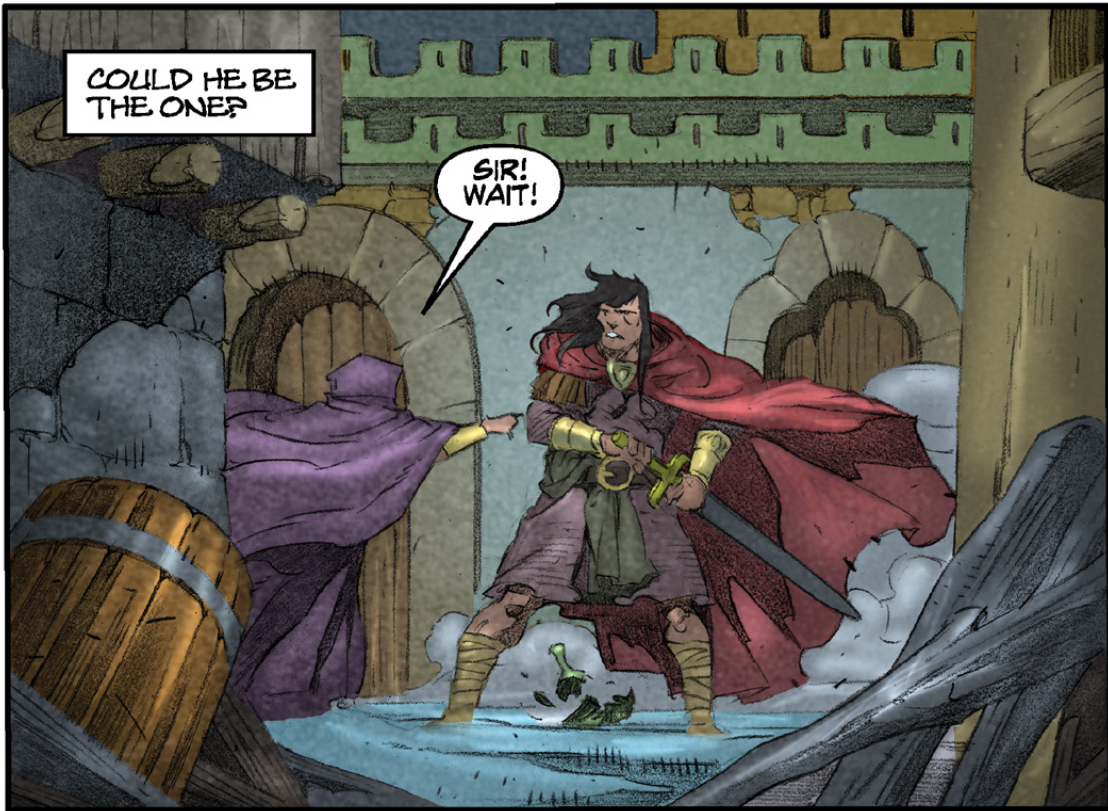
 One of the themes that Robert E. Howard returns to again and again in his Conan tales, is the idea that civilization is a temporary thing that must be wiped out by barbarianism.

That's nonsense, even in his own writing.

Conan on the other hand?

Well, as the protagonist, even when he should be dead multiple times over from a wide variety of sources, he changes the tide and sets the course.

If barbarianism had been the superior way, Conan would've died multiple times over because as often as he's written in the bowels of deep civilization, he's also against those with whom he shares more in common.

And because he's the protagonist, he's better at almost every single thing they do than they are.

Conan is a Cimmerian. It's hill country.

Try telling that to the dozens if not hundreds of Picts Conan has killed. Doesn't matter if he's ambushing them in the woods, his own hunting and woodcraft far outstripping 'barbarians' whose lifestyle Conan is emulating, or just outrunning them over open terrain and avoiding them shooting at him as he's climbing up a ledge and casually pulling arrows out of his legs.


It doesn't matter if he's on the frozen plains fighting against the Vanir. He's better than the Vanir at everything they do.


It doesn't matter if he's a Pirate off the coast and raiding countries that no civilized people even know about when he's fighting with and for the Kushites.

Barbarianism isn't the answer to civilization.

It's Conan.

Saturday, September 7, 2024

Conan Is Not A Hero

 One of the things that I've debated with others about is the difference between Conan being the protagonist and Conan being a hero.

Sometimes herosim can be a difficult thing to define.

For example, Conan often has a sense of honor and a sense of fair play. It's rare for him to betray someone even if he knows that person is going to try to do him in.

And Conan meets a lot of fellow rogues and slayers and he trusts them because of the whole honor among thieves.


Because Conan is the protagonist, this works well for him. Things don't even well for the Prince of Thieves here.

But here's the thing.

Conan is here breaking into someone else's place. Mind you, those who try to cast Conan as a hero often note, rightfully so mind you, that those Conan steals from, are often the worst of the worst. In this case a wizard necromancer who tortures and enslaves others.  Whose wealth and power give him full domination over the city and its rulers.

But we have to be clear.

Conan isn't doing it to rid the city of the necromancer. He'd rather not even meet the necromancer if possible.

This doesn't count other times where due perhaps to his nature, Conan repays those wrongs done to him even if those wrongs were done while helping Conan. For example, in A Witch Shall Be Born, ther'es a scene where Conan is nailed to a tree. It was made popular in the movie, but it took place in this story first.


This is another one of those things where Conan should've been dead but he gets saved by an outside force. But when he's saved, his savior does not do it gently and Conan suffers a bit for it. As soon as he's well, he repays that saving by crushing the dude 's wrist and banishing his savior from his own band of rogues.

There's another story where Conan drags himself out of the Sea into a boat, ingrains himself into the crew, follows the Captain ashore, and literally murders him. And note, since we're talking Cimmerian September, I'm just sticking with Robert E. Howard stories.

Again folks, Conan is no hero.

One could argue that in the world of Hyborea, where Conan is an adventurer, there are no real heroes, and today's allies may become tomorrow's enemies. 

These things are true.

But those elements don't fit into D&D and its nine alignment systems. Conan commits great acts of savagery and also acts as a savior. He's almost never a casual murderer and does not go after women and children.

When looking at the idea of inspiration for your TRPG games, try to remember, games like GURPS and Hero, where one can take disadvantages that indicate one's personality, like 'Honorable Strong' or 'Fears Magic' etc... are more likely to be useful than D&D where it boils down to "What's your alignment?"


Friday, September 6, 2024

Conan is the Choosen One

 So I've mentioned it before, but Conan, the barbarian, is saved through all sorts of things or just doesn't die when he should.

He falls further than he should be able to survive but hits something that saves him.

He's overcome but his enemies leave him for dead.

He's about to be killed, but unexpected allies show up.

He's about to be killed, but unexpected enemies show up.

He's about to be hunted down, but his enemies realize he's on sacred ground or something similar and leave him alive.

One could argue those are all just bad writing plot devices. They are and these examples all happen under Robert E. Howard's pen. If you were going to add other writers the list would be nearly endless. The list of Conan being a chosen one would be near endless too,

But for Howard himself? Yeah, Conan is still the chosen one.

Here's a princess literally being told by the servants of Mitra in Black Colossus, available in The Coming of Conan the Cimmerian https://amzn.to/4dYywVh, to place the kingdom in the hands of the first man she meets.

It's Conan.


And that's fine.

But it's another showcase that Conan, even under the hand of his original author, is a chosen one.

He'd kinda have to be since the very first story of Conan is him as a king.

There's no worry that he's going to be killed ahead of that eh?

So when you see the Bro OSR chest thumpers talking about how the old school is the best school because it's sword ad sorcery origins give it a more fatal scenario of how characters live and die, know that they either haven't read the original Appendix N books or they're ignoring the heroes of those books to utilize the old school rules as a club to kill characters.


Sunday, September 1, 2024

Conan, Dungeons and Dragons, and Surviability

The difference between Inspiration from a source of material, even one found in Appendix N, and game play itself, can be vast.

One of the things that cracks me about personally about some of the 'Bro OSR' or the hardcore OSR players, is that it's too hard to die in 5th edition and the character death is needed to make the stakes real.

Those folks either ignore all of Appendix N or decide it's inspiration was in the monsters and dangerous bits.

Even the blood soaked savage Conan is saved often through sheer nonsense.

In the first tale of Conan ever penned, The Scarlett Citadel, available in this collection, The Coming of Conan the Cimmerian (Conan the Barbarian Book 1) https://amzn.to/3TfFPzI , Conan is saved from certain death by some dude we as the readers have never heard of before.


It's literally the first time this sort of hand waving to save Conan occurs, but it's far from the last time it happens. There are times when Conan is left for dead, as happens in The Hours of the Dragon (available The Bloody Crown of Conan (Conan the Barbarian Book 2) https://amzn.to/3X5GdBX ). Heck, a re-read of Hour of the Dragon shows it happens several times including once when he's left in a field where ghouls try to eat him and he awakens 'luckily' enough in time.


If you've ever seen some of that 'hardcore OSR talk', you'll know what I'm talking about. Stabbing downed enemies and mounting their heads on pikes and that sort of stuff. and other times when some other unlikely circumstance saves him.


Elric, Corum, and others in the original Appendix N all have similar moments.


When deciding what the fatality levels of your campaign are, don't feel too bad if you push them to not be as strict as the original 1st ed AD&D where death at -10 is something mentioned in the DMG but not the Player's Handbook. You're staying true to the source material that inspired the game.

Saturday, July 6, 2024

Corum and the art of killing Gods


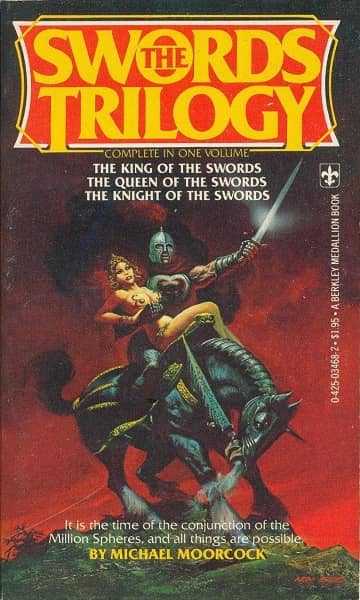
In Michael Moorcock's first Corum Series, the Swords trilogy, Corum must save his 15 planes from the powers of Chaos.

These powers are represented by the Kight, Queen, and King of the Swords.  For those who are more familiar with Michael Moorcock's Elric series, the Knight of the swords should be very familiar as it's Arioch, Elric's patron demon god.

Over the course of three novels, Corum dos manages to banish these gods.

Depending on the edition of Dungeons and Dragons you've run or played in, this might not seem that odd. Early editions of the god featured stats that, while powerful, were not so out of line that a group of players couldn't kill them.

Third party companies like Wizards of the Coast, when they were producing TRPG content, even made a series of books to augment gods with Primal forces which cut through mortal defenses. That was The Primal order series of books. Fun stuff. Find it if you can. Greatart.

But back to Corum.

Corum, at this point, has two artifacts, the Hand of Kwll and the Eye of Rhynn. They are described in detail. The hand is physically powerful and Kwll, unknown to Corum, controls the hand directly in several cases to save Corum's life.

So how does one go about killing the gods?

The Knight of Swords notes that Gods have to keep their heart separate from themselves so that the other rules know their whereabouts. Corum has to destroy it. Arioch leads him around, and Corum deduces where it is.

But it was a game because Arioch was unable to remove his own heart and Corum, taking it from it's chambers, has done Arioch a service.

Oh no!

So Corum's hand does the logical thing and crushes it. This banishes Arioch.

So no actual fight. No big battle. No clash of swords. 

The Queen of Swords is enraged at her brother's banishment. But she cannot go to Corum's five planes. There are rules of balance after all. The Eternal Balance must be maintained.

But Corum angers the Goddess so much she decides she is more powerful than the balance itself! She enters Corum's plane and... the Cosmic Balance Banishes her.

The King of Swords gets to meet the lost god Kwll directly. Corum, after finding Tanelorn, the city of refuge, the city of peace, a city with as many incarnations as there are champions, discovers that this Tanelorn is being used to imprison Kwll.

Kwll wants his hand back. Corum asks him to fight Chaos. Some back and forth and we get Kwll kind of agreeing but not really.

But then when it comes time to fight, Corum is shocked at the raw forces of chaos arrayed against them and tells Kwll to retreat and not honor the bargain.

Kwll gives a great line. "I made no bargain." And proceeds to destroy all the gods of chaos reamining.

Oh, and all the gods of law.

I don't point these out to indicate that it's lame or a cop-out. But to indicate that sometimes the way characters win, especially in older tales where the heroes have no direct manner of winning, no sword strength or sorcery powerful enough to win, there are often other ways to win.

Many of Corum's adventurers could be done with skill checks and investigation. Rare is it when Corum solely wins through strength of arms, and many times when he does, it is in a situation where he did not wish to do so, but Kwll controlled the hand and forced him to violence.

Think about how things can be accomplished in your own games that don't involve swinging a sword. Are there multiple paths that will get the players to the same place? Some are easier than others. Some provide a greater reward with risk than others.

Corum is an interesting read in that when Gods die, they don't die but are merely banished and have a host of early ideas that others have built upon. Go check them out.


Thursday, July 4, 2024

Corum by Michael Moorcock


As a preteen, I read a lot. My father lived by Diversy and where Clark and Broadway merged. There were several bookstores and used bookstores in the area.  Mind you, this was before Barnes and Noble and even Borders. We had Crown, Waldenbooks, Barbarba's Books, and the bookstores that were used, among others.

So I was always buying books and back in those days at least, reading them.

The above picture is the one I picked up for Corum. I was a fan of Michael Moorcoc, via Elric like many before me.

Corum, though, is a bit different. 

I've reread the original a few times and read the First Comics adaptation, now available via Titan in the Michael Moorcock library. We readers didn't know how lucky we were to have Mike Mignola, famous for his creation Hellboy, on hand for those earlier volumes.

I'm lucky enough to have an hour lunch and I've been listening to audio books so I figured it was a good time to revisit Corum.

What's the old saying?

No man steps in the same river twice for the river has changed and so has he?

Some themes were far more obvious to me this time around, and I was just scratching my head at how dumb Corum appeared to be. 

The writing is evocative and I recommend anyone interested in the history of fantasy read it as it was written in 1971 so in and of itself stands as a historical artifact. It's also not by an American author and while we can argue a man of England isn't that far off, the author has always brought his own viewpoint to things.

As a youth, when I first started in TRPGs, when playing Advanced Dungeons and Dragons 1st ed, one of the things that was fascinating about Corum, was the hand and eye he bore in the first trilogy. In AD&D, we had the hand and eye of Vecna. Clearly Gary had been reading Moorcock as well eh?

Corum even had a one book TRPG products that was licensed from Chaosium who had the rights at the time. I do not recall it with any fondness as I remember reading it and it didn't have details on the  Eye of Rhynn and the six-fingered Hand of Kwll. It would be like buying the Stormbringer TRPG and it not having states on Stormbringer. 


Like some of the works of Robert E Howard, the author famous for Conan, but also the creator of Kull, Solomon Kane, and others, these books fall in and out of publications with some frequency.

The last hardcover I have is of the White Wolf edition when they were doing a 'library' collection, and they did Moorcock's worst as well as Fritz Leiber, known for his tales of 'the Twain'.


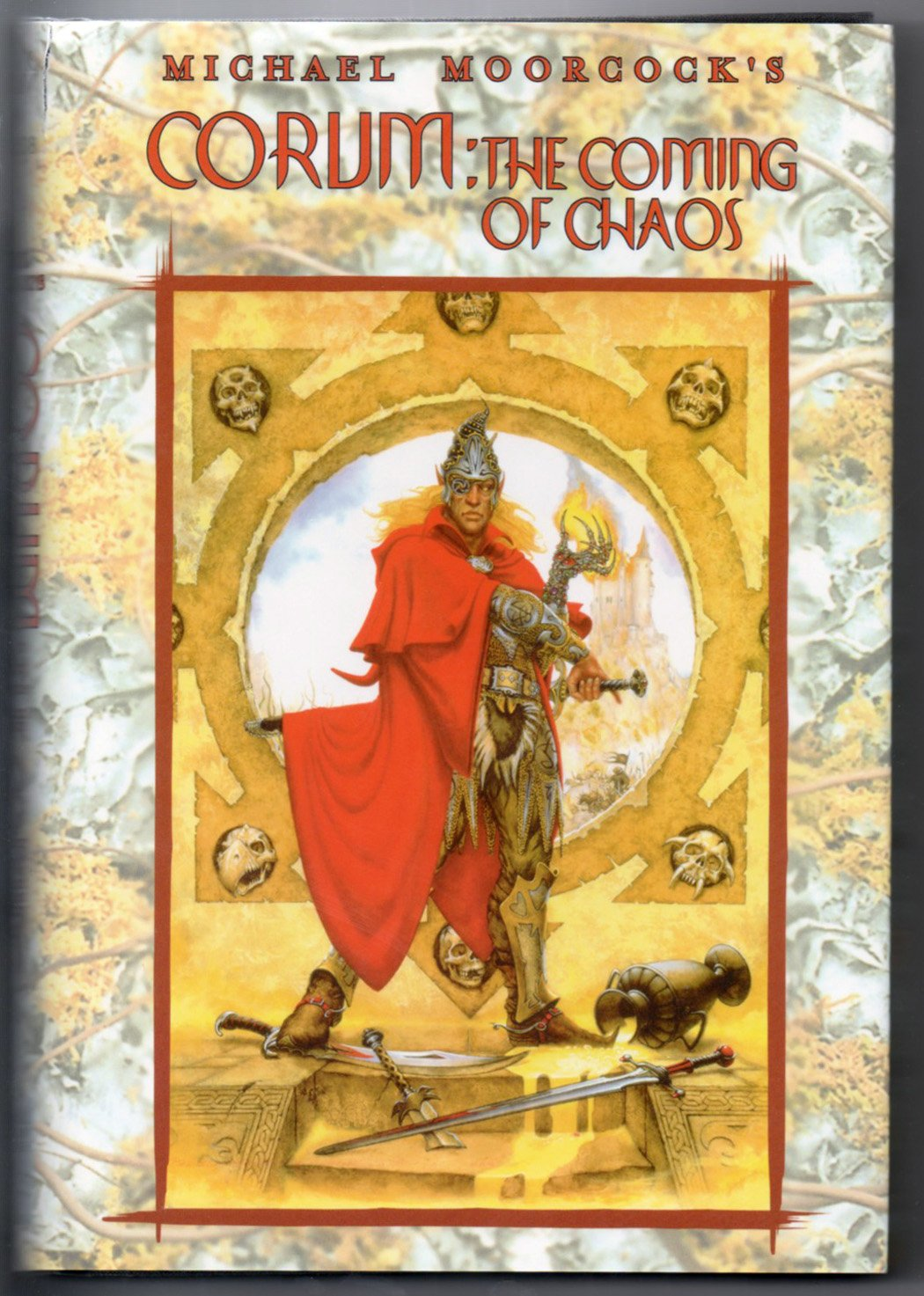
Corum has a new collection out, though, with a cover that's cropped from an older cover. I love the design on the original cover. It reminds me of the Ace versions of the Elric paperbacks I had, with the design and art style. Strangely enough, there's no e-version so if you read things in e-version like I do these days, to say on space mostly, you're out of luck.


I'll try to return to some actual gaming throughs on Corum. Having listened to all six of the novels recently and back to back, a lot of things really stand out in terms of how the author handles quests and whats expected of the hero. Some of it might be useful for gaming both in terms of what not to do and what to take inspiration from.

Saturday, April 6, 2024

Monkey Man for TRPGs


Monkey Man is a modern action film (2024) that brings a different perspective to the screen in that the action takes place in India.

It engages in action scenes and sequences worthy of films like The Killer (2023 version), the Equalizer, the Beekeeper, and others, but I'd put it more in the sequence of John Wick.

While all of the main characters mentioned above are greats, the first three are often untouchable by their foes.

John Wick? Not so much.

And in Monkey Man, we are introduced to 'the Kid', who like John Wick, takes the abuse and keeps coming back for more.

But how can you use a movie set in India for your own games?

Sadly, many of the themes that run through Monkey Man are fairly universal.

Corruption: Here we see a system of corruption that runs through the whole of society. This includes the political, police, and religious figures. All have their fingers deep in the pie and all embetter themselves at the cost of everyone around them.

The Police: Having corrupt officers is a common theme in many countries. The opportunity to self-enrich while promoting the public good is all too often taken. This may result in the police literally stealing from people when they come across something the police think that the other people shouldn't have. "Where would you get this much money legally?" to acting as enforcers to other bad elements.

For an American take on corruption of the police, the movie Training Day or the television series the Shield should both be viewed.

The Priest: In a fantasy campaign, it can be more difficult to have a 'false' priest due to the nature of how, in many games that say use a pantheon, are directly powered by their gods. The gods are often a known factor it can be a little more tricky unless something takes out the actual god and then instructs those willing to follow it under the new mask root out all of those who are not 'heretics'.

In a modern game, a corrupt priest is far easier to see. America has many mega-churches whose teaches indicate a lot of worship of wealth. 

But what if in addition to the accumulation of wealth, they went out of their way to do other things? What if the church needed more land and a group of squatters needed to be removed?  Why then you call you good friends in the Police...

Tiers of Society: While officially the caste system is no more, much of its ramifications in Inda are still felt. So how does that work in other countries? In America, at least, anyone who thinks that there aren't different 'castes' of society isn't paying attention. These range from merely places to eat to places to be seen. 

If trying to use those elements in a campaign, the question is how the characters fit. In modern games like super-hero games, it's one thing for Tony Stark to be allowed access to someplace like The Hellfire Club, but it's quite another for someone like Peter Parker, the down-on-his-luck Spider-Man, to have the same access.

In such an instance, merely getting access TO those places is if not an outright adventure, a plot point. In Monkey Man, the Kid uses his network of overlooked poor people to first steal the purse of a powerful CEO and then personally return it to her, getting him a job on the inside. 

Not all entrances are through the front doors.

Drugs: While not a center point of the movie and further used to drive home the corruption and opulence of the upper class, drugs are a common sight in such situations and can be used as a reference point for many different elements. For example, disregard of the law. Illegal drugs were handed out like candy in special vials.  On the other hand, alcohol being served had a different purpose. It showcased that certain wines with certain meals and into certain glasses. Not knowing those things by default is seen as a mark of a lower classed person and for anyone trying to infiltrate such an organization, a dead giveaway.

Undesirables: Part of the tiers of Society is the haves. Those who dwell in the upper reaches of society, but then there are the have-nots. The undesirables if you will. And there are always more of them then there are of the upper crust.

In Monkey Man, we see this contrasted in many ways. From where the Kid sleeps amongst multiple others to the church he winds up taking refuge in after he's a wanted man. In that church, because the people dwelling there are 'undesirables', no one even thinks to look for the Kid there.

These unknown by greater society locations can act as a getaway from higher powers but that usually comes with a cost.

For example, in the comic the X-Men, one of their summer events was the Mutant Massacre where the Marauders went into 'the Tunnels' to take out the Morlocks. These 'Tunnels' were often underused and acted as a 'forbidden' place for normal people to go. If there are a few places like that known to the characters, allow them to take advantage of them to evade pursuers.

The Action: No discussion of Monkey Man and the Kid would be complete without discussing the action. While its a common theme, try to encourage players to have their characters take advantage of their local surroundings. Several of the fight sequences here take place where day to day activities have items that aren't used as weapons, but could be.

The Kitchen: The kitchen is the biggest example of this. Between a variety of heavy boards for cutting, dishes for plating, and well, silverware, including knives for cutting, the kitchen is a place where many things can be used as improv weapons.

Need to set something on fire in the kitchen? Between the various oils and fats and open flames, that shouldn't be a problem.  Need to set up an explosion? Are these gas stoves being used?

Dining Room: While not as dramatic as the kitchen perhaps, there are still plates and glasses. Breaking open a bottle of wine on an enemy's skull and then stabbing him in the throat with it are great examples of on hand weapons. This doesn't count things like jumping from table to table or bashing someone's brains out with a heavy chair. And if there's a bar in the dining room? Another place to jump atop and dual wield heavy bottles.

Monkey Man has a lot going for it and if you're running a modern campaign, fairly easy to lift wholesale into your own campaign in terms of ideas and characters. 

Saturday, August 11, 2018

Wolfheart by Richard A Knaak


Wolfheart
Written by Richard A. Knaak
World of Warcraft
$7.99 in Kindle Format

I'm a fan of Richard A. Knaak from way back in the 80's. I read his Legend of Huma and Kaz the Minotaur as well as his numerous Dragonrealm series. In those days Dark Horse and the Gryphon were some unique characters although the Farmboy who saves the world cliche was in full bloom.

Since then Richard A. Knaak has done work for a variety of properties including Diablo and World of Warcraft.

The last time I knew anything about Warcraft, Thrall was warchief, Night Elves were an almost unknowable immortal force and there were many stories to yet to be told.

So licensed settings change quick yeah?

Thrall is apparently dead. There's a brand new warchief in play and he isn't a fan of "can't we all get along." Instead, he's an aggressor. He leads the Horde on a mission against the Night Elves and the Alliance.

The Night Elves? No longer immortal. They are aging and susceptible to disease. One of the characters introduced in the book, Jarod Shadowsong, is brought in trying to save his lover, Shalasyr, whose once immortal frame cannot resist the lure of death anymore.

Mind you, much like many older characters, the pains and aches of these Night Elves are for storytelling purposes only. Few of them are ever hindered by these aches. There's not a "Malfurion staggered and fell to the ground clutching his chest knowing that the foe would get away this time..." No, it's purely a storytelling device used here.

The Alliance? Well, it's got members I don't recall hearing about before, including some dark dwarves whose portrayal as being paranoid of others up to the point of bringing their own food to large gatherings, such as that of the alliance, is entertaining and gives us a different take of the dwarf.

The gnomes and goblins of the Warcraft setting, always playing with technology that is resource intensive and dangerous to both user and enemy, are in full force here as well.

In terms of readability, I enjoyed Richard's work even though so much had changed. If you like the World of Warcraft and are a regular reader, the changes might be normal for you or you might already be passed these. This is a done in one book that ties into the other books and history of the setting so it's a fixed point in time in a setting that keeps moving forward.

Made me glad that I wasn't playing a game in the setting. I get mad enough when events like the Spellplague happen and give us a massive time skip in a setting to 'shake it up'. All of the changes described in this volume would make me leery of ever playing in such a setting again.

In terms of gaming, if you're looking to shake things up, this novel has enough inspiration to last for numerous campaign settings:

1. The Old Order Changes: Take your pick. The orcs have a new leader. The Night Elves are no longer immortal. The spirit of one of the ancients chooses a new champion in the modern era. The landscape itself is shaken up. Forces that were once enemies are now potential allies.

2. Sowing Dissension: Being a long-lived race, the Night Elves have had a few splits. But what happens when some of those errant children wish to return home? What happens if during those negotiations some of those elves are murdered? There are always numerous factions within the factions. Just because some Night Elves rever the druids and priests doesn't mean they all do.

3. The Enemy of My Enemy: The wolfkin in this series, worgen, werewolves who have control over their own shapeshifting, are lead by a man who once quit the alliance. In doing so, he created a rift among the human kingdoms. That rift is not easily mended but under threat of destruction by the orcs, well, giving someone another chance as opposed to being wiped out? Let's take a roll of those dice eh?

4. Competent Enemies: One of the nice changes of pace here is that the Horde are dangerous. They are cunning. They are competent warriors in the field. They have strategies in place for dealing with things like scouts and reconnaissance. In some aspects, the orcs as portrayed by Richard A. Knaak should have wiped out all resistance in this book. With their numbers and abilities, they had too much of a head start against the opposition. Divine resistance indeed. Where Thrall might have been a sympathetic hero, Garrosh is strong, cunning, and has powerful alliances and allies on his own side. His failure to take a complete victory here is a hand waved situation.

5. Relationships: In a campaign that involves characters, and there's nothing wrong with beer and pretzels Dungeons and Dragons, but in one that involves the relationships between characters, there are lovers, friends, family and rivals and frienemies. Use them all. Some will be poisoned by the actions the characters take. Will they seek to make them better? Some will be cast aside as the characters experience their own growth and their own wants and needs change.

Wolfheart is a novel that thanks to it being done in one, is an interesting look at a setting in motion that has probably already left the actions and elements of this novel in the distant past. Richard's writing allows one to see how the various conflicts of the world happen as the battle for resources and the need to redeem ancient actions shapes the modern world.


Tuesday, July 31, 2018

The West is Dying: Book 1 Fall of the First World


The West is Dying
Book 1 Fall of the First World
Written by David C. Smith
$2,99 Kindle
$19.99 Paperback


I read a few of David C. Smith's books back in the 80's. I read one Oron book and the six volumes he penned for the Red Sonja series. I had never heard of The Fall Of the First World though.

I found this one in the clearance section of Half-Price Books Skokie. After looking it over, turns out Davids revisited it with a more modern cover and name. Originally it was The Master of Evil with some weird I don't even know if I'd call it an 80's cover, but the new one is kind of 'grimdark' generic so take your pick and poison.


The border around the book certainly reminds me of the 80's. "Don't let the art full bleed damn you!"

I remembered enjoying the books from back in the day but if you asked me why I don't remember. I think they were violent for the time. Maybe 'proto-grimdark' if you will. You know, before every genre was sliced and diced for advanced marketing.

The Fall of the First World harkens back to the likes of Kull and Conan. While Conan is well known to be in the Hyborian Age, Kull takes place well before Conan. In similar fashion, the 'First World' takes place before the modern eras.

The West is Dying sounds like it could have been written today. While I'm sure at the time it was probably based more on the collapse of the Roman Empire, due to things like being a vast empire with numerous other emerging empires rising and starting to nibble, due to corruption and devaluation of wealth, due to incompetent leaders and leaders who betray their people, I'm sure that some reading it in 2018 would think it was just written as opposed to being first publishing in 1983.

There are some things that David does that sit well with me. He introduces a large cast of characters and much like a well known 'modern' author, he kills some you think would be favorites with no warning. If the script says, well, telling the 'bad guy' you're going to try to fuck his plans now means you die, and you're stupid enough to tell the bad guy your plans... well, there is no mystery savior popping out of the shadows to save you.

David also has a good descriptive voice. I could easily use some of his descriptions in a role-playing game and players would know what I'm talking about. "Cyrodian the second prince of the empire, was indeed a man to inspire fear: Huge - taller by a head than the tallest soldier in the Khamar palace guard - he was broad-shouldered, buffalo chested, with arms and legs the size of oaks. His beard and mustache were coarse, and he wore his hair in a modified soldier's cut far from the forehead, unkempt at shoulders." (pg. 24 trade paperback)

David also described death in its many forms exceedingly well.  "On the floor, the fat man groaned and rolled back and forth, holding his hands over his belly. Long rolls of intestines moved out of him like fat brown worms, and he sobbed as he attempted to push his bowels back inside." (pg. 332 e-version)

The only place I'd offer a warning, is that because this is the first part of a trilogy, and because it has a wide scope, much like modern sagas, it has a lot of characters and a lot of locations and a lot of things going on that are barely touched on in this book. Wizards, for example, are low fantasy, but their might cannot be denied. And there are several of them and you're left wondering, "Well, how is that going to play out."

New kingdoms and their players are introduced quickly and their stance against 'Rome' made clear. New plots and perils come to fruition at the end, but the author leaves us on a cliffhanger.

The Kindle versions are affordable at $2.99. And their all done. If you're looking for low fantasy sword and sorcery stylings, David C. Smith is an author whose is probably very unrecognized by modern readers. Check him out and let me know what you think.


Monday, July 30, 2018

Stealing From Jurassic World: Fallen Kingdom for your RPGs

Dinosaurs have been a part of the Dungeons and Dragons experience for decades. this wiki stub provides a brief breakdown but falls to include the new 5e product Tomb of Annihilation which features more dinos in the jungle.

But what does that have to do with the new summer blockbuster Fallen Kingdom? Let's see what you can easily steal from it:

1. Fallen Kingdom: Have the players or the people in the campaign run through an area that has now fallen into ruin? Did an old campaign fail with the players not saving Waterdeep? With Shadowdale being destroyed? Have the new players go through those ruins. Have them see the price of failure.

2. The environment as a challenge: While 4e may be hated for many reasons, it's skill challenge system had some potential. It allowed your characters to try and succeed at something with a certain number of successes needed before hitting a certain number of failures. Need to jump onto a crumbling spiral stairwell while lava burns through the roof? Need to dodge falling boulders while driving a carriage unto a boat that's leaving dock? Set some skill checks and devise some penalties for each failure. Maybe you get splashed with acid. Maybe you get jostled on the vehicle. Maybe a nearby monster gets to take a bite at you.

3. Minions: While it's great to give players equal opposition and sometimes even have them go against stronger foes, giving them numerous opportunities to knock out weaker foes gives them a chance to flex their own physical prowess.

4. New Enemies: In a game like Dungeons and Dragons, one of the most iconic monsters is the owlbear. Fallen Kingdom introduces the much cooler indoraptor, a super raptor.


In a game like dungeons and dragons where half-orcs, half-elves, half-dragons and more often hit the standards as a player race, well, seeing some new and unique type of dinosaurs is an almost assured thing. More importantly, though, it should serve as an example of making your own mark on a campaign. Has a new wizard decided to follow through with owlbear variants? Has a new dragon cult determined that dragons crossed with demons are stronger than those crossed with devils? Many many moons ago, Mongoose Publishing created a book dedicated to this type of monster creation, Crossbreeding. Well worth a look for ideas.

5. Random Events: The biggest failing for me of Fallen Kingdom is the surprise savior bit that keeps getting played out over and over. Hero comes to save kid! Blue comes to save hero! Love interest comes to save both! But from that idea, comes the idea that if the heroes and villains are fighting in a wilderness-based area, perhaps there are other things out there that will gladly take turns and bites out of both groups?

6. Unique Features: The inoraptor has a distinct feature, outside of its own unique look. It taps one of its talons on the ground. It's something that instantly gives it personality and character. The raptor blue has enough features that it's no longer 'just' a raptor, it's a character. The big old T-Rex that's been around forever? It's now scarred but still standing and still doing its iconic poses and roars. Try to remember when the party isn't fighting nightless hordes to give them something to remember about the encounter.

7. Feature Expansion: At the end of the movie, the 'genie' is out of the bottle. Even though, you know, as technology progressess it would've been out of the bottle years ago. Dinosaurs are hinted to be at a much more involved state of the world. What if in most fantasy setting with a demon infestation that infestation explodes outwards? Overall perhaps smaller but in more 'mundane' areas? What if that magical desert starts spiking out in odd growth patterns and intrudes in other rareas? What if an outer planar feature that was just a portal becomes a city or opens up for much longer? Some huge ramifications and some serious thought should be given to such an event.

Jurassic World Fallen Kingdom isn't perfect but it's a fun summer film and can provide numerous opportunities to add fun elements to your own campaign.

Sunday, December 17, 2017

Wulf the Saxon by G. A. Henty

Wulf the Saxon
A Story of Norman Conquest
Written by G. A. Henty
$6.99 Paperback

I've mentioned shopping at the Half-Priced Books in Skokie Il before and perusing their dollar rack. This book is another captured from that shelf.

It's not going to win any modern awards, but it is a book over one hundred years old! I didn't realize that when I first picked it up. My cover is so out of date that I couldn't find the right image to put up on my blog so I had to scan it. I've also never read anything by G. A. Henty and was surprised that he had written so many books that I might be interested in as their historical eras are ones that have long fascinated me.

It's the story of 1066 and the battle of Hastings as told through the eyes of Wulf the Saxon.

There are a few bits readers should draw out for their own games:

1. Water is powerful: There are two separate occasions Wulf has trials and tribulations due to the waves he rides upon. One time casting him and his liege at the prisoners of William the Conqueror, the other dashing the boats of the English navy to pieces. This is a common trope in many stories though. If you've seen Frank Miller's 300, there is a scene where the Persian Fleet is destroyed.

Don't be afraid to showcase how wild, powerful, unpredictable and uncontrollable elements are outside of the characters and even their patrons.

2. Death is not to be feared: When the former king of England is ready to die, he's speaking of rejoicing. If the belief in the afterlife is firm, death should not be a trial. It should not be a tribulation. It should be a time of earnest celebration.

3. A celebration of Victories: If the party is in town and the GM needs to give the town some local color, have the players come upon the village while it is in the midsts of celebrating a victory over some regional foe. Orcs, bandits, ogres, trolls, and even hill giants all may be threats to such townships but having claimed a victory over a great force, say perhaps at a ford or river or pass, the town celebrates that victory every year to remind themselves of the cost and the valor of those who died to achieve that victory.

4. Names. There are many ways to go about naming a character. For example, we have William. He's sometimes referred to as William of London or even as Bishop William of London. The main character, Wulf, is known as Wulf of Steyning and eventually takes the last name of the family he's adopted into.

5. Hostages: George R. R. Martin's fantasy series, A Game of Thrones, has 'Reek' who was raised by the Starks only to betray them. Being raised by an enemy is a common feature of history. Your children go as hostages to another lord and are raised under that lord's banner and learn that lord's ways and methods. It can lead to high drama if years down the road those loyalties are tested.

A name can come from a variety of places. Adding the 'of XXX" is a frequent use. We have such individuals of Edwin of Mercia in this book. In fantasy, we have Elric of Melnibone for example. Instead of 'of XXX,' sometimes it's a descriptor, Conan the Cimmerian.

Names can also be of a profession or of a rank. Many nobles may go by Lord or Lady, for example, Lady Agnes. In religious factions, the rankings of the Church should be in full play. Is there a difference between a Bishop and a Cardinal? If you have four or five characters call Harold, you need a way to distinguish them.

They can be descriptive. Elric is also known as the White Wolf as is the most popular of Witchers. In this book, we have Edith of the Swan Neck.

Names can denote heritage such as Harkon the Son of Sweyn.

Names can also be of the House. For example, the House of Leofric. The House of Jor-El.

A character's name can say a lot about him without the character ever saying anything. Use it wisely.


Monday, December 4, 2017

Focal Point: The Complete Game Master's Guide To Running Extraordinary Sessions

Focal Point
The Complete Game Master's Guide To Running Extraordinary Sessions
Written by Phil Vecchione, Walt Ciechanowski, and John Arcadian
Published by Gnome Stew
$24.95
EGP42006
234 b & w pages

Dusts off blog.

Been busy with work, painting miniatures and day to day living. Been reading a lot of work-related non-fiction and short story anthologies like House of Fear. I bought House in October for Halloween themed horror and am still reading it.

Shame!

Anyway, in between the mundane, I did manage to finish off Focal Point, a book on game mastering by Gnome Stew by a trio of authors who've done some work for Gnome Stew before.

First off, I hope one day to never see a non-standard gaming book size again. I get that there's some weird small press creed or it's easier to stock or they can be thrown farther or what have you but man I hate the way they look on my shelf.

Layout is simple one column format with different varieties in type to set off special sidebars. Art is solid and goes well with the material. I'd say the cover art is one of the weakest pieces in the book. They might have been better just going with the die and the lighting as opposed to the art there is there. Then again, everyone's an art critic right?

I've been playing since the mid-80's.

I generally play with the same group of people.

Some things in the book will not apply to me.

That doesn't make it any less useful to read thought.

When running a game, there are many chainsaws to keep in the air. Any book the helps remind you of things you may have missed, that provides you with ideas on game elements that could be enhanced, that's told in an entertaining way, is worth reading.

The authors use Gemma and her group to frame the 19 chapters. Chapters are organized into wider sections, Lights, Camera, Action. The chapters move and the story of Gemma and her group flows with it. It's a good framing device.

For me? As long as I play with my normal group, things like 'trigger' warnings aren't a problem. Advice on getting people to pay attention to the game? Variable utility depending on who the culprit is. Good to see that I'm not the only one with such problems though.

Advocating game mastery as a way to streamline gaming? Such good advice. I'm tempted to have one of my friends who works with wood put together a sign, "Read the Fucking Book."

I get at conventions or a brand new system, there are going to be things unknown for players who may be dipping a toe into the waters of the game. But four weeks later, few people, especially the Game Master, should be pondering how the skill check system works. Or at least know where it's at.

I'm not sure if it's just me being an older bastich, but watching how some people think that anyone who knows the rules is 'merely' a rule lawyer and they suck, is wrong.

Expertise in a game system is not a problem. Abusing that knowledge over your other players, standing in every effort to move the game forward, arguing with the GM, those are bad elements.

Knowing your game system is not bad.

One of the things that the book hits a few times, is that gaming is a group effort. The gamers need to get along together. They should know how they're going to work in combat. They should have some idea of how things are going to happen once the action starts. They need to have each other's backs.

Now again, as it's important to point these things out least someone go, "But what about..." Yes, if you're playing the Shield or playing some Vampire double betrayal special, then group unitiy in and of itself may not be the end goal of the game.

But even in those instances, system mastery will reward the group as one player is not dominating game time thanks to not knowing the system and having to look up everything over and over again.

Focal Point may read a little dry at times, but it's all solid advice. It'll go on the shelf next to the other books in the series and perhaps one day be updated through a Kickstarter into a big old Hardcover with all three books that can sit alongside the big boy books and leave it's paperback short shame hall.

If you'r a game master, especially a new game master, I recommend not only checking out Gnome Stew's web site, but picking up their books. You may come across bits you already know, but tuck those away and move onto the examples and other bits that may be new territory for you.

Tuesday, October 10, 2017

Murder in Lamut: Legends of the Riftwar Book II

Murder in Lamut
Legends of the Riftwar Book II
Written by Raymond E. Feist & Joel Rosenberg
$3.99 Kindle Edition
$6.34 Mass Market Paperback

I picked up my first Raymond E. Feist book from the SFBC, Magician by Raymond E. Feist, many decades ago. One of the fun things about the internet is you can google the image of the book you used to have.


I haven't kept pace with everything but I have bought a few of the old Midkemia Press gaming books like Carse and Tulan. Recently I even had bought a few more, Jonril and Heart of the Sunken Land.  Be sure to check out their website as they even have a few free PDF products.

I never played any of the Betrayal series, but I have friends who did back in the day and they loved it.

In short, Midkemia as a setting has received a lot of love.

In the Legends of the Riftwar series, Raymond E. Feist allows other others to join him in crafting stories set during that time period. In this volume, Joel Rosenberg, best known for his Guardians of the Flame series, to play in the city of Lamut.

The novel starts with three different introductions, one for each of the main characters. Durine, Kethol, and Pirojil, are mercenaries who have fought against the Tsurani invaders, the 'villains' of the Riftware series, as well as the 'bugs' in the mountains. Throw in goblins and other humans and what have you and you'll understand that these are seasoned men.

The characters are given small arcs to showcase their unique talents but as this isn't one of those mega-novels, their development arcs aren't lengthy or intensely detailed. At the end, the characters are much the same as they were at the start.

Durine is a huge ugly individual whose reknown for his strength and size.

Kethol is known for his wilderness lore. He is the closest we have to a 'breakthrough' character in that he starts to care about the job and the people involved.

Pirojil is the brains of the operation. He sees beyond people's everyday facades and it makes him the one best able to determine who may be a murderer in Lamut.

They are hired by the city's Swordmaster to protect one Baron Morray. As outsiders, as skilled outsiders, they are not involved in the many local factions and ongoing issues that the Kingdom itself is going through. Fans of the Riftwar series will enjoy the numerous references to other events in the series as seen from far away and will enjoy the 'guest' appearance of Fantus the drake.

Although some novels in the series are high magic on the order of gods and things older and worse than gods battling, Murder in Lamut is entirely down to earth. None of the main characters are magicians or magic users, and at this point in time, the series hadn't gone to the higher ends involving the magician's guild.

This makes it a good read for those who enjoy a little bit of gritty work in their series but take note when I say gritty, I don't mean the subgenre 'grimdark'. There are people working hard and the characters have an earthy feel to them, but one never reads the novel as if this was a work where anyone could die at any second and that life itself was but the stuff of stardust dreams.

It's been a long time since I've read any Raymond E. Feist work and even longer since I've read any Joel Rosenberg's work so I can't tell you who wrote which section, but I can tell you that it doesn't feel that it was written by two people. It's a smooth flowing book that a dedicated reader with enough time should be able to finish in a day.


Tuesday, September 26, 2017

The Red Knight by Miles Cameron

The Red Knight
Book 1 of the Traitor Son Cycle
Written By Miles Cameron

The internet works in mysterious ways. I bought the Red Knight a while ago when it was on sale with the intention of reading it whenever it fits into my schedule. But as I have a ton of books that fall into that category, the time never seemed right.

Then I was reading on Mark Lawrence's blog about 'grim' fantasy books, and The Red Knight was receiving high rankings in a list. Being a fan of Mark Lawrence's Prince of Thorn's book, I immediately went and downloaded the Red Knight.

Fantastic stuff.

It's a massive tome being well over six hundred pages.

It takes place in its own fantasy medieval Earth or at least medieval style Earth. It retains tropes of real-world religion while throwing magic and divisions of that magic into the mix. The 'Wild' that of nature is green in hue and wild in power. The 'Sun' or religious power, is Gold and pure in power.

The Red Knight is a 'nameless' knight known as The Captain for most of the novel. He leads a ragtag band of mercenaries through the war-torn world, currently in an Arthurian country where a true king leads his knights into glory for his beauteous queen.

The author's writing perhaps isn't the pinnacle of 'grimdark', but people come and go with some frequency. Just when you think, "Ah, this character is important to the plot... oh wait, a spike in the neck, nevermind."

Since the Red Knight has a mercenary group at his command, there are a lot of characters to play with. That not being enough though, the author gives us viewpoint characters for the 'Wild' as well, including 'Thorn', the former royal mage who betrayed humanity itself and now looks more like Groot or Treebeard.

The Red Knight himself is almost typical in his design. A young man blessed with an extraordinary power which is filled with heresy because of his emo origin. He's an excellent swordsman, he's a great magician, he's a great leader. Yet he's not happy. His angst makes him less than perfect and makes those around him want to help him.

As more of his background becomes known, the reader has to wonder how much of his rage is justified and how much of it is wasted. For example, when the Red Knight meets one of his brothers, the two are more or less on the same page and join forces.

There are numerous complexities in the novel and multiple factions. The author does what I thought was a great job in showcasing elements that lead you to believe one thing only to turn out to be an entirely different thing.

One of its overarching themes though was that of love and sacrifice. In some ways, it reminded me of Wonder Woman. Wonder Woman is there to show how love and sacrifice for others can better the world. When the Wild is perhaps closer than its ever been to victory, one of the key players on the Wild side finds that he cannot do what needs to be done to cement that win. I found it ringing true.

But there are also elements that ring about the sacrifice part. The heroes don't just walk away from all holding their heads higher. Many die in the battles, many gain new scars, some scarred in ways they thought themselves immune to.

The Red Knight has a lot of things going for it. The large cast of characters, the numerous factions, the exploration of how magic itself works, the red herrings, all provide hours of entertainment.

Miles Cameron, in addition to his writing chops, is also a gamer, so if you want to support players who write fiction, especially great fiction, you could do worse than the Red Knight.

Monday, September 11, 2017

The Red Knight and the Art of Making NPCs

The Red Knight
Book One of the Traitor Son Cycle
Written By Miles Cameron
$11.80 at Amazon

When making Non-Player Characters in Dungeons and Dragons, the question is really how much is too much? How many game stats do we need for the effective playing of such characters?

If you're an artist or have an artist friend willing to help out, portraits are a quick way to customize your NPC's.

If you're strapped for time though, having a list of names and associations with those names is another route. It's a route Miles Cameron takes in the Red Knight to describe many of the mercenaries who follow their nameless Captain, the Red Knight.

Some examples:

Sauce had won her name as a whore, giving too much lip to customers. She was tall, and in the rain her red hair was toned to dark brown. Freckles gave her an innocence that was a lie. She had made herself a name.

Ser Thomas: Bad Tom to every man in the company was six foot six inches of dark hair, heavy brown and bad attitude. He had a temper and was always the wrong man to cross.

Two Veteran archers - Kanny, the barracks room lawyer of the company, and Scrant, who never stopped eating.

Bent, the eldest, an easterner, and Wilful Murder...

Geslin was the youngest man in the company, just fourteen with a thin frame that suggested he'd never got much food as a boy...

The book is filled with such characters. Sometimes a few sentences of description, sometimes not even a single whole sentence.

Giving the characters something for the players and the Dungeon Master to latch onto, makes the keeping of said characters easier, even if you don't list out height, weight, hair, eyes, or even armor. This is probably much more important to keep in mind when dealing with characters that the players are not going to engage in anything more than banter in. Extra work that the Dungeon Master enjoys is never wasted work but is it work that you could be doing something else you enjoy, that will see game play?

Miles Cameron brings his wide cast of the crew to life with quick descriptions and it's a great mining pool for those Dungeon Masters who want examples of how the pros do it.